"Akit is the man. He knows Clipper." (spenta)
"It’s a fantastic blog for any San Franciscan."
(Kevin)
"Your blog is always on point, and well researched!" (Nina Decker)
"Everyone's favorite volunteer public policy consultant..." (Eve Batey, SF Appeal)
"You are doing a great job keeping on top of Translink stuff. Keep up the good work!"
(Greg Dewar, N Judah Chronicles)
"...I don't even bother subscribing anywhere else for my local public transportation info. You have it all..."
(Empowered Follower)
"If anyone at City Hall wants to make public transit better for all San Franciscans, it would be wise to follow Akit religiously...
or, better yet, give him a job."
(Brock Keeling, SFist)
Showing posts with label fees. Show all posts

Wednesday, September 26, 2012

SF's 10 Cent Checkout Bag Ordinance - It's Stupid & Let's Repeal It

Why SF continues to suck, and why I patronize Daly City.
Why I shop in Daly City, SF continues to suck ass.


Starting on Monday, October 1, 2012, a revised city ordinance will change the way we shop and purchase items in San Francisco.

All plastic bags issued by all San Francisco retail establishments will be banned and will only be allowed to give out paper and reusable bags.  The law also requires a minimum ten cent charge per bag given to the customer.

The money collected by the vendors for the bags will be kept for their establishments to compensate for the higher cost of paper bags; none of the money collected will be given to the city.

Fines for non-compliance of the no plastic bag rule and failure to charge a minimum of ten cents per bag will range from $100 to $500 per violation.

On the other hand, restaurants in the city can still issue plastic bags with no fees attached until the ordinance affecting them will kick-in on October 1, 2013.

People can avoid paying the minimum 10 cent per bag charge if they bring their own bag, or do it Costco style by not taking a bag and just stuffing it in their coat pockets.  Those using WIC or Food Stamps are exempt from the 10 cent per bag fee.

Akit's Opinions
I personally think the 10 cent minimum charge per paper or reusable bag law sucks big time.  Why force retailers to charge a ten cent fee when establishments should be making their own choice?  As the city doesn't collect any money from the 10 cent minimum policy, establishments can just decide to absorb the cost or slightly raise the cost per item to compensate for the mandatory use of paper bags.  In the past, IKEA decided to charge for every plastic bag at the checkout, but was not forced with a gun by local city governments to charge a mandatory fee, they did it independently and it worked.  People decided to leave the individual items in their carts (like what many do at Costco) or buy one of their 99 cent huge bags.

The other problem I hate about the 10 cent minimum charge is being told to carry my own bags.  That's fine for me when I drive my car to go shopping as I carry a variety of bags in my trunk for big and small things.  But how about those times I may take the bus and I see in the store window something I like?  Do I carry bags in my coat pocket?  No.  There's no room in my pockets as I have other items like a tissue packet, hand sanitizer, and my glasses case.

It makes practical sense to eliminate plastic bag usage, but sometimes plastic is better than paper; for example, when the ban goes into affect for restaurants, paper bags are not the best item to hold hot food.  When the city banned styrofoam food containers, the new paper containers did not work great on items like steamed rice, spaghetti, and anything that uses some kind of sauce like gravy or curry on rice; the container would get so soggy, you could poke a finger into the container.

I've lived here in San Francisco my entire life and will continue to do so, but I'm getting real tired of the city government and it's Board of Stupidvisors turning us into a nanny state telling us what aspects of our lives should be good and bad.  We had clowns pass a law saying that kids toys can't be free in their fast food meals, and now we're forced to pay a fee for every single shopping bag?

I'll be happy to do one of two things: Vote for any city supervisor candidate who will repeal the 10 cent minimum charge law, or get it repealed by getting it on the ballot.  Angry citizens should unite together and lets kick this city's government's ass.

And while I'm angry, I don't mind continuing to shop in Daly City and Colma, San Mateo County is happy to accept my sales tax money and doesn't have a stupid 10 cent bag charge.

For information about the new ordinance: http://sfenvironment.org/article/prevent-waste/checkout-bag-ordinance

Wednesday, September 7, 2011

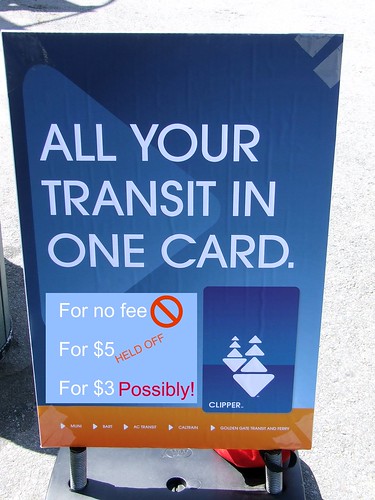
Answer to Why Clipper Cards are Still Free (No $5 Acquisition Fee)


Ever since Clipper started in mid June 2010, the cards have been distributed for free to the public to use. Over the past year, Clipper had to change the rules as local news media told the public how to abuse Clipper's negative balance policy (read my reaction to it) with just a brand new card with $2 on it. Clipper decided to raise the minimum new card balance requirement to $5, but never pursued a $5 card acquisition fee.

It wasn't until the new Muni gates came in and I learned that the card acquisition fee would be waived until June 30, 2011. This meant the end of free cards. Now that it is September, the MTC, nor Clipper has taken any action to tacking on the $5 fee, and now I found out why.

If you don't want to read all the material, go to the "Quick Summary" section near the bottom of this blog post.

The Title VI Draft Document
The MTC published their findings as they are required to do so under Title VI of the Civil Rights Act of 1964 to make sure they are not discriminating against people protected under it while the Clipper card program is in use and transitioning passes and tickets to the blue card. If you don't know what could happen if Title VI is not done, just look at BART's AirBART people mover project, they lost millions in federal dollars by not doing an analysis and now will have to absorb that cost themselves.

While this is only a draft to be reviewed by the Operations Committee this Friday, it does give insight into why the $5 fee has continued to be waived after their established deadline of June 30, 2011. Read the document here (PDF file).

A little history...
Back in 2006, TransLink (this was prior to Clipper) was in full operation on AC Transit and Golden Gate Transit & Ferry. The new dark green card had an acquisition fee of $5 for any passenger interested in a card. The fee was used to offset the cost of acquiring the card from the manufacturer and defeated the purpose of abusing the card's negative balance policy of $5. The card was issued for free to those signing-up for autoload or had it connected to a pre-tax commuter benefit program (since the card was linked to someone's name, they knew who owed a debt to TransLink). They also set aside a quarter of a million cards for transit agencies to give out as free promotional items.

In April 2010 (just two months prior to changing name to Clipper), the MTC and members of the TransLink consortium agreed to a three month free period for people to obtain cards (no $5 acquisition fee), and also agreed to waive the fee permanently for all seniors and youth transit passengers.

In August 2010 (a month after changing to Clipper), the MTC agreed upon giving out Clipper cards with no $5 acquisition fee until the end of the fiscal year (June 30, 2011) to promote people to switch, and especially their plans to have all transit passes go Clipper only would cause possible hardship to passengers not willing to fork $5 for a card.

Today...
Sometime in June or July 2011, the MTC was going to reinstate the fee, but had to hold back because of Title VI. The MTC feels that reinstating the $5 acquisition fee "could present a barrier to acquiring Clipper cards for persons protected by Title VI, and the reviews recommend eliminating the fee permanently." (Page 16 0f 30 of the draft document).

The MTC argues the $5 fee is necessary to address these six objectives for the program (directly quoted from the document, page 16 of 30):
  1. Cover the cost of the cards;
  2. Discourage fraudulent abuse of the negative balance feature;
  3. Discourage the casual disposing or loss of cards;
  4. Discourage hoarding of cards;
  5. Minimize potential barriers to adoption of Clipper; and
  6. Continue to support/encourage customer adoption of the Clipper card.
But they also had to take these two points into consideration as well in deliberating of reinstating the $5 fee:
  1. Since the Clipper card is reusable and will last at least three years with good care, a regular transit rider would use it enough times to justify most of its cost (compare a transit agency's cost of purchasing from a company that produces its monthly passes vs. how much it costs for the MTC to obtain a card that costs more than one paper pass, but can last years).
  2. For business reasons, having the card fee would help people to retain their cards, offset the cost of procuring them, and stops the abuse of the negative balance feature.
The MTC also noted that the Clipper program has some substantial benefits in the interest of the public that a $5 would just be a barrier to deny people. Some of them include automatic e-transfers, riding multiple agencies with one card, universal cash fund, multiple passes, etc.

Waiving the $5 fee did come with some harsh realities...
1: Hoarding the cards was a problem because the cards was initially free with no minimum purchase required to obtain one. Managers at Walgreens locations said people asking for free cards with no initial value loaded was taking away their staff's time. The MTC instated a $2 minimum e-cash load for every new card obtained by the customer. Hoarding also became a problem with abusing the negative balance feature, as noted below.

2: Abusing the negative balance feature came at a heavy cost when the news media told people now to abuse the negative balance feature at the expense of taxpayers. People could obtain a new card with just $2 of e-cash and ride any transit agency that cost more than the value on the card's chip and just throw it away. The MTC debated on what to do, including eliminating the negative balance policy, but instead decided to raise the e-cash minimum to $5. Deciding to raise it to $5 was a good idea as the abuse started to go down.

The MTC's plan...
The proposal is to change the acquisition fee to $3 ($2 less than originally proposed) and a $2 minimum load requirement ($3 less than what is current). This means a minimum of $5 will need to be handed over by the customer to obtain a card and get a starting e-cash balance.

The commission believes this is an appropriate adjustment that's right in the middle: The card's not free, nor will it have a big impact to those covered under Title VI. The MTC wants to make people change their minds about Clipper by not making the cards something easily disposable, but make it worth of some kind of value (the $3 acquisition fee). Clipper has already given away 1.1 million cards for free, by treating it as a throw away product, it's not sustainable and costly to taxpayers. The new fee and minimum balance would support the operational needs.

In order to comply with Title VI, the MTC will have to go out into the communities and conduct research to see if the $3 fee is feasible. After compiling the feedback, the MTC will make the final call on the fee.

Quick Summary
For those of you not wanting to read all the details, here's just a quick one you can read:
  1. The $5 acquisition fee for Clipper has been waived for a long time.
  2. MTC wants to activate the fee because of people abusing the Clipper cards (e.g. negative balance benefit).
  3. The $5 fee and an existing $5 minimum e-cash balance (total of $10) may be a negative impact on certain people covered under federal law.
  4. Continuing to give it for free will be very costly to taxpayers.
  5. MTC takes the middle ground, wants to charge $3 for new card, plus a $2 minimum e-cash purchase (total of $5). Helps to cover the cost of procuring the cards and any other operational costs.
  6. MTC can't take action until they do community outreach.

Akit's Opinion
I'm no fan of giving out plastic Clipper cards for free. The negative balance policy and abusing it is the worst problem of all as that encourages people to buy multiple cards with the minimum value and forces us taxpayers to pay more. Plus, issuing over a million cards when a portion gets thrown away after one use is not very sustainable.

Sure, I understand that Title VI is important and charging a high fee to obtain a card would not be feasible. I initially suggested the acquisition fee should be the highest one-way transit fare for whichever agency is participating in the program, but Title VI would kick that straight in the ass.

The mentality of people needs to change by making people value their cards and should keep them. Even at SF State, students, faculty, and staff value their campus ID because the fee is $22 to obtain a replacement, and the card is used in so many ways, from borrowing library books to accessing the campus swimming pool. Clipper can't charge a high fee for obtaining the cards, so they are going with something in the middle, $3 card fee and $2 minimum e-cash load.

The $3 card acquisition fee will cover the procurement of the cards valued at $2.22 a card, but will only cover 78 cents of $1.31 for the distribution of them (as per MTC documents, page 17 of 30). This means by taking the middle ground, they will recover most of the cost of the card, but a small amount will be paid by us taxpayers. Even then, the little remaining cost can be written off if a passenger uses it for the multi-year life expectancy of the card when compared to cost a transit agency must pay to procure and distribute monthly passes and paper transfers in a same time period.

Even then, I still believe people will continue to abuse the negative balance policy because they'll feel that while there is a $3 acquisition fee and just $2 in e-cash, as long as the passenger takes a one-way trip that costs more than $5, the card is just another one in the trash.

If the MTC wants to take true action, yes, enforce the $3 acquisition fee with a minimum balance to meet Title VI, but only allow people who register their card with Clipper to be allowed to have the negative balance. This keeps track of who abuses their card privileges and makes people become responsible for paying that negative balance, or if it gets too high with multiple cards, the MTC can act like FasTrak abusers, making them go through collections. For BART, it's easy to stop the negative balance policy by modifying their exitfare machines to force those passengers to pay-up the difference before being allowed to exit the system.

Friday, June 10, 2011

June 2011 Clipper Card Updates from MTC's Operations Committee

Clipper on Muni
The Operations Committee of the MTC will be meeting today at 9:30AM to discuss about what else to spend money on.

The minutes from last month's meeting (PDF document) shows the committee asked questions about the $2 monthly fee charged to those who uses third-party benefit programs and gets their passes/e-cash directly loaded to their Clipper cards. The MTC rep at the microphone said the fee is similar to what others around the nation gets charged. The fee will last for two years and will be re-reviewed after the two years is up.

At today's meeting, Clipper will be discussed in agenda item #4 (PDF document).

Here's highlights about Clipper for the month of May & early June:
  • Muni's senior pass has fully transitioned to Clipper only.
  • Clipper cards used on BART accounts for 32% of all BART fare transactions. Advertising about the Clipper card at stations is given credit for the nearly 1/3rd of all ridership.
  • People did not take the $2 monthly fee for direct loading of passes very lightly. When compared to the past (when the fee was not charged) and today (the fee charged), only 61% said okay to paying the fee; 39% said no thanks to the fee and found alternate ways to get around it.
  • Cubic is asking the MTC to shift 50% of their customer service work to a Cubic call center in Tennessee. Since the customer service phone center is in Concord, in case if there's a major power outage or problem, the Tennessee office can take the brunt.
  • Booz Allen Hamilton, a consulting firm for Clipper has a new parent company. It doesn't affect the MTC or Clipper that much.
Contract Actions
The Operations committee will be voting upon some contracts and change of contracts:
  1. A total of $1,241,000 in contracts to three companies that handles customer education and promotion of the Clipper program, and one company that conducts inspection of equipment and budgeting.
  2. $250,000 will be invested to open a third Clipper customer service center. This new customer service center will be located in Oakland and will be contracted to the AC Transit ticketing office. The new service center will include advertising and improved equipment to allow such services as replacing a defective card.

Akit's Opinion & Analysis
It's amazing to believe 32% of all BART transactions happens with a Clipper card. When you don't have to worry about demagnetizing tickets and not forgetting to take a paper transfer before leaving the station, that's a big plus.

I'm still not pleased with the $2 fee for adding passes and other fare media directly to Clipper cards. A process that's so easy shouldn't come with a cost; but the alternate options with no fee can be a hassle: debit cards and vouchers costs money to produce and mail, and takes time out of peoples' day to obtain their next fare media. Clipper, MTC, and the commuter benefit agencies shouldn't wait two years, talk NOW. If 39% of people backed out, that's a serious sign the idea is FAILING.

Hard facts to swallow: The MTC says that in February 2011 "about 20,000 Clipper customers were taking advantage of the automated add value services through third party transit benefit programs..." Since 39% of people rejected the $2 hike, this computes to 7,800 people saying "up yours" to paying the fee.

If Cubic wants to shift 50% of the customer service phone calls to another state, doesn't that just mean layoffs here in the Bay Area?

It's good there will be a third in-person customer service center, and it will be the first for the East Bay. In all honesty, there should be Clipper customer service centers at all transit agency main offices or major transit hubs so it covers each county.

Lastly, why not join ("Like") the new Akit's Complaint Department fan page on Facebook? Click here and join in the fun!

Monday, April 6, 2009

The Worst SFMTA Muni Fee Hikes and Route Changes

If you haven't noticed the "NextBus" signs at most bus stops, it is telling people about the big changes that might happen to SF Muni as early as July 1, 2009. While some of their proposed ideas won't cause too much ruckus, like raising the fare of special event service and raising motorcycle parking rates, some of their other ideas are just outright nuts or are missing some important questions that needs to be answered. Just how many brain cells are the folks at the SFMTA missing?

First up, the increases in fees:
The SFMTA released a PDF document of the possible changes to paying for transit and parking services. Here's my opinions on some of the craziest ideas:
  • Charge a 50 cent fee for transfers. Are they just nuts? The bus drivers freely place the transfers on a rubber band attached to the farebox and people take them as they pay their fares. Most bus drivers don't even pay attention to the fare box and usually assume that people paid their full fare. Does this also mean when I pre-purchase a transfer for the ride back from the Giant's game that I will also pay the additional 50 cent fee, or since I just want to take one ride so I can transfer to BART (a much more reliable and trustworthy system) that I will not be charged this fee increase? Remember folks, over ten years ago, SFMTA eliminated transfers and the passengers revolted so loudly, that in six months, transfers returned.
  • One huge question: If transfers will be 50 cents, then what is OFFICIAL PROOF OF PAYMENT for passengers who don't want a TRANSFER? What will Muni issue as POP to prevent you from getting a ticket for fare evasion? This means totally restructuring the POP program and printing new POP (non-transfer) tickets and passengers who don't want a transfer now has to carry a piece of paper that really makes no sense at all. Smart people may realize that they can carry this POP receipt, board a back door of another train or bus, and get away with "proof" when a fare inspector asks for a receipt.
  • "Premium pass?" Well, they ripped-off my original idea, but why add express buses to the list as a "premium" service? BART and the Cable Cars are the true "premium" service. Plus, if I was carrying a regular (will now be known as "cheap") pass, what is the surcharge for riding the express? How about the 9X? People may just decide to enter from the rear door more often to avoid the premium charge.
  • Extend parking meters to 10PM instead of the usual 6PM. Just how much more money will it cost DPT meter maids to patrol the meters that late (including vehicle maintenance)? Plus, I don't think the meter maids union will like the idea of forcing employees to work the night shift, when they could be at home eating dinner with their family.
  • Sunday meter service? Not a bad idea for places like Irving street, but the question comes up again, how much more money will it cost for the meter maids to patrol on a Sunday? Plus, I depend on the fee-free meters on Sunday for major Japantown events due to my large amount of hours I volunteer there.
  • Increase parking garage rates. I agree that some city owned garages could use a fee hike, but I disagree with raising fees on the already expensive garages, like the garage next to the Metreon and Westfield (SF Centre).
Changes/termination/reduction in vehicle route service (this can vary, depending on which "option" they pick):
  • Cutting out the Ocean Beach branch of the 38-Geary is a really bad idea. I have a feeling that by eliminating this route, they won't increase the number of 38L-Geary Limited and 38-Geary Ft. Miley branch vehicles. Each Richmond district terminal locations are at capacity; for example, the 38L's terminal can take up to three articulated 60 ft. buses at one time, and usually if there is a fourth one, it has to illegally park next to the Seal Rock Inn. Also, if they don't increase buses to make-up for the loss, the vehicles will get even more crowded, like insane crowded.
  • Removing N-Judah service on the Embarcadero on weekends. Not bad, but does this mean a reduction in train service for the thousands of passengers leaving the baseball game and depending on Muni to get them to BART Embarcadero?
  • 66-Quintara service eliminated west of 19th avenue? Then the route will only go ten city blocks, from 9th Avenue to 19th! That's too damn short.
  • 18-46th Avenue service to follow possible eliminated 38-Geary Ocean Beach branch service is a really terrible idea. That line serves the Cliff House, and is the perfect connection for tourists to visit the Legion of Honor. Plus, the hills are so steep, the 18 is necessary for people who have disabilities or limited mobility. Also, forcing it to serve the Ocean Beach branch will make the route EVEN SLOWER (plenty of stop signs). The current 18 route is quick since it goes through traffic signals, very few stop signs, and drives on a main drag (Pt. Lobos/Geary). Hey Supervisor Eric Mar, the Richmond could really use your influential power to stop them from pulling this stunt.
  • Shutting-off community service routes at 8:30PM. Being an SFSU employee, I think the 17-Parkmerced plays an important role, especially for students and faculty who work or study late and live within the Parkmerced and University Park North communities. The route may also be helpful for the Stonestown workers who live in one of these communities nearby the SFSU campus. Plus, if Muni metro service is unreliable, the 17 supplements service to SFSU and some of the M-Ocean View routes.

Some of my proposed solutions:
I keep emphasizing these ideas, but I'll focus on the best ones that will benefit everyone the most:
  • Yes, the Culturebus service must be terminated immediately. The 5-Fulton does a decent job to serve the Culturebus stops, either nearby or just a short few minute walk.
  • I previously proposed cutting the fare inspector force. Muni will terminate 28 fare inspector positions. That's a step in the right direction. Just remember to terminate the major assholes who piss the passengers off at every moment. Calm fare inspectors work better to not agitate the already pissed-off public who ride the crappiest service in town.
  • Motorcycle meter rates must go up, they pay a super cheap rate for hours of parking, plus no short term limit of one hour.
  • If they will charge for transfers, increase the time limit to two hours. Passengers get pissed at the fare inspectors when their transfer expires when they get stuck in the tunnel due to some unfortunate incident.
  • Transfers should be FREE for passengers who ride the express buses and pay the so-called "premium" fee. AC Transit gives their Transbay passengers a free local AC bus transfer.
  • Once the economy goes back up and there's more money for Muni, will this mean the return of the cut service? What promises will SFMTA/Muni back this up with? Do we need them to sign some covenants to make this official?

And my best solution ever...
GET TRANSLINK OUT IN FULL FORCE! If they do this, they can...
  1. Reduce printing costs on passes and transfers.
  2. Faster and efficient boarding of vehicles, meaning fewer delays and more reliable service.
  3. Reduce maintenance costs on the fareboxes.
  4. Reduce cost of sorting money and change.
  5. With BART planning to be on Translink in early June, make the proposed "premium" fast pass on Translink only. Express bus boarding is even faster, and BART doesn't have to mess with demagnetized Muni passes. Then, Muni only needs to print one type of pass, meaning less waste for the retailers who sell them.
  6. Stop printing token tickets. There are very few vendors who sell them, and only one takes Commuter Checks. Each token ticket costs the same as a regular fare, so Translink e-cash can easily replace it. Plus, Commuter Checks can be electronically transferred to your Translink account, therefore releasing the leash on riding only one transit agency.
  7. With all this effciency with Translink, Muni should offer a small incentive for cash payers. Say a 5 cent discount for full cash fares, and if they plan to charge for transfers, a 25 cent discount (25 cent transfer charge). Efficiency has its rewards.
So, what can you do to tell your POV about all these damn cuts and fare hikes?
Go to an SFMTA meeting or write to them. Click here to learn more.

Monday, May 19, 2008

AT&T Park (SF Giants) - America's Ripoff Joint

I love AT&T Park (aka: Pacific Bell Park, Pac Bell Park, SBC Park, and Telephone Park) because it is a beautiful stadium to watch games. Even sitting at the upper deck gets you great views of the park, the views of the water and East Bay, and doesn't require you to use binoculars to view the game.

But have you noticed that we are getting really ripped off? Like real badly...

Here's a list of things I think is terrible about the ballpark:
  • Outrageous prices on tickets. They offer three levels of prices:
    • Cheapest tickets are for games on Monday-Thursday.
    • "Weekend" tickets are for Friday, Saturday, and Sunday games.
    • "Premium" games are always against the Dodgers, New York teams, and some A's games.
  • Then, the tickets for certain sections go for outrageous prices. Want the crappiest seats in the park? Go for the centerfield bleachers. Worst upper deck seats are the last five sections in left field. They sell for cheap, but who the hell can watch a game in those seats?
    • The best seats, therefore the most expensive seats are in the "Lexus" dugout seats, equipped with padded seats, and you are so close to the home plate.
      • Just how much for face value? It cost me about $125. This does not include any additional fees.
      • The best seats for A's tickets is no more than $90. The cheapest seats for the A's is just $9! Come on AT&T Park.
  • And how about those ticket fees? They try to nickel and dime you for every time you buy a ticket. If you purchase at a Giants Dougout location (except the ballpark location) or any tickets.com outlet, you get charged a 17% FEE. What the hell is this?
    • The best time to buy tickets is when you visit the Dugout store at the ballpark or the advance ticket window. They have a much lower service fee.
      • Here's an interesting fact, San Francisco Muni wanted to get a little more money to provide service to the ballpark. They wanted to propose an additional tax on game ticket fees. Hell no.
        • To add insult to injury, Muni DOES NOT ACCEPT BART-TO-MUNI transfers when purchasing your ticket to return from the ballpark to BART. What little bitches! I get a 25 cent discount, and I WANT IT!
  • And how about the food?
    • These guys rip you off so badly. I can easily spend $25 at a ballpark for a half-assed meal. For that money, I can go across the street at Amici's and get myself a large New England Clam Pizza with a soda and possibly some pesto pasta!
      • Why half-assed food? Here's something. I ordered a clam chowder in a bread bowl, and while the soup was OK, the damn bread was STALE! So dry, that the bread bowl soaked in soup was dry enough to make me cough for five minutes.
  • And to add insult to injury...
    • The Giants have now BANNED ALL OPEN BEVERAGES from entering the park, including bottles that have their seal broken.
      • Their reply is that this is to prevent underage drinking.
        • My answer: It is just another way to rip us off by making us fans purchase beverages that cost nearly three times its regular price at grocery stores and other places.
        • Plus, I can't bring in my iced coffee drink from McDonald's

If the Giants wants to stop ripping us off with these outrageous prices, it's time for some changes.
  1. Barry Bonds is gone, he was the star attraction, and now you are selling games with about 9,000 seats still available (this happened at last Friday's game). Also, the team is doing terrible. Reduce prices on admission tickets. Eliminate the SRO (standing room only) and use those prices to offer the hardest seats to sell (upper deck left field).
  2. Lower food prices. It should not cost $4.00 for a Churro (Costco is only $1), and no little hot dog costs $4.50.
  3. Cut back on some of these bogus "park safety" rules. Open bottles are OK, as long as it is not beer or liquor. Why not have the staff sniff the liquid? Alcohol has an obvious smell.
  4. If you love watching them on TV, write to KNTV (aka NBC 11, the second worst local TV station in San Francisco) and tell them to give it back to KTVU, the ULTIMATE KING OF BASEBALL AND NEWS.
  5. It is time to follow other major league parks and offer ALL YOU CAN EAT plans. Our neighbors, the Oakland A's have nosebleed top deck seats with all you can eat food and drink, like hot dogs, nachos, peanuts, popcorn, sodas, and ice cream. All for the starting price of $35 a ticket. AT&T Park management should use the upper deck left field seats (crappiest in park), and use them for all you can eat plans for a fair price. You'll get a great attendance boost, and with a good choice of food, will be extremely popular.
Well, there's my thoughts. Thanks for reading. If you have any comments on this, please post them on my blog site at: http://www.akit.org/2008/05/at-park-sf-giants-americas-ripoff-joint.html

Saturday, March 17, 2007

SFSU - CSU/UC 10% Fee Hike?

I'm a little shocked that the Trustees of the California State Universities and the University of California decided to raise university fees 10%. Depending on where you go, some will be paying as high as $350 or as low as about $150.

What's the big idea about this?

Here's my take on the issue: We raise university fees (not tuition, supposedly it's provided "free" to all CA residents) because we don't have enough in the state budget to properly fund programs. So they take some real crazy measures to really screw with us.

Here's some good examples of screwing the students: You raise fees to: give university presidents and chancellors a fat ass pay raise or perks (why does SFSU's President Corrigan get a $1,000 housing and car allowance?), nobody wants to attend it because quality is going down the drain (i.e. turn a 30 student class into a 70 student class with only one professor to get more moola), and Arnold aint dishing out the dough to keep us happy.

Here's the big problem, we have public universities, and that means that tuition/fees should be much less or NONE to the students. With a raise in fees, that means that the poor and disadvantaged will never get a fair chance to get a B.A. or B.S. degree. We can still afford to attend community college for $20 a unit, but an A.A. or A.S. degree doesn't pull a lot these days when getting a job.

I guess George Carlin is right, everyone except the rich will be working for the corporate world doing labor for low wages.

Wednesday, February 28, 2007

Quality or Quantity of our College Education?

A good question for you, what is better for everyone? A quality college education or quantity for big bucks?

That's an argument that was put forward by one of my professors on Tuesday. He argued that his class a few semesters back was supposed to be a small one with less than 35 students. Currently, his class holds 70+ students! What's the big idea?

The CSU system is focused more on providing smaller, more intimate classes (like my graduate classes), not mega sized classes so that the state can rake in on your tuition/fees that keeps rising so high.

Think about this: Why is SFSU's Human Sexuality course has so many students (a TON OF STUDENTS)? You could think that it's because of the GE requirements, or because the students gets to watch some "amusing" videos, or maybe because the idea of sexuality is so attractive (it sells!).

I like small classes because it provides a more intimate environment for everyone, and you really get to know your professors much more (just don't get caught sleeping in class). I also enjoy that I can visit their office hours with little or no wait, and really get the help that I need. Mega sized classes feel so odd to me because there is always a wait for help, they prefer doing things online, and multiple choice tests is no help either!

I guess it is all about the money these days. Is it cheaper and profitable to have two professors teach 35 students each for the same course in separate sections or have one professor teach 70 students in one class section?

Maybe the Simpson's are right. In the future, school will be taught in triple decker seat classrooms and only one teacher on the TV will be communicating to hundreds of schools at once.

Let's summarize my rants:
Please don't break down our classroom walls to make mega-sized lecture halls.
35, maximum!
Stop raising our student tuition/fees!
I want quality, not quantity. It's like graduating from Berkeley with 50,000 other students at the same time; sure makes that name sound so pristine.