"Akit is the man. He knows Clipper." (spenta)
"It’s a fantastic blog for any San Franciscan."
(Kevin)
"Your blog is always on point, and well researched!" (Nina Decker)
"Everyone's favorite volunteer public policy consultant..." (Eve Batey, SF Appeal)
"You are doing a great job keeping on top of Translink stuff. Keep up the good work!"
(Greg Dewar, N Judah Chronicles)
"...I don't even bother subscribing anywhere else for my local public transportation info. You have it all..."
(Empowered Follower)
"If anyone at City Hall wants to make public transit better for all San Franciscans, it would be wise to follow Akit religiously...
or, better yet, give him a job."
(Brock Keeling, SFist)
Showing posts with label Muni. Show all posts

Thursday, February 18, 2021

Clipper Card Coming to Apple Pay and Google Pay


That's right, Akit is out of retirement for just this special story, after more than four years of not blogging.  How are you?  I've been doing well; in the last four years, I've got a job promotion with a decent pay raise, and I've been working remotely from home for nearly a year due to this virus.  Hoping I can get the vaccine in the coming weeks and eventually return to in-office work.

If you read the blog entry title, the Clipper card will be available with Apple and Google Pay starting Spring 2021.  If you want to read the articles, see the Apple Pay article and Google Pay article.

For you very long time loyal readers, I've been blogging about the Clipper card, and it's former name, the TransLink card for such a long time.  Since not much has changed, I can help provide some insight in what your mobile phone wallet will do for you.  However, since I own an iPhone and Apple watch, information about how Google Wallet may be limited.

Want to sign-up for an email notification when Clipper is ready for Apple Pay?  Click here to go to Apple's website to register.

Let's look at the benefits and features that will come with Clipper Card on Apple Pay:
  1. No more carrying a plastic card with you.
  2. For Apple users, it will be available on Apple Watch and iPhone.
  3. Express Transit will be supported on Apple Pay.  What this means, there is no need to open your Apple wallet on your phone or watch.  Just tap the phone or watch on the reader and it will automatically open the app and scan.  But it does require you to activate this feature on your wallet's settings.  One thing to note, if you just restarted your phone or just put your watch on, you need to authenticate yourself with your passcode to have the Express Transit feature on standby for your next ride.
  4. Express Transit also works if you are in power reserve mode, but only on iPhone.  Power reserve mode is when your phone shuts down due to low battery, but will function as your Clipper card for up to five hours until you can recharge your phone.
Here's some possible features that may come with the Clipper Card, but this comes from learning about how this works from reading and watching videos about the Suica card which is used in the Tokyo, and WMATA's SmarTrip card used in the Washington D.C. area:
  1. You can add cash funds or possibly passes by purchasing them on your phone, and would be available for instant use.  There would be no need to reload your virtual card at a ticket vending machine, such as at all BART stations, or visit a Walgreens or retail store.
  2. You will be able to transfer your blue plastic card's data, cash purse, passes, etc. to your virtual wallet by allowing your phone to scan your card.
We've seen the benefits, now the problems:
  1. You can only add your Clipper card to one device, either your iPhone or Apple Watch, not both.  You can have it on both, if you have separate cards.  Hard choice, phone or watch?
  2. If the ability to transfer your plastic card's data to your mobile device is allowed, once transferred, your plastic card is void.  You cannot use both the mobile wallet and plastic card. Please note, this is coming from the SmarTrip website; I would assume it will happen to plastic Clipper cards once migrated to your phone or watch.
  3. If your card needs to be read by a fare inspector or any person who uses a handheld reader, such as a cable car conductor, Express Transit feature on Apple Pay won't work; you'll need to open up your Apple wallet on the device you have your card on.
  4. The Commuter Check debit card is not supported on Apple Pay because I just tried adding it.  Unless if Clipper has a separate app that someone can manually enter their card number, you may not be able to reload Clipper card purse funds or buy passes using the commuter benefits card via your phone; you would have to do it at a vending machine or retail store.
  5. If your watch or phone is dead or if you have a battery that isn't holding its charge, maybe stick to your plastic card.  Non functioning devices means no working Clipper card.
  6. If you ride Muni occasionally, take at least two rides, and don't ride the cable cars (and they are not operating due to COVID), it's better to use Muni Mobile's day pass for $5, as a single ride on Clipper and Muni Mobile is $2.50.  Clipper cards don't have the $5 pass available to purchase.
  7. It is unknown if you can migrate your SF State ID card with Clipper (for the Gator Pass) to your phone.  It is also unknown if you can migrate a Senior card, RTC discount card, and other discounted cards to Apple and Google Pay.
  8. One last thing, it's highly unlikely that contactless credit and debit cards, including Apple and Google Pay credit/debit cards will be accepted on Clipper.  The major weakness of the Clipper card system is that all card readers on buses are not connected through cellular service 24/7 to verify if the card is legit or stolen.  Clipper and formerly TransLink has been in use for nearly 20 years.  There's planned 2.0 upgrade coming in the future.
Okay, what would Akit do?  I have the blue plastic adult Clipper card, iPhone, Apple Watch, and a commuter debit card. (Remember, you may not be able to have the same card on the iPhone AND Watch)
  • My option would likely be my Apple Watch.  Especially since face masks aren't friendly with Face ID on iPhone, Apple Watch seems to be the easiest choice, I can just tap the watch over the reader.  Although, in the case of Muni metro and BART gates, my watch is on my left wrist, so I'll have to move my arm over to scan it.  I would also activate Express Transit so I don't have to open up the wallet on the watch and scroll to the Clipper card.
  • A possible problem is using my commuter debit card as a funding source to reload my virtual Clipper card, since my debit card can't be added to my Apple wallet.  Hoping they will have a new Clipper card app that lets me add funds by manually adding a commuter benefits card.
  • For longer day trips within San Francisco, I would not use Clipper, and instead use Muni Mobile for their $5 day passes (no cable cars) or $13 one day passport that includes cable cars.
    • Cool tip: Once cable cars resumes service, it's $8 for a single ride.  Two cable car rides costs more than an all day unlimited Muni Mobile one day passport good for all the cable cars, buses, light rail, and historic streetcars you want.
Want to see how a contactless transit card works?  Watch this video of the Suica card on Apple Pay is being used at a fare gate at a train station in Japan: https://www.youtube.com/watch?v=HNzi5b1Rsxc&feature=youtu.be

Monday, July 4, 2016

The Worst and Absurd Public Transit I've Taken on a 4th of July Holdiay Weekend

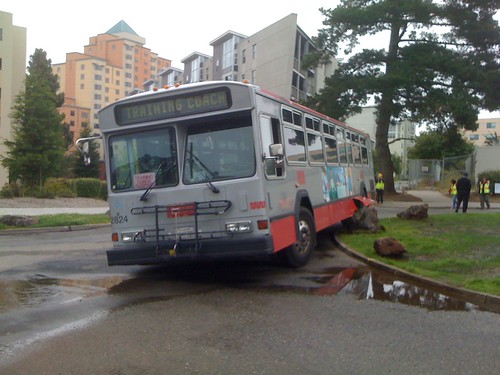
Improved Muni on Rock Photo
Akit comes out of retirement... once again.  I felt the need to blog because this weekend just sucked trying to get around the city.  This has to be the strangest 4th of July weekends I've been through involving public transportation.

Saturday: The scariest stuff I've seen...

I'm waiting for a 47 or 49 bus at Van Ness and Sacramento and I'm looking at the diagonal corner where a mentally ill woman is harassing some people sitting on the street.  One of them sitting down decides to chase her and the woman quickly runs away, by walking in between two parked vehicles and into the street.  Less than a second later when she runs into the street, she gets hit (sideswiped) by a passing Muni bus, and I was hoping she just didn't get killed.  The Muni bus pulled over across the street and I hurried to call 911.

Ugh, the 911 operator is telling me to get to the lady quickly; is the guy nuts? I'm not running through several lanes of active traffic while I'm on a diagonal corner.  Fortunately, the fire truck arrived and I'm telling them what I saw.  The lady who was hit was lucky, she was walking around when the medics found her.  If she entered the street less than a second prior, she would have hit the front of the bus and likely be dead.


Sunday: I experienced one too many moments of absolute absurdity on Muni

(1) I'm on the 47-Van Ness bus going from Market Street towards the Wharf and the bus pulls over to pick-up a wheelchair passenger.  I and another passenger are sitting in the designated wheelchair spot, so we both get up, and I'm trying to look for the lever to raise the seat.  The bus driver insisted he wants to do it, but since I'm standing there, I insist I handle it.  He re-emphasizes that he has to do it because he claims he'll "be fired if you get hurt."

This is one of those "what the fuck" moments when this society is so damn afraid of litigation, and so I let the damn driver do the seat, while all the passengers laugh with me at the amount of absurdity that just happened.  It's not like I'm grabbing a wrench and fixing a broken bus.  Hell, you are more likely to get injured lifting your bike on the Muni bike rack or ride the running board on a Cable Car than lifting a seat on a bus like any nice person would do.

The driver sounded pissed while trying to act nice when I insisted can do it.  But I had the last word right before I exited when a lady was asking the driver why he didn't stop at California Street, so I told her the agency cut some stops on Van Ness to speed up the bus line, but this driver is going so damn slow on Van Ness (like there's no traffic and he's going like snail) it's an insult.

(2) Later that day, I'm taking a F-Market bus substitute and it stops in front of the Market Street Railway museum on Don Chee Way.  And the bus just sits there, for five minutes while the driver bails the bus.  He's trying to look for his relief driver and all of us are sardine packed in the bus wondering WTF is going on?  Eventually he kicks everyone off the bus to ride the next one and the Muni supervisor wearing blue isn't doing shit or even apologizing to the passengers.  Yeah, taxpayer dollars being used well.


Monday: Golden Gate Transit just SUCKS

I wanted to visit Sausalito, so I decided to pick-up the 30 bus at the Golden Gate Bridge toll plaza because it takes less time than going all the way downtown for the ferry boat.  Things went okay until the driver didn't take the Alexander Avenue exit to go downhill to Sausalito, and the driver drops us off at some odd Marin City bus transit center.  The driver said to everyone to catch the 17 bus which after waiting 30+ minutes never arrived.  Hell, two Muir Woods shuttles came by, and some other buses, all while any Sausalito bound buses never came by; only until a West Marin Stagecoach van came by to pick us all up.  I only had less than an hour to enjoy Sausalito before I had to take the ferry back, otherwise I'd be stuck in the town much longer waiting for another boat.

You know what's bad about Golden Gate Transit?  EVERYTHING.  The 30 bus driver didn't disclose anything to the passengers about not stopping in Sausalito.  That alone would have saved me time and money because I would have gone somewhere else.  And waiting at the Marin bus hub was a fat insult, just nothing was coming by and all the buses arriving was LATE AS HELL.  But what about NextBus?  IT DOESN'T EXIST!  They can afford wifi on buses, but not GPS technology to tell us when the bus is going to arrive.  Oh, and trying to call for assistance to Golden Gate Transit's hotline?  The phones are not answered on holidays.

Seriously?  Golden Gate Transit is a flat out piece of crap.  At least the Golden Gate Ferry service is worth it, because it arrives on-time, it leaves on-time, they have nice employees.  I don't know how people can tolerate Golden Gate Transit, it's makes Muni look awesome in comparison to this trash.

And that's my three day weekend.

Thursday, November 12, 2015

MuniMobile Smartphone Payment App is Now Available for Everyone

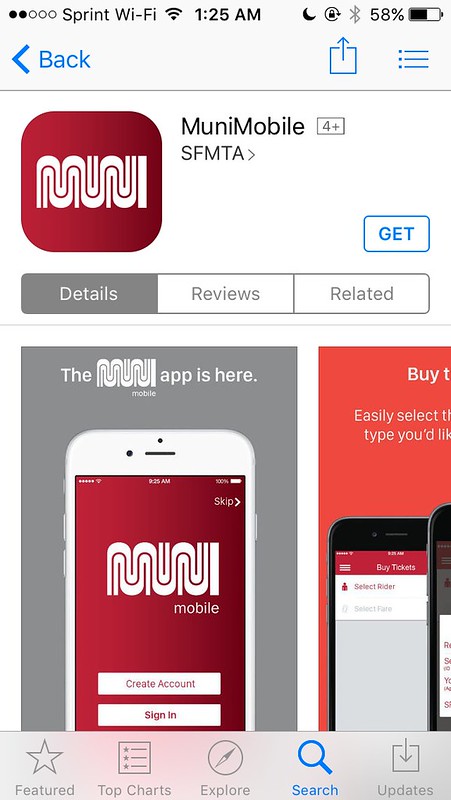
Contrary to the news media saying next week Monday, the MuniMobile fare payment app is now available for download on the iTunes App store for everyone to use.

If you have an iOS phone, go to the App Store and search for "MuniMobile."  If you are on a computer, click here to go to Apple's iTunes Preview site to read about the application.

Since I don't own an Android, I can't verify if it's available.

As I was a beta tester, I was able to play around with the app and I did buy a couple of single ride fares to try it out.  I didn't encounter any fare inspectors, but all the bus drivers knew what it was and let me through without asking any questions.

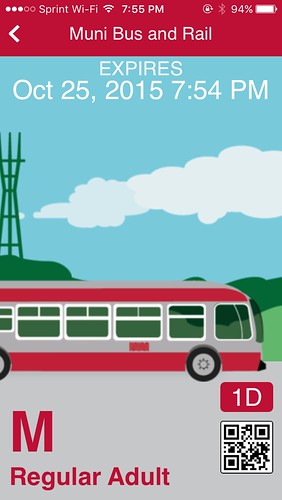
The only real odd thing about the app is the Muni logo is backwards when the animated bus passes by from the left to right; the MuniMobile ads posted on the buses show the bus going the other direction with the logo facing correctly.

To learn more about my experiences with the MuniMobile application, visit my other blog entry.

Lastly, if you want a personal recommendation, stick to your Clipper Card; it's the only method to get inter-agency transfer discounts or free Muni rides from Daly City BART.  MuniMobile is better for tourists (especially the Passports on sale), people who rarely ride Muni or wants to pay for their rides with a credit card, and as a backup fare option if you run out of Clipper Card money.

Monday, October 26, 2015

Testing San Francisco MuniMobile Fare App

I haven't posted in over a year as I went into retirement from blogging, but Akit's out of retirement for a special edition blog post!

I was recently selected out of 1,600 applicants to participate in the SFMTA/Muni Mobile Fare App beta testing.  From what I've read around, about 800 people were selected to be Muni's guinea pigs for this project.

This reminds me of the days when I was a pilot tester for TransLink (old name for Clipper).

Let's give you folks who didn't sign up or selected a taste of how this all works.

First of all, you need to have a phone operating on Apple iOS or Android.  Once Muni releases the program to the whole public, you can download it at your application store for free.

When you first use the app, you can choose to register for an account or you can look around the app.  But if you want to buy fares, you must register for an account.


The Ticket Choices
You get to pick a variety of options, including:
1: Basic single fare
2: Single ride on a Cable Car
3: 1, 3 or 7-day Passports (valid on all of Muni, including Cable Cars)

The photo on the right is for adult fares, but you can also select Senior/Disabled/Medicare, Youth, and SF Paratransit options too.

The prices are all the same as paying cash or Clipper, and has no credit card surcharge tacked on.

Once you select the item(s) you want to purchase, you simply use the app to pay and it will direct you to a PayPal site to handle it.  You can choose to pay with your personal credit or debit card, or if you have a balance on your PayPal account, you can use that too.


Use Your Ticket
Once your payment is confirmed, your ticket is stored in the "My Tickets" menu.  Click the ticket you want and it will give you one last chance to back out.  If you want to use the ticket, click "use ticket" and the ticket activates immediately.

If you are using a single fare ticket, you should only activate it when you see the bus or train arriving.  90 minute clock immediately activates, and this will also be your Muni transfer; the driver will not give you a paper transfer.

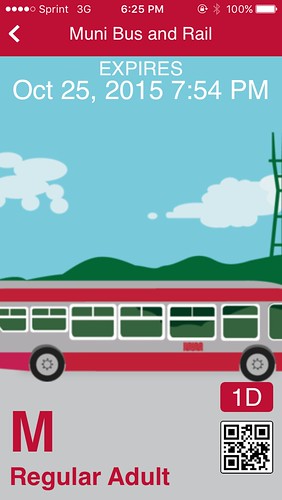
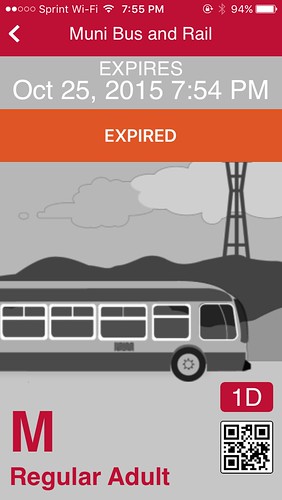
Once the ticket is activated, it will show an animated screen with blue skies, clouds (or is it Karl the Fog?), Sutro Tower, and the Muni vehicle driving by every so often.  The expiration will show on the top, and the type of ticket purchased on the bottom.

Just show the screen to the driver to verify it's a legitimate fare, take a seat and relax.

If you touch the screen, the background colors will change.  GlobeSherpa who made the application must have done this to prevent people from fraudulently using the app by playing a video clip or showing a screenshot.

If you touch the QR code on the lower right corner, it will show a large QR code that fare inspectors can use to verify your ticket.  I haven't encountered one yet, but who knows if they will carry a device to verify the QR code or not.

You can also close out the app and easily return to the Muni app to restore the ticket.


Expired Ticket
Once it expires, the ticket still looks like it's valid, but it's not when you compare the top time of 7:55PM to the bottom time of 7:54PM (left photo), but once you return back to the main menu by clicking on the left arrow on the top and then restore the ticket, it will definitely say: "EXPIRED" (right photo).  It's an odd quirk, hopefully something that can be fixed.

In Summary
Why you should use this app:
  1. When you don't have cash or your Clipper card on hand, it's an easy way to pay for your Muni fare.
  2. You want to pay for Muni with a credit card.
  3. If you don't want to disclose your credit card info, you can load some funds in your PayPal account and pay for Muni that way.
  4. You can buy Muni passports without visiting one of the few locations in the city for them.
  5. You can buy Cable Car tickets without hassling the conductor.
  6. It's eco friendly because you don't get a paper transfer or receipt in return.
  7. Faster than Clipper because once you pay for the ticket, you can activate it immediately.  If you order something on Clipper via their website, it can take up to five days to activate.
  8. If you activate your single fare ticket after 8:30PM, your expiration will be 5AM the next day (a.k.a. late night transfers).  Clipper cards and those paper tickets at the metro vending machines DON'T give you late night perks, just the lame 90 minutes.

Why you may want to avoid this app:
  1. For single rides, you are better off paying cash to the bus or metro operator and getting a paper transfer.  You'll always get a minimum of 90 minutes, but most hand torn paper transfers have much longer expiration, sometimes even four hours.
  2. If you transfer from BART, Golden Gate Ferry, Golden Gate Transit, or SF Bay Ferry to Muni you don't get the 50 cent inter-agency discount with the app, it's only good on the Clipper card.  Make sure to pay for your ferry, BART, or GGT fare with your Clipper card, and use the same card on Muni to get your discounted ride.
  3. If you transfer from Daly City BART to Muni, you get two free rides, one away from the station on the 14R, 28, 28R, 54, and 57, and one going back on the same bus lines within 24 hours, but it's only on Clipper.
  4. They don't sell monthly passes, it's only on Clipper.
  5. Prepaid tickets have an expiration date.  I bought mine on October 23rd, but if I don't use it, it will expire on January 21st.  Not a good idea to hoard those tickets.
  6. You have a smartphone with a lousy battery.  If the battery dies, you can't use the app!
  7. If you have a credit card that gives you a bonus when using it for travel (e.g. 2% on travel vs. the standard 1%), you won't likely get that bonus because it is charged through PayPal.
  8. If you use a pre-tax commuter benefit debit card, it looks like it's not supported on the app.  It's because the credit card processing is done through PayPal which may not be acceptable to the required federal standards for commuter debit cards.  Continue using your debit card on Clipper.
CORRECTION: Commuter benefit debit cards are accepted as per SFMTA's website: https://www.sfmta.com/getting-around/transit/munimobile/munimobile-frequently-asked-questions#BuyingTickets

However, do not link a your commuter debit card via your PayPal account.

Suggestions on Improvements:
Muni and GlobeSherpa can do a handful of things to make it better.
  1. Make the expiration easier to read.  A light blue sky background with white letters is hard on people, especially for the operator to read.  White letters is fine, but some black shadow for the letters makes it easier.
  2. I was expecting some more backgrounds in the animation.  Why just Sutro Tower?  Why not Coit Tower or the Golden Gate Bridge?
  3. When a ticket expires, it needs to automatically grey out and the orange bar is shown saying EXPIRED.  It should not be the normal background.
  4. Allow commuter benefit debit cards be accepted to purchase tickets.
  5. Fingerprint scan option to open the app, especially helpful to prevent your kids from accidentally activating your tickets.

Monday, September 15, 2014

Clipper Card on iPhone's Apple Pay Service - Could it Really Happen?


Greetings readers, it's been a while since I've blogged.  I'm still happy and well, but I've been sticking to my public social media accounts on Twitter and Instagram more often.  I thought I'd write a blog entry today because of what's been happening in the news for the past week.

The announcement of the next generation of iPhones, in particular Apple Pay, is really attracting a lot of news these days as the next cool way for people to pay for stuff at their favorite big retailers without pulling out their plastic credit card.  And while the Android platform has been using their NFC chips for a good while to be able to pay with credit cards and read NFC tags, with Apple playing along, that puts a huge chunk of the smartphone market able to now use NFC technology.

But what really intrigues me about the big evolution of NFC to be capable on Apple devices is the opportunity for public transportation to play a role in being a part of it.  Simply put, will the Clipper Card be an option for Apple Pay and Android?

Here's the pros if the Clipper Card was available as an option for people to scan their phone to a Clipper Card reader:
  1. No more carrying a plastic Clipper Card in your wallet.  Just put your phone to the reader to handle your fare/pass transaction.
  2. Be able to instantly view your card's balance, transfers with the time it expires, and your passes.
  3. Be able to instantly view your ride history, and have instant proof of payment on hand for fare inspectors.
  4. Using the Clipper Card app, be able to add card value or buy passes using a linked credit card with instant available use, without the horrible five day waiting period currently in use for people who buy online for their plastic card.  Read about the five day rule here.
  5. Also, using the Clipper Card app, people can also purchase day passes like for Muni.  Muni does sell the passports for Clipper, but people still prefer the scratch-off ones or buying it from the Cable Car conductor.
  6. Also, there could be an option for people to not use a Clipper Card, and instead use a registered credit/debit card to make their one-time transit fare payment.  It might be a cool perk for those with pre-tax commuter benefit debit cards to simply tap their phone and just deduct the balance from the card; no more need to load the money to a Clipper card, just touch and pay.
But there are some cons:
  1. It may not be possible to have Clipper do this.  The Clipper Card system itself was one of the first smartcard systems ever in the United States, and as of today, the system is outdated when compared to other agencies using smartcards.  When Clipper first started, it started as the TransLink card program which the MTC awarded a contract to ERG, a leader in smartcard technology for transit systems.  But many years later, Cubic, a titan in the transit technology market, bought out ERG and took over its contracts, including TransLink/Clipper.  The folks at Cubic had an uphill battle to get their products to properly function with the thousands of ERG cards and technology in use, such as the BART and Muni fare gates (Cubic products).  Cubic had to take the right route, they couldn't remove the ERG products already wired and installed and start from scratch (that would cost a ton of money), so they made a hybrid system so both ERG products and Cubic products work together.  Since the Clipper system is outdated, it may not be able to take mobile phone payments. 
  2. If the above is true, we may have to wait until 2019-2020 for the next generation of Clipper Card technology to have the features.  The expected end of life for the currently installed technology is to end roughly around 2019 and that's when the contract with Cubic is to expire.  The Metropolitan Transportation Commission intends to put in the next generation of Clipper by starting from absolute scratch, instead of preserving the old infrastructure.  A simple way of thinking is, the MTC may be able to save money by delaying smart phone implementation until the 2nd generation system is functional.  Click here to read about the second generation of Clipper plans.

Akit's Opinions:
In my opinion, I wish the Clipper Card was available as a smartphone function to just tap the phone to a card reader to ride public transit, or even just allowing people to use a linked credit card to just tap and pay for their rides would be wonderful.  Also, with the ability to order passes or load more cash value from your phone means your virtual card on your phone will have instant available use of your pass or funds, without the terrifying five day waiting period or running to your Walgreens or train station to load-up.

But looking at all of the cons, this may be something the MTC may not want to pursue, especially if the Clipper Card program is to be in a coffin by 2019 and a new program will be functional by then.  The technology being used today is outdated but functions as expected.

If there has to be a compromise, here's my recommendation:
I feel this may be an opportunity for Clipper to work with Apple and Google to allow Clipper card users to get an app that utilizes a plastic Clipper card and an NFC capable phone to let people scan their card to read their ride history and review their balances on their card (currently, the FareBot 3rd party app for Android can do this).  This may also be an opportunity for people to order their passes, add cash value, etc. on their phone, and tag their card to their phone to update the card's data with the new information so people can instantly use the card with the new information.

What's your thoughts on this?  Leave a comment.

Thursday, July 3, 2014

New Change to BART to Muni Transfer Policy using Clipper Cards

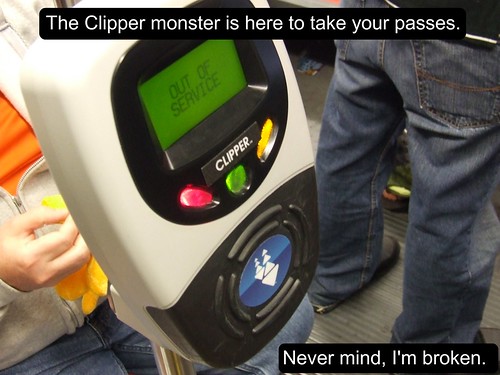
Clipper Monster Reader FAIL

If you use your Clipper card to transfer from a San Francisco BART station to a Muni vehicle or metro, there's a change in policy regarding the transfer rule.

The old rule:
When exiting BART from any station between Embarcadero and Balboa Park, you have one hour to transfer to Muni.  When tagging the same card you exited with BART and use it on Muni, you get a 25 cent discount on your Muni ride.  When you are ready to take your next ride on Muni (after the Muni 90 minute transfer expires and its less than 24 hours from the time you exited BART), your next Muni fare transaction is 25 cents off.  This is the exact policy just like when BART stations issued paper discount transfers which gave the same benefit.

The new rule:
When exiting BART from any station between Embarcadero and Balboa Park, you have one hour to transfer to Muni.  When tagging the same card you exited with BART and use it on Muni, you get a 50 cent discount.  There is no discount for a second ride.

Note: This policy is not valid if you have a Muni monthly pass.  It must pay in Clipper e-cash funds.  As always, if you have a Muni monthly pass on your card, Clipper always seeks the best deal, instead of yanking $1.50 out of your pool of funds.

Also, this policy is not in use at the Daly City BART station.  Passengers still get a free ride on any Muni line that serves Daly City BART.

How did I notice the change?
When I go to baseball games at AT&T Park, I have to take BART and Muni metro to and from the park.  I noticed when I tagged my card on the Clipper card reader to get back after the game, I had to pay full fare.  When I got home, I reviewed my Clipper card records online and found out that there was that change in transfer policy.

Akit's Opinions:
It's a simple change that makes it more simplified for Clipper card users.  Instead of wondering if the return ride 25 cent discount works, you just get the full 50 cents off in the first Muni ride away from BART.  I like it.

Reference to policy: https://www.clippercard.com/ClipperWeb/muni/fares.do

Thursday, April 3, 2014

Why the SFPD are Doing Muni Fare Inspections Improperly and Citing Innocent People


This morning, I was reading an article written by Jessica Kwong for the SF Examiner about a Muni passenger who was written a ticket by a San Francisco Police Department officer for not paying their Muni fare with their Clipper card.

The article stated the passenger boarded the F-Market streetcar and used his Clipper card to tag at the entry.  Ten minutes later, a SFPD officer asked for proof of payment from the passenger and tagged the passenger's Clipper card at the vehicle's card reader to verify.  The card was rejected and the passenger was issued a $200+ citation for fare evasion.  However, the passenger retrieved his Clipper card records from the Clipper Card website and it showed he did pay the fare.  The passenger intends to contest the citation in court next week.

The news reporter also got statements from SFPD officials and SFMTA/Muni basically stating that a police officer tagging a customer's card on a vehicle card reader is sufficient enough and there's no problems with it.

However, with my expertise on writing about the Clipper Card for numerous years, there's some serious flaws with having police officers and fare inspectors to verify a passenger's card use by tagging a card reader.  Here's why:
  1. When a passenger boards a Muni vehicle and tags their Clipper card upon entry, the card reader will immediately verify the transaction with a green light and single beep.  The screen will also show the type of transaction completed ($2 fare deducted, transfer being used, or valid pass).
  2. Once the card is tagged, it cannot be tagged again on the same vehicle reader; this rule is called "passback."  This is a standard rule used on all electronic transit fare cards to prevent a passenger from using the card for valid entry, and "passing back" the card to their friend or family member to tag the card again so they can score a free ride.
  3. The "passback" is removed after a certain set amount of time for those who ride the same bus again for a return trip (for example, if I board a 6-Parnassus bus at 1PM, have lunch, and board same exact bus at 2:15PM, the passback is eliminated and tagging my card won't result in a rejection).
  4. When a passenger transfers to another vehicle, the card is perfectly okay to tag and get the green light to enter.  This is because they are boarding a new vehicle, even if they tag card on bus #1 at 1PM, and board/tag bus #2 at 1:10PM.
PROPER FARE INSPECTION: When a police officer or fare inspector uses a handheld card reader that is issued by Clipper, it will read the card and verify if the card was tagged or not by showing a "YES" or "NO" on the screen, followed a confirmation sound of "ding" or "buzz."  If it says no, inspectors can immediately review the card use history clicking on a few screens on their reader to check if there's a valid pass and the last several times the card was used.  If it all checks-out fine after the secondary card history check, all is well; but if it shows passenger failed to pay, a ticket is issued.

IMPROPER FARE INSPECTION: If a police officer or fare inspector verifies use by tagging the card to a Clipper card reader, it will either give a single beep/green light confirmation or red light/error confirmation.  The single beep/green is because the "passback" was eliminated after the set window ended, but a red/error sound means the "PASSBACK" IS STILL ACTIVE.  Cops and fare inspectors SHOULD NOT use this method of inspection because if they get the red light, and are ignorant to realize "passback" is active, the passenger gets a citation and have to waste their time at a court hearing to fight the charge.

As for the statement from SFMTA's Paul Rose saying there's "no concerns" about law enforcement officers verifying via the vehicle's card readers, he is half-correct and half-wrong.  Here's why:
  1. Correct statement: This can only happen in the Muni metro.  Only if a passenger tags their card upon entry to a subway station's fare gate, and a police officer verifies by tagging the card on a train's card reader, it will give the green light.  The rules state when a Muni passenger tags their card upon entry via a faregate, it is not necessary to tag their card on the vehicle card reader when they board the train; but if a passenger tags their card in the vehicle (after tagging card to enter the metro station) and a police officer checks the card, say 10 minutes after on the vehicle card reader, it will result in a red light/denied message and is subject to a ticket, even though they have tagged their card lawfully at a Muni fare gate.
  2. Incorrect statement: There is a serious concern if a police officer verifies a passenger's Clipper card at the vehicle card reader because the "passback" may still be active on the card.  Reason for this explained earlier in this blog entry.

Akit's Opinions:
In summary, if we assume the passenger does have proof from the Clipper Card website saying he did tag his Clipper card and was cited by a police officer, he should be found not guilty or have his case dismissed on the grounds that the officer improperly issued the ticket.

Due to the poor judgment of the police and SFMTA, and improper procedures to verify Clipper card use, strict policies needs to be written-up to prevent this from happening again.

Fare inspections SHOULD NEVER be verifying card use by using a vehicle's card reader because of the "passback" policy.  ALWAYS use the handheld card reader.

Tuesday, February 11, 2014

Horrible Budget Ideas from the Geniuses at Muni (SFMTA)

On February 4th, the SFMTA Board of Directors had a special meeting covering various issues and topics.  One of the topics they covered is the upcoming fiscal year budget by showing a PowerPoint presentation.  Thanks to the public disclosure laws, we are able to view the materials the board gets to see.

To view the budget presentation, click here.

A lot of the material was all blah blah blah that wouldn't matter to me, but I found a chunk of information that made me quite frustrated that SFMTA employees would try to make the Board even think about accepting.

If anyone recalled the Mayor Frank Jordan era, Muni decided to implement a new fare structure where passengers had to pay an extra 50 cent fee to ride express buses or pay for a premium Muni pass, and eliminated all transfers.  The citizens hated it so much that Muni decided months later to restore transfers and kill the premium fees for all express buses.

So here's the stuff that made me go nuts:

Page 10: Automatic Indexing
The SFMTA is going to raise the price of its fare products by 3% for the 2015 and 2016 fiscal years.  What this basically means is your Muni fare will increase from $2 to $2.25 ($0.75 to $1 for youth, seniors, and disabled), and monthly passes will rise two dollars for adults and one dollar for discount passes.  Some of the fare products like visitor passports and cable car fares will remain the same.


Pages: 15 and 16: Possible Revenue Sources
I thought they've gone insane by proposing these ideas to generate extra money:
  1. They want to raise the price of riding the F-Market historic streetcar line.  On top of the regular Muni fare, a premium surcharge will be $1 per adult, and $0.50 discount for eligible people.
  2. Or instead of a surcharge, one idea is to charge passengers the equivalent fare that Cable Car passengers pay at $6 per single ride on the F-Market.
  3. For passengers who ride the limited lines and peak express bus lines, a surcharge on top of the regular single ride Muni fare of $1 for adults and $0.50 discount for eligible passengers.
  4. A policy to ban "M" Muni Only adult passes to ride the limited and express bus lines, therefore forcing those passengers to either pay for a "A" Muni premium pass or pay the FULL MUNI FARE + SURCHARGE if they only have the "M" pass.
  5. A plan to increase visitor passport fares by $1 or $5.
  6. A plan to increase the "A" pass $2 above indexed price due to BART's increased cost for rides within San Francisco.
However, since the Clipper card would be responsible for many of the fare and pass transactions, it will come at a big cost to Muni to modify the fare structure.  They estimate it will cost more than $250,000 to have the Clipper software rewritten with the new rules, but also have to tackle the Title VI equity analysis.


Pages 17 to 20: Possible Revenue Reductions
So by raising money (as seen above), the agency also wants to lose money in their real stupid ideas:

  1. The SFMTA wants to continue the free Muni for youth program at an expense of $2.7 million for the 2015 fiscal year, and $2.8 million for the 2016 fiscal year.
  2. The agency also wants to extend the free Muni for youth program to include 18 year olds which will balloon the program's expenses to $3.6 million for 2015 FY, and $3.7 million for 2016 FY.
  3. If the agency considers number two, they will also have to rewrite what "youth fare" means for passengers.  By redefining it to say it's good for 18 year old passengers, Muni is expected to lose up to $2.1 million in fare revenue.
  4. If the agency decides to eliminate Sunday meter parking fees, the loss would be about $9.3 to $9.5 million a year in revenue.  This takes into account the agency's estimated 'cost savings' for killing the Sunday meter program.
  5. If a proposal to give free Muni to seniors and disabled passengers is approved, upon the assumption that 50% of citizens are eligible, Muni is going to lose at least $4 million in revenue, and if it's increased to 67% are eligible, Muni is going to lose at least $6 million.


Akit's Angry Opinions
I've never seen such stupid ideas in my life.  So let's go down the list of their bad ideas.
  1. New adult fare at $2.25 a ride will definitely slow down the system for passengers paying the farebox; although, the agency would consider giving passengers who pay with Clipper a fare discount as a way to encourage more usage and speed boarding times.
  2. I really don't like the idea of charging any premium fee for the F-Market route, especially for those who live near the F-Market line along the Embarcadero.  Why punish the average citizen who can't afford the parking rates and make them pay extra to get to their house or workplace?  The F-Market has been the perfect alternative for visitors and citizens to get to Fisherman's Wharf without paying the insane Cable Car single fare fee of $6 a ride.
  3. What I hate even more is if Muni charges a $6 fee for the F-Market, equal to the Cable Car fare.  If anyone recalls the 74X CultureBus, a premium Muni bus service, they were charging a very high premium fare of $7 a ride (went up to $10), and because of the high fare for passengers, died a horrible death because of severe lack of ridership.
  4. I am very against the idea of making all limited lines and peak express lines a premium fare service.  If anyone recalls this, I reported back in 2010 that Muni attempted to make the express lines a premium fare service and rejecting "M" passes, but finally decided in September 2010 to not go forward with the idea.  Some people have to commute long distances on Muni, and the limited and peak express buses helps get them to their destination in a respective amount of time.  If there's a premium fee, it will force people who can't afford the extra cost to take the much slower local buses.  But how about the people who live west of 43rd Avenue and Geary?  The only bus line from 48th Avenue to 43rd is the 38L-Geary Limited inbound line, and will you force the elderly and disabled who live deep in the Outer Richmond district to walk several blocks just to save money?
  5. If Muni says okay to a premium fare for limited or express buses, I'm very against having "M" pass passengers get their passes rejected and being forced to pay the regular fare PLUS the premium fee.  At least give these people some respect by either honoring the pass and charging a small surcharge or honor the pass as full fare with premium.
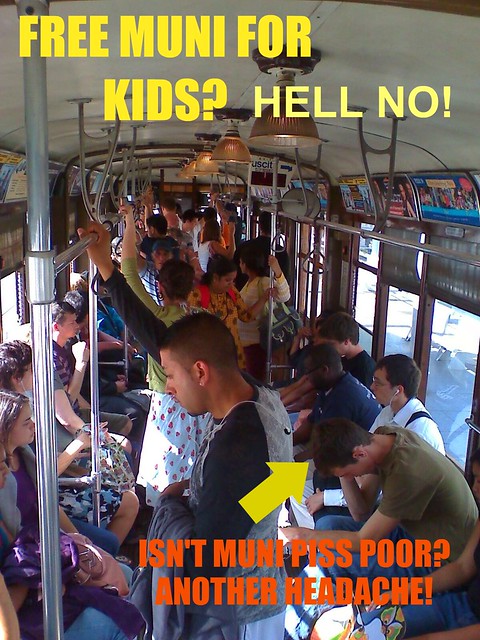
  6. I've never liked the idea of giving out free passes to kids.  I applauded the MTC board for saying screw you to the kids on the idea of spending public money for free rides for the youth, only to have the SFMTA board decide to spend its own cash for the pilot program.  And the youth responded by humiliating themselves in the news media by getting angry (here, take a look at a Chronicle picture of a kid so upset he's not getting free rides on the bus).  Renewing the program comes at a huge expense to us taxpayers.  Remember kids, the price you pay for Muni rides today is the best offer versus all the other major transit agencies in the Bay Area.  And, you get a FREE TRANSFER.
  7. Oh, and let's not forget the idea to give seniors and disabled passengers free rides too.  Where do you think that money comes from?  The public's pockets.  I wonder how many people will try to fraud Muni and the MTC who issues the disabled IDs.  Get a crooked doctor to sign-off paperwork and why not apply for a shot a free rides on Muni for life?  Sounds similar to people who cheat the disabled parking placard system.
  8. Last but not least, let's talk about the end of the Sunday meter fees.  I think charging for Sunday meters is a great idea because business districts gets more turnover (more customers), there's more available parking, and for anyone who doesn't want to pay the meter fees, can opt to ride Muni as an alternative.  When Sunday meters was free, visiting neighborhoods with major parking issues like Irving Street from 19th to 27th Avenue was horrible; cars wouldn't move for hours and some people would double park forever waiting like a vulture for an open space.  So keep the Sunday meters running.
A lot of times, Muni's 'smart people' likes to rattle the cage and think of these harebrained ideas, including restoring programs like charging a premium fee for express buses when it utterly failed in mere months over 20 years ago.  Some of these ideas won't likely be implemented because it will anger the public, but some might fly without a doubt like continuing to give the kids free rides.

When Muni pulls these ideas out of their ass, I'm very grumpy.  I would spit on their grave if there was one (can anyone find the CultureBus gravestone?), but for now, it's just ranting on this blog.

If you feel the need to express your opinions about Muni's ideas to raise money and give out more free crap, contact your city supervisor.

Saturday, January 18, 2014

Muni Substituting Diesels on Trolleybus Lines on Sunday - Major Delays to Happen


This Sunday is the big NFC championship game where the 49ers are traveling to Seattle to face the Seahawks.  But the more troubling issue is why Muni is not allowing any trolleybuses to run in the city, and instead substituting it for diesels all Sunday.

From the Chronicle, the reason why the trolleybuses are being locked in the garage is a precaution in case there's fans rioting in the streets.

Riots?  If citizens wants to riot, they'll vandalize or destroy any Muni bus they please, regardless if it is diesel or electric.

The truth of the matter is, if Muni takes all the electric trolleybuses off the streets on Sunday, you will experience severe delays on all trolleybus lines.  There are not enough diesel buses to make-up for a huge loss.

And how do I know of the delays?  Last week Saturday, Muni switched all electric lines running along Market street to diesel only (excluding the 14-Mission), but they had a legitimate excuse, there was major road construction on Market and it blocked the overhead wires and the tracks used by the F-Market.  I ride the 6-Parnassus, but the diesel buses ran too far apart, with wait times of 30 to 40 minutes; normally the wait with trolleybuses is about 15-20 minutes.  Even the bus substitution for the F-Market was terrible, I was waiting 25 minutes for a bus that was sardine packed; after that point, I turned around and went home.

But wait, there's more.  This Sunday, Muni is cutting-off all Cable Car and F-Market service and they are also going on diesel as well.  For the entire three day weekend, the N-Judah will not run trains from Duboce and Church to Ocean Beach, and instead run much slower and smaller capacity buses.  This means that all the diesel lines will be STRETCHED THIN.

I seriously question the SFMTA's choices of cutting-off all the trolleybus lines for diesels.  Like I said earlier, with all the lines being forced to diesels, there is not enough diesel buses to make-up a huge gap like this.

Monday, October 28, 2013

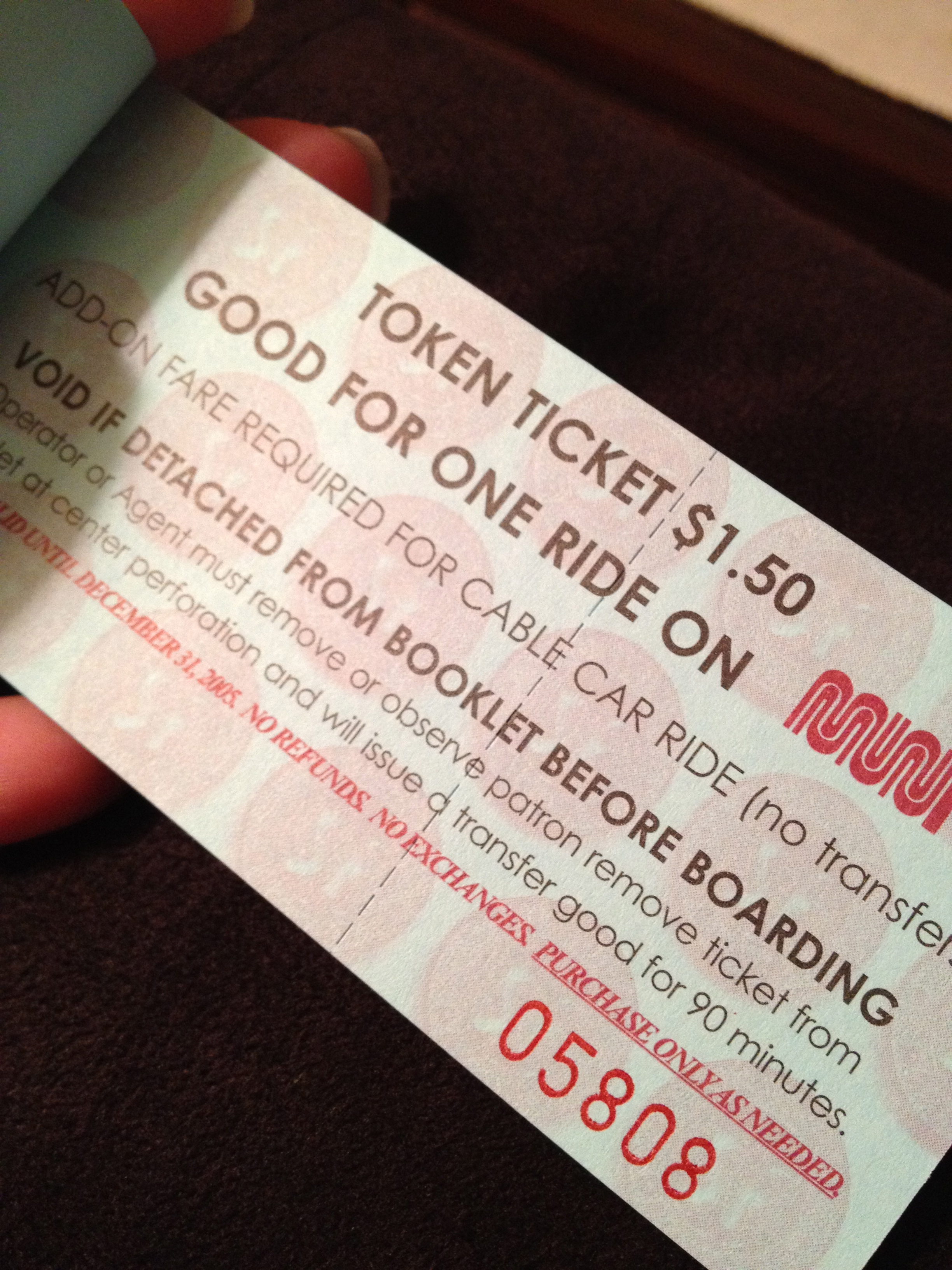
Muni's 10-Ride Ticket Books (Tokens) Finally Gets a Grave


Bothersome thingsQuietly announced this morning, the people at the SFMTA announced the upcoming end of sales of Muni 10-ride ticket books sold for Clipper cards.  The sales will end starting on January 1, 2014 and any person who has in possession a 10-ride on their card must use them no later than July 1, 2014.

Why are the 10-ride ticket books going to extinction?  It's elementary, Watson; you see, the 10-ride books was not sold at a discount, so it's the equivalent as paying in cash or Clipper e-cash.  10 ride books costs $20, but the regular adult Muni fare is $2 a piece, so the ten-ride book basically dug itself its own grave.


A Little History About Multi-Ride Books and Why it's Dying a Horrible Death
Back in the 'good old days' of Muni, they sold tokens in bags of ten.  The little coins was sold in bulks of ten so passengers can save 25 cents per ride.  It wasn't until 2005 when a fare hike from $1.25 adult cash fare went up to $1.50 caused the little coin's demise.

For a yet to be determined project: old sf muni tokens.

Since the regular cash fare and passes was going up, people wanted a fare product that was resistant to the hikes, and that was the Muni token.  People decided to hoard them by buying as much as they can, that Muni was starting to run short of the coins, had to limit customers to how many bags they could buy, and decided to not produce more coins because it costs more to produce them.

Muni transitioned during that time from actual metal tokens to paper token tickets to meet demand.  But with a new policy of no discounts, people who decided to buy them had to spend $15 for a 10-ride ticket book; this meant a very small population of San Franciscans and commuters could use the ticket books because of programs like Commuter Check which had to be spent on physical transit media, like the 10-ride books.  This program continued for a long time until the Clipper card came to life.

Strangely, when the Clipper card debut and the new Muni metro station ticket machines opened-up, Muni stopped selling the actual paper 10-ride tickets in favor of having passengers load them onto Clipper cards.  But since there were no discounts for buying in bulk, the demise of the 10-rides was going down the drain even more.  People who used commuter benefits programs are now able to transfer their benefit funds into Clipper e-cash funds that was universal money good on many transit agencies.

Basically, with Muni's decision to not provide bulk discounts for buying transit rides in advance is the primary reason in my opinion that the ten-ride books are finally being executed by a firing squad.

If you want to learn more about the history of Muni tokens and it's eventual death, read a past blog entry I wrote three years ago.

Akit's Opinions & The Future?
I think it's fine for Muni to finally end the 10-ride books.  The end of the books means that the Clipper card sales options will be one less, therefore simplifying the already complex Clipper card program crammed with various types of passes, transfer rules, and many other transit agency policies.

But how about Muni taking on the lead like AC Transit by offering passengers paying e-cash with Clipper to get a discount?  AC Transit proposed to passengers that if you pay with Clipper, you will save 10 cents from the adult fare, so instead of feeding a cash box $2.10, you just pay $2 with Clipper.  Muni should provide this carrot on a stick to encourage passengers to use Clipper to reduce delays because of passengers paying in cash.

Photo of Muni ticket book by Flickr user: cbcastro using a Creative Commons License.
Photo of Muni tokens in hand by Flickr user: joe.moore using a Creative Commons License.

Wednesday, October 2, 2013

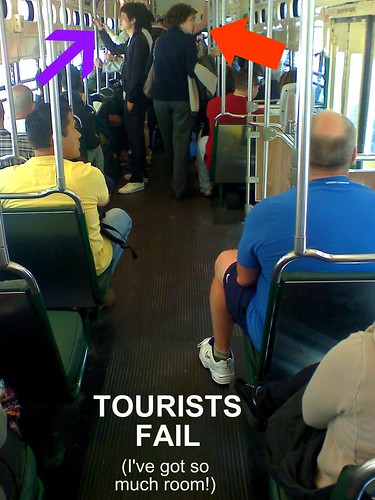
What's Worse Than Nail Clipping on Muni? Using Your Speakerphone

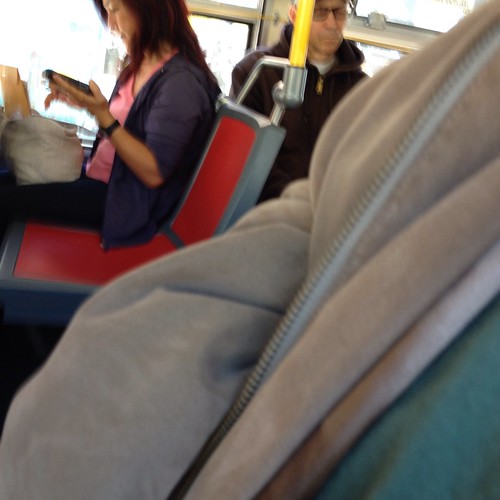
The annoying ass perp in pink.
I've blogged in the past about people who have done some annoying stuff on Muni (see questions and thoughts while riding Muni).  Number one was nail clipping because the sound is so irritating, but I think I found my new number one annoyance while riding Muni.

If you've watched the season premiere of South Park, it showed an irritated Kyle who is frustrated at Eric Cartman for having conversations on his cell phone by using his speakerphone everywhere he goes.

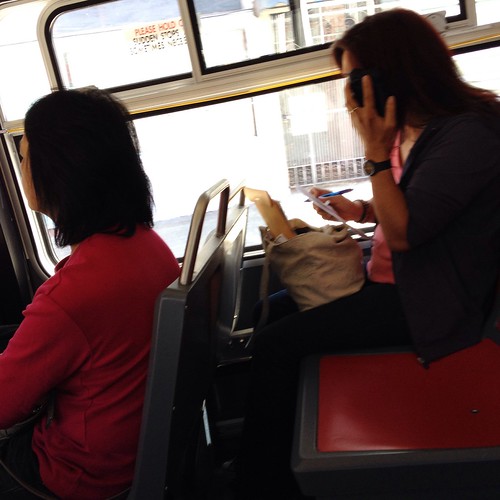
But while that happened in the animated television world, it happened on Saturday early afternoon when I was taking the 44 bus going northbound.  When the bus was in Golden Gate Park to stop in front of the Academy of Sciences, I saw a woman pull out her smartphone and was making a phone call.  All seemed normal at that point until I started hearing the automated telephone greeting through her speakerphone.

The entire back half the bus can hear the automated message on her phone and she was able to connect to a telephone operator to ask questions and get responses.  To make matters even more amusing, it was a conversation with the operator that would be confidential or a private matter, such as calling your credit card company or your doctor.  She continued having the conversation back and forth between the operator, and I can hear the conversation while I was listening to music with my headphones.  I snapped a couple of pictures of her so I can humiliate her on my blog, Twitter, and Instagram accounts.

Get off the bus and chat.
The people around me was rolling their eyes at her while the conversation kept going on, and it finally stopped when she exited the bus at 6th Avenue and Geary.  Thank my patience for not outbursting and telling her to shut the hell up or stop using the speakerphone, because I was getting close to doing just that.

Are some people so oblivious these days they'd pull a stunt like that on public transit?  It's a private conversation you fool!  Even the automated message on the bus reminds passengers to refrain from using their cell phones to prevent crime; it should also be a crime to yack on your cell phone with the speaker on.

Wednesday, June 12, 2013

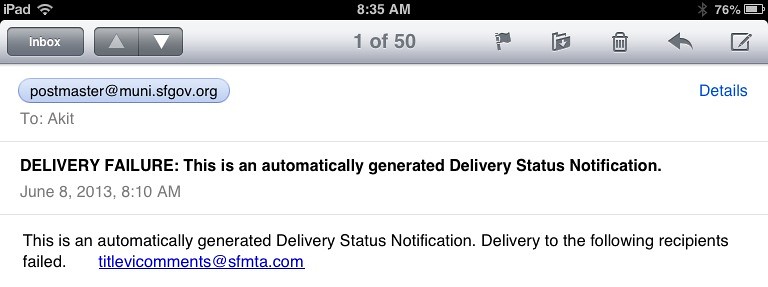
UPDATE: SFMTA (Muni) Response to Title VI E-Mail Problems

Click on image above to enlarge
Here's an update from a blog post I did a few days ago about the SFMTA/Muni having some issues with their e-mail telling people about the Title VI document and the e-mail address that didn't go anywhere.

After contacting Paul Rose, spokesperson for the SFMTA, he stated:
Hello,
This was a mistake on our part.

We are having some technical difficulties and will reissue the email with revised information in the next day or so. In the meantime, if anyone has comments, they can call us directly at 415.701.4740.
I'll post a copy of the new e-mail when it gets sent out to the public.

Monday, June 10, 2013

Akit's Top 10 List - San Francisco's "Official" Ice Cream Flavor?


What if San Francisco had its own ice cream flavor, what would that be?

SFGate asked that question to their readers, and while many said the flavor should be urine, I wanted to think of some fun flavors too, including the last one on this list to make fun of our incredibly stupid city laws.

Here's a list of flavors I would have declared as the "official" San Francisco ice cream:
  1. Rainbow.  It's both a symbol of our diverse city, but also represents our LGBT community.
  2. Any ice cream mixed with crumbles of locally made chocolates like TCHO.
  3. Green tea.  If you like tea, that's a simple one.
  4. Vanilla ice cream mixed with crumbled fortune cookies.  Did you know the fortune cookie was born at Benkyodo, a San Francisco Japanese confectionery and made for the Japanese Tea Garden?
  5. Sriracha.  Who doesn't love this spicy kick sauce?  Make your mouth have a sweet and hot orgy.
  6. Coffee ice cream, but the coffee must be sourced from a local company like Blue Bottle.
  7. Ex-Supervisor Ed Jew flavor.  Contains tapioca balls because he tried to scam tapioca drink businesses, and has a peach flavor because he's having canned peaches for breakfast every single day at the federal prison.
  8. Board of Supervisors flavor.  When you taste it, it tastes good, but slowly turns horrible (similar to passing laws that seems to be 'good,' but goes bad after people realizes how stupid, wasteful, or horrible it is).
  9. Muni flavor.  Put it in your mouth, the flavor might show up right away, but usually the flavor shows up 10 minutes late or doesn't show up at all.
  10. "Nothing" meaning absolutely nothing at all.  Reason?  The city supervisors banned the flavor (just like plastic bags and fast food toys), and there would also be a 2% Healthy San Francisco surcharge to that empty cup of ice cream just served to you.

Saturday, June 8, 2013

SFMTA (Muni) Invites Public to Meetings - But We Cannot Review Documents & Comments Email Address Doesn't Work

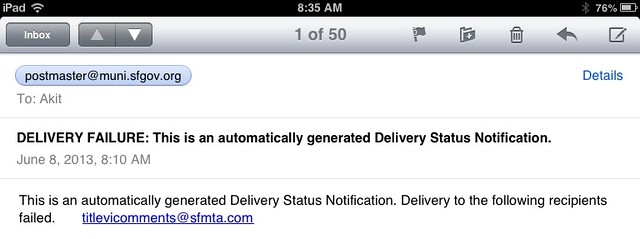
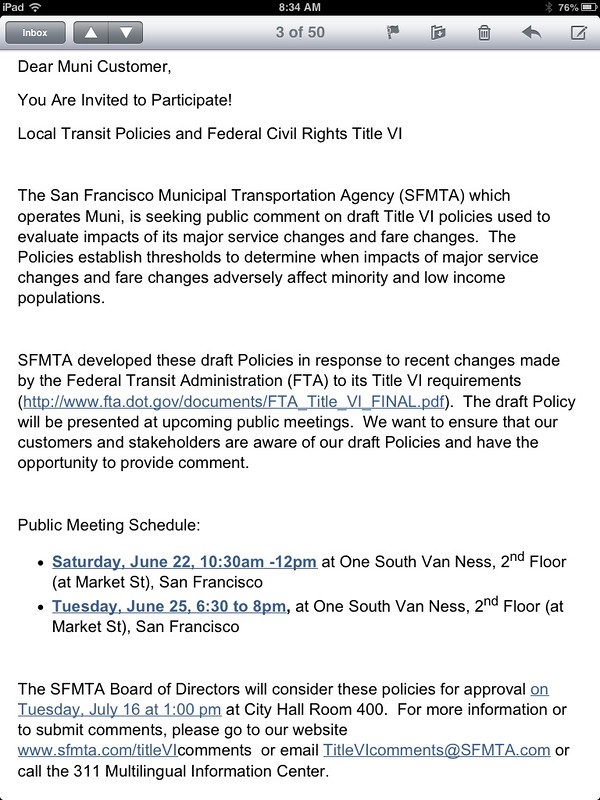
On late Friday afternoon around 5:20PM, I received an e-mail from the SFMTA inviting members of the public to review their draft document which could affect Muni with major service changes and fares.  Under federal law, public transit agencies must do a review under Title VI requirements of the Federal Transit Administration (FTA).

I've mentioned about Title VI before, when the Clipper card program wanted to impose a change to include a fee for obtaining a new card.  Read the story here.

Here's the e-mail message for you to read:

When you look at the letter, it mentioned that the agency created a draft of new or revised policies due to a change in the Title VI requirements by the FTA.  It gives a link to the FTA document to review the federal changes, and the SFMTA will be presenting their "draft policy" at upcoming meetings on June 22nd and June 25th.

I was interested in reviewing what the SFMTA drafted regarding possible changes for Muni, so I went to the bottom of the message and clicked on the link, but it referred me to the SFMTA search results page and not the website.  I even hand typed the address, including the "titleVIcomments" and still received the search page and no actual SFMTA Title VI website.

Thinking that this must be a mistake, I used their email address: TitleVIcomments@SFMTA.com.  I wrote that there's no SFMTA draft document to review, suggested a new e-mail be sent to the correct SFMTA website, and asked for a response within a week

Here's the response from the SFMTA, and it was a really quick response:
Click on image above to enlarge.

Yep... EMAIL ADDRESS DOESN'T EXIST.  That's pretty disappointing.

This has three huge issues:
  1. Why is the website link to the SFMTA website not going to the location of the document?
  2. If people just attend these public meetings without spending some time prior to review the document online so they can give proper comments to the SFMTA representatives and the Board of Directors, isn't that a violation of public hearing/meeting laws, or something like that?
  3. If people cannot e-mail comments because the e-mail address doesn't exist, is that also a violation of public hearing laws because the public cannot write to the agency?
I'm going to contact SFMTA's press department for further information.  I'll post an update when I get a reply.

Wednesday, May 29, 2013

Akit's True Muni Stories - Crying Baby & a Beer

I thought I'd share one of my favorite true stories onboard Muni and one hell of a coincidence that it happened.

On a weekend in the afternoon, I was riding the F-Market to Fisherman's Wharf because I desperately wanted the best clam chowder at No. 9 Fisherman's Grotto (if you think it's Boudin, HA!).

During the ride on the Embarcadero, there was a very loud crying baby on the vehicle.  The mother was trying to keep the baby quiet and looking around, I saw a lot of passengers just stressed.  For me, I was saying to myself, "this is birth control for me."

At the Pier 39 stop, most of the passengers, including the crying baby hopped off.  With the very few passengers left, we all chatted about the crying kid; everyone agreed that it was just too damn loud.

I responded with a fun joke: "I could sure use a good beer right now."

Just seconds later, I hear a bottle rolling down the aisle.  It was an empty beer bottle.  The passengers looked at me in awe.  I guess it was a sign it was time for a good beer [and some chowder!].

Tuesday, March 26, 2013

SF State/19th Avenue & Holloway Muni Metro Stop: Passengers Jumping from Platform

Would you dare to jaywalk across three lanes of traffic on one of San Francisco's busiest streets?

Let's take it up a notch, would you jump off a Muni metro platform and jaywalk across three lanes of traffic just so you don't miss your bus?

The fact is, this does happen.


Take a look at the Google Maps image I've posted.  This is the metro platform stop for the M-Ocean View line at 19th Avenue and Holloway, in front of SF State.  You are looking at the east side (inbound) platform.

On some mornings, I notice passengers who just got off the inbound M-Ocean View line decide to jump off the platform and run across those three lanes of traffic just so they can take a shortcut to the bus stop that's on the sidewalk to catch the 17, 28, or 29 lines.  The first time I saw that, it was older Chinese women who was doing this, by risking their own life trying to make it across without getting hit by an incoming car.

While it's entirely possible to jump the platform and make it to the other side, the west (outbound) platform has a fence to prevent people from jumping, especially SF State students finding a cheap way to get across without walking down the ramp and using the crosswalk.  The city has installed fencing from Holloway to Winston to prevent jaywalking, especially at the track junction that was wildly popular and very illegal to get from one side of 19th to the SF State campus.  The city had to install the fencing because there have been some instances where people walking on the tracks was hit by a train or university police had to chase down someone on the active rail tracks.

It makes me wonder, why isn't there any fencing to prevent jumpers for the inbound side of the platform?  I wouldn't dare to attempt to jump from a platform and run across three lanes of traffic on the busiest and most dangerous road in San Francisco just to catch a bus.  I'd rather walk down the ramp and use the crosswalk, even if that meant missing the bus.  It's better for the city to prevent people getting mowed by a car than installing the barrier after the fact when someone's dead or in a coma.

Maybe I should text a tip to SFPD the next time I see it happen; never mind, since they don't read it in a timely manner.

Friday, March 8, 2013

Muni Should Seriously Question How They Spend Their Money

Oops!
Photo from Flickr user "Nathan Y" using a Creative Commons License

Just a week ago, it was the first day for San Francisco's youth to use their free Muni passes for sixteen months.  Sure, it was a joyous occasion for city politicians, advocates for youth, and the kids that qualified for the program, but has angered many (including yours truly) that it's a huge waste of millions of taxpayer dollars.

My primary argument: The city and Muni should be spending the several million dollars that is now being used for free rides, and actually using it towards preventative maintenance and maintaining critical systems.

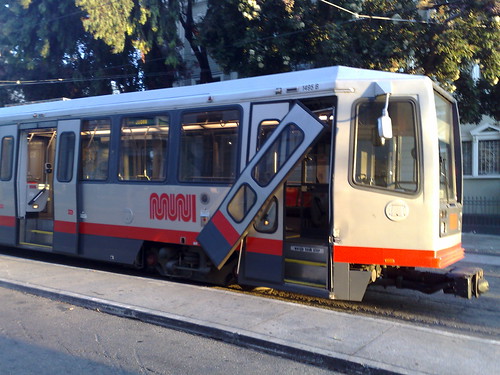
So just the day before the release of the new passes for kids, something big came up, a Muni metro's passenger door fell off on the journey between Castro and Church station.  Muni metro vehicle 1439's front door fell onto the trackway, and while passengers were not injured, it sure points out the need for money for maintenance on the agency's aging fleet.

(Note: Photo used in this blog entry not the actual one of the incident)

I think all that money Muni is spending on free passes for kids is one big joke.  If a person got killed from that incident by flying out of that train, the city would be spending a huge amount of dough inspecting every single door.  But with an agency still bleeding red, how can they spend money on youth when it should be invested in prevention and repairs?  If another transformer blew in the metro system, there would be another metro meltdown because no trains can operate without electricity; I'd rather see the millions spent to maintain and possibly upgrade the transformers so it can help everybody, and not just kids getting a free ride.

As I mentioned before: Kids, you should be very fortunate that Muni gives the best discounts out of the rest of the agencies in the Bay Area.  You get a 62.5% discount (versus adult fare) with a free transfer, other agencies don't give free transfers or cut the discount to 50% or less.

There's no way to cancel the pass program, but I'm hoping the city will realize after the pilot program ends, that it's NEVER RENEWED.  Too damn expensive.

Monday, February 11, 2013

Muni Fare Inspector Saturation Raids, Are They an Effective Use of Resources?

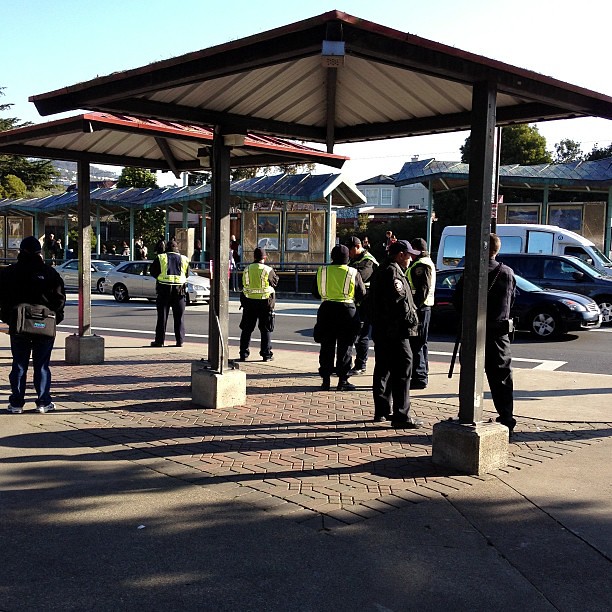
Last week Wednesday, I noticed several fare inspectors and two police officers waiting at the 19th Avenue and Holloway bus stop in front of San Francisco State University waiting for buses to arrive so they can be checked for proper proof of payment.

Last week Friday on my commute to my job, I noticed about the same number of fare inspectors and police officers at the 19th Avenue and Taraval bus stop for the 28/28L line going southbound.

It makes me wonder if the SFMTA is utilizing their Muni fare inspection teams in the most efficient manner.  I have questioned Muni's tactics in 2009 when thousands of Giants fans were inspected as usual at the entrance to the Muni metro platform in front of the ballpark, and was checked a second time at the Embarcadero station exit; it was a waste of the agency's resources because all the ballpark passengers were screened prior to entry to the system.

Their 'saturation' enforcement has been a controversial issue around certain communities as activists claimed fare inspectors target low income minorities, but in the agency's point of view, they are using the teams to transit lines that have the highest amount of fare evasion.

Normally, fare inspection teams are usually two inspectors that typically board a vehicle for a short ride, and go up and down the aisles to quickly check everyone for proof of payment.  But the saturation teams uses several inspectors and at least one police officer to board a vehicle at a stop, check everyone, disembark the vehicle, let the vehicle go, and wait for the next one.

While each method of enforcement meets the goal of surprise inspections to make sure passengers are in compliance with the established policies regarding proof of payment, I feel the saturation inspections are a waste of manner, and other methods of using them can be more effective.

By having several inspectors board the bus at once, it brings that feeling of the FBI wanting to raid a house and make you feel like a criminal.  When having a team of two handle a vehicle going from stop to stop, things are a lot calmer, and I've seen that be a lot more comfortable to see two inspectors ride the metro from one stop to another to quickly check everyone.

A Better Way?
In the above photo, this was in front of San Francisco State University where this particular team checked every single southbound 17, 28, 28L, and 29 bus that stopped there.  With two police officers also present, the feeling in the air was more like all the passengers are suspects and criminals, and those who wants to attempt to run will be tackled by the cops.

I feel a better and more effective way to make the large team more useful to check passengers is to spread them out at that particular intersection.  Have a team of two on the metro platform riding between the SF State and Stonestown stops checking passengers, have a team on the east side of the street to check the passengers riding northbound, and have the remaining at the west side stop.  By doing it this way, the large team is spread out checking all buses and trains going each direction, and police backup is right nearby when needed.

The same method could have also been used at 19th and Taraval by checking all the L-Taraval trains, but several inspectors just checked buses going one direction that came every 10 minutes.

What Inspections?
Personally, the number of fare inspections where I've been checked has been very rare and too far in between.  The most I've ever been checked is when I exit the Powell Street Station, but that's only about once every two or three months on the weekends.  The most hardcore fare inspections is after ballgames at AT&T Park, and that's necessary because everyone should pay their fare to ride the train to get home.

The agency thinks all the major lines are the headaches of fare evasion, but sometimes they should look at the smaller and less popular lines.  I don't think the agency realizes that the lines going through neighborhoods and are not considered a major route, also has their fair share of evasion and I feel Muni doesn't do a thing to make sure the agency is looking out for all cheats, no matter what route is taken.

Some Advice for Us, the Passengers
To some of you, you don't mind the inspectors.  To others, you hate their guts.

Here's some tips to making things just a little easier, and to keep that $75 ticket monkey/ticket off your back:
  1. Always get a transfer if you pay a cash fare.  Make sure it has at least 90 minutes on it.  If not, ask the driver for a new one, because 90 minutes is the MINIMUM.
  2. If you pay e-cash on Clipper, use a stopwatch to time how long your transfer is valid.  Once 90 minutes goes by after the first tag, the card is invalid.
  3. Carry spare cash with you if you have a Clipper card.  If you board the bus at the 89th minute and the card reader says okay, 60 seconds later, your transfer just expired.  Pay cash and just take a paper transfer.
  4. Always be aware, expired transfers are not valid during the journey.  This means, if you boarded while it was valid, but expires during the ride, either pay for a new one or get off the vehicle immediately.  But if Muni lacks the manpower or efficiency to check transfers, you might as well continue to ride expired.

Thursday, February 7, 2013

Clipper Card's Plans for Expansion & Improvements in 2013


The Metropolitan Transportation Commission's Operations Committee (a.k.a. the defacto Clipper Card Board of Directors) will be meeting this Friday to discuss about Clipper card matters.

In a recently released agenda (PDF document) for the meeting, it mentions about what is planned for the Clipper card program for the year.  Here's the list:

First half of the year:
  1. They will enhance the website to make it easier to use.  If you log into your account, it's more streamlined.  They will also introduce a mobile phone friendly website in the near future.
  2. Youth and seniors will be able to apply via mail instead of going to an in-person location.
  3. The Clipper card will be accepted at five San Francisco parking garages.
Second half of the year:
  1. The end of Clipper card cheats on BART when the exitfare machines at every BART station will be functional to add value to cards.  This means passengers can't exit BART with a negative value on their card.
  2. Limited use tickets for social service agencies to distribute.
  3. Modifying Clipper's back end systems for more efficient and reliable processing.
  4. Preparing for expansion of program to smaller transit agencies not part of the current consortium.
  5. Working on long range plan for Clipper, including meeting with other transit agencies and other technology innovations.
Lastly, the board is reviewing a possible change in state law regarding personal information stored for transit rides after a recent controversy of how long Clipper and MTC keeps rider information data.  The law proposed in the legislature would make the maximum to six months.

Akit's Opinions
A lot of these goals they listed is pretty reasonable.  They are already working on the website and a mobile version will be quite helpful.  An Android and iPhone app would be great too.

I believe the most significant change will be accepting the Clipper card at city parking garages.  The only concern I have is how will this work; the problem is that Clipper card funding can be considered toxic if the e-cash purse is funded with pre-tax commuter dollars, therefore using it for parking, other than proper work transportation purposes is considered illegal.

Thursday, January 31, 2013

Muni Metro Exiting Passenger Hit By Car - Will SFPD Finally Enforce the Law?

Many of who takes Muni metro have experienced at least one close call when exiting a surface stop and a car decides to blow past the train.  Those moments put chills in your bones, and maybe the feeling you want to slash the tires of that moron.

For you loyal fans, I've written about this a couple of times: An incident where I had a close encounter with a speeding SUV while I was exiting the metro, and a popular stop along the N-Judah line where cars pass by a stopped metro vehicle on a regular basis.

As we are aware, state law forbids drivers to pass a stopped light rail vehicle that is boarding and discharging passengers, or basically whenever the train doors are open.  We call this the "Do Not Pass" law.  Drivers are only permitted to drive past a light rail vehicle once it goes into motion, and not when just the doors close (there's the assumption passengers may still exit the train), or can legally pass a vehicle if it is in a designated "safety zone" at 10 MPH if it is marked with signage saying so.

Just yesterday morning at Taraval and 19th Avenue, a passenger exiting the L-Taraval train was struck by a car, and while it's not life threatening injuries, it delayed the entire line for 45 minutes.  (News article from SF Appeal).

You would think education would work, well it seems the answer is no [facepalm].  People continuously disobey the law and puts passengers entering and exiting the trains in danger.  When will the SFPD conduct enforcement and teach violators a serious lesson in driving?

Citizens constantly complain about laws being broken in their neighborhood, but the cops just don't do anything or say there's more serious things they need to do.  There are tons of occasions that the police or even the city will finally make changes or stronger enforcement when someone GETS KILLED because of it.  For example, a former two-way stop at 47th Avenue and Fulton was so extremely dangerous the city kept it a two way (stop signs for north & south) and extended the red no parking zone for better visibility, but only turned it into a 4-way when a pedestrian was hit and killed by a speeding driver going on west on Fulton.  The SFMTA tried stalling citizens complaints by responding it would "delay Muni," but from the many who called to complain, we all knew it was total bullshit.

When I drive on streets like Judah and Taraval, I always respect the law and wait behind the metro vehicle to let it do its job to embark and disembark passengers.  I've had assholes honk at me, including a taxicab, demanding me to pass the vehicle; all I do is keep my foot on the brake, roll down my window, point my finger at the yellow sticker on the back of the train saying not to pass, and pull my middle finger up to flick them off.

I don't have hundreds of dollars to pay the fine and court costs.