"Akit is the man. He knows Clipper." (spenta)
"It’s a fantastic blog for any San Franciscan."
(Kevin)
"Your blog is always on point, and well researched!" (Nina Decker)
"Everyone's favorite volunteer public policy consultant..." (Eve Batey, SF Appeal)
"You are doing a great job keeping on top of Translink stuff. Keep up the good work!"
(Greg Dewar, N Judah Chronicles)
"...I don't even bother subscribing anywhere else for my local public transportation info. You have it all..."
(Empowered Follower)
"If anyone at City Hall wants to make public transit better for all San Franciscans, it would be wise to follow Akit religiously...
or, better yet, give him a job."
(Brock Keeling, SFist)
Showing posts with label golden gate ferry. Show all posts

Thursday, February 18, 2021

Clipper Card Coming to Apple Pay and Google Pay


That's right, Akit is out of retirement for just this special story, after more than four years of not blogging.  How are you?  I've been doing well; in the last four years, I've got a job promotion with a decent pay raise, and I've been working remotely from home for nearly a year due to this virus.  Hoping I can get the vaccine in the coming weeks and eventually return to in-office work.

If you read the blog entry title, the Clipper card will be available with Apple and Google Pay starting Spring 2021.  If you want to read the articles, see the Apple Pay article and Google Pay article.

For you very long time loyal readers, I've been blogging about the Clipper card, and it's former name, the TransLink card for such a long time.  Since not much has changed, I can help provide some insight in what your mobile phone wallet will do for you.  However, since I own an iPhone and Apple watch, information about how Google Wallet may be limited.

Want to sign-up for an email notification when Clipper is ready for Apple Pay?  Click here to go to Apple's website to register.

Let's look at the benefits and features that will come with Clipper Card on Apple Pay:
  1. No more carrying a plastic card with you.
  2. For Apple users, it will be available on Apple Watch and iPhone.
  3. Express Transit will be supported on Apple Pay.  What this means, there is no need to open your Apple wallet on your phone or watch.  Just tap the phone or watch on the reader and it will automatically open the app and scan.  But it does require you to activate this feature on your wallet's settings.  One thing to note, if you just restarted your phone or just put your watch on, you need to authenticate yourself with your passcode to have the Express Transit feature on standby for your next ride.
  4. Express Transit also works if you are in power reserve mode, but only on iPhone.  Power reserve mode is when your phone shuts down due to low battery, but will function as your Clipper card for up to five hours until you can recharge your phone.
Here's some possible features that may come with the Clipper Card, but this comes from learning about how this works from reading and watching videos about the Suica card which is used in the Tokyo, and WMATA's SmarTrip card used in the Washington D.C. area:
  1. You can add cash funds or possibly passes by purchasing them on your phone, and would be available for instant use.  There would be no need to reload your virtual card at a ticket vending machine, such as at all BART stations, or visit a Walgreens or retail store.
  2. You will be able to transfer your blue plastic card's data, cash purse, passes, etc. to your virtual wallet by allowing your phone to scan your card.
We've seen the benefits, now the problems:
  1. You can only add your Clipper card to one device, either your iPhone or Apple Watch, not both.  You can have it on both, if you have separate cards.  Hard choice, phone or watch?
  2. If the ability to transfer your plastic card's data to your mobile device is allowed, once transferred, your plastic card is void.  You cannot use both the mobile wallet and plastic card. Please note, this is coming from the SmarTrip website; I would assume it will happen to plastic Clipper cards once migrated to your phone or watch.
  3. If your card needs to be read by a fare inspector or any person who uses a handheld reader, such as a cable car conductor, Express Transit feature on Apple Pay won't work; you'll need to open up your Apple wallet on the device you have your card on.
  4. The Commuter Check debit card is not supported on Apple Pay because I just tried adding it.  Unless if Clipper has a separate app that someone can manually enter their card number, you may not be able to reload Clipper card purse funds or buy passes using the commuter benefits card via your phone; you would have to do it at a vending machine or retail store.
  5. If your watch or phone is dead or if you have a battery that isn't holding its charge, maybe stick to your plastic card.  Non functioning devices means no working Clipper card.
  6. If you ride Muni occasionally, take at least two rides, and don't ride the cable cars (and they are not operating due to COVID), it's better to use Muni Mobile's day pass for $5, as a single ride on Clipper and Muni Mobile is $2.50.  Clipper cards don't have the $5 pass available to purchase.
  7. It is unknown if you can migrate your SF State ID card with Clipper (for the Gator Pass) to your phone.  It is also unknown if you can migrate a Senior card, RTC discount card, and other discounted cards to Apple and Google Pay.
  8. One last thing, it's highly unlikely that contactless credit and debit cards, including Apple and Google Pay credit/debit cards will be accepted on Clipper.  The major weakness of the Clipper card system is that all card readers on buses are not connected through cellular service 24/7 to verify if the card is legit or stolen.  Clipper and formerly TransLink has been in use for nearly 20 years.  There's planned 2.0 upgrade coming in the future.
Okay, what would Akit do?  I have the blue plastic adult Clipper card, iPhone, Apple Watch, and a commuter debit card. (Remember, you may not be able to have the same card on the iPhone AND Watch)
  • My option would likely be my Apple Watch.  Especially since face masks aren't friendly with Face ID on iPhone, Apple Watch seems to be the easiest choice, I can just tap the watch over the reader.  Although, in the case of Muni metro and BART gates, my watch is on my left wrist, so I'll have to move my arm over to scan it.  I would also activate Express Transit so I don't have to open up the wallet on the watch and scroll to the Clipper card.
  • A possible problem is using my commuter debit card as a funding source to reload my virtual Clipper card, since my debit card can't be added to my Apple wallet.  Hoping they will have a new Clipper card app that lets me add funds by manually adding a commuter benefits card.
  • For longer day trips within San Francisco, I would not use Clipper, and instead use Muni Mobile for their $5 day passes (no cable cars) or $13 one day passport that includes cable cars.
    • Cool tip: Once cable cars resumes service, it's $8 for a single ride.  Two cable car rides costs more than an all day unlimited Muni Mobile one day passport good for all the cable cars, buses, light rail, and historic streetcars you want.
Want to see how a contactless transit card works?  Watch this video of the Suica card on Apple Pay is being used at a fare gate at a train station in Japan: https://www.youtube.com/watch?v=HNzi5b1Rsxc&feature=youtu.be

Monday, September 15, 2014

Clipper Card on iPhone's Apple Pay Service - Could it Really Happen?


Greetings readers, it's been a while since I've blogged.  I'm still happy and well, but I've been sticking to my public social media accounts on Twitter and Instagram more often.  I thought I'd write a blog entry today because of what's been happening in the news for the past week.

The announcement of the next generation of iPhones, in particular Apple Pay, is really attracting a lot of news these days as the next cool way for people to pay for stuff at their favorite big retailers without pulling out their plastic credit card.  And while the Android platform has been using their NFC chips for a good while to be able to pay with credit cards and read NFC tags, with Apple playing along, that puts a huge chunk of the smartphone market able to now use NFC technology.

But what really intrigues me about the big evolution of NFC to be capable on Apple devices is the opportunity for public transportation to play a role in being a part of it.  Simply put, will the Clipper Card be an option for Apple Pay and Android?

Here's the pros if the Clipper Card was available as an option for people to scan their phone to a Clipper Card reader:
  1. No more carrying a plastic Clipper Card in your wallet.  Just put your phone to the reader to handle your fare/pass transaction.
  2. Be able to instantly view your card's balance, transfers with the time it expires, and your passes.
  3. Be able to instantly view your ride history, and have instant proof of payment on hand for fare inspectors.
  4. Using the Clipper Card app, be able to add card value or buy passes using a linked credit card with instant available use, without the horrible five day waiting period currently in use for people who buy online for their plastic card.  Read about the five day rule here.
  5. Also, using the Clipper Card app, people can also purchase day passes like for Muni.  Muni does sell the passports for Clipper, but people still prefer the scratch-off ones or buying it from the Cable Car conductor.
  6. Also, there could be an option for people to not use a Clipper Card, and instead use a registered credit/debit card to make their one-time transit fare payment.  It might be a cool perk for those with pre-tax commuter benefit debit cards to simply tap their phone and just deduct the balance from the card; no more need to load the money to a Clipper card, just touch and pay.
But there are some cons:
  1. It may not be possible to have Clipper do this.  The Clipper Card system itself was one of the first smartcard systems ever in the United States, and as of today, the system is outdated when compared to other agencies using smartcards.  When Clipper first started, it started as the TransLink card program which the MTC awarded a contract to ERG, a leader in smartcard technology for transit systems.  But many years later, Cubic, a titan in the transit technology market, bought out ERG and took over its contracts, including TransLink/Clipper.  The folks at Cubic had an uphill battle to get their products to properly function with the thousands of ERG cards and technology in use, such as the BART and Muni fare gates (Cubic products).  Cubic had to take the right route, they couldn't remove the ERG products already wired and installed and start from scratch (that would cost a ton of money), so they made a hybrid system so both ERG products and Cubic products work together.  Since the Clipper system is outdated, it may not be able to take mobile phone payments. 
  2. If the above is true, we may have to wait until 2019-2020 for the next generation of Clipper Card technology to have the features.  The expected end of life for the currently installed technology is to end roughly around 2019 and that's when the contract with Cubic is to expire.  The Metropolitan Transportation Commission intends to put in the next generation of Clipper by starting from absolute scratch, instead of preserving the old infrastructure.  A simple way of thinking is, the MTC may be able to save money by delaying smart phone implementation until the 2nd generation system is functional.  Click here to read about the second generation of Clipper plans.

Akit's Opinions:
In my opinion, I wish the Clipper Card was available as a smartphone function to just tap the phone to a card reader to ride public transit, or even just allowing people to use a linked credit card to just tap and pay for their rides would be wonderful.  Also, with the ability to order passes or load more cash value from your phone means your virtual card on your phone will have instant available use of your pass or funds, without the terrifying five day waiting period or running to your Walgreens or train station to load-up.

But looking at all of the cons, this may be something the MTC may not want to pursue, especially if the Clipper Card program is to be in a coffin by 2019 and a new program will be functional by then.  The technology being used today is outdated but functions as expected.

If there has to be a compromise, here's my recommendation:
I feel this may be an opportunity for Clipper to work with Apple and Google to allow Clipper card users to get an app that utilizes a plastic Clipper card and an NFC capable phone to let people scan their card to read their ride history and review their balances on their card (currently, the FareBot 3rd party app for Android can do this).  This may also be an opportunity for people to order their passes, add cash value, etc. on their phone, and tag their card to their phone to update the card's data with the new information so people can instantly use the card with the new information.

What's your thoughts on this?  Leave a comment.

Tuesday, July 2, 2013

BART Strike Day Three - Ferry Fare Discounts & Tips for Stress Relief

While I am typing this blog entry, day three of the BART strike is highly likely.

Assuming if both sides can hash out a deal very soon, BART won't be able to run at full force for at least a full 24 hours, which means whatever day they restart service, only some trains are going to run.

So while most of you have been hassling through alternatives like AC Transit, ferry boats, and casual carpool, I feel the need to provide just a few tips to get you some relief:

Discounts for Oakland, Alameda, and Harbor Bay Ferries
If you are paying cash for the ferry boats listed above, you are paying more than you should.  Instead, pay with a Clipper card and pay discount prices.  Here's what you will pay:

Oakland/Alameda: $4.75 paid with Clipper.  You'll pay $6.25 with cash.
Harbor Bay: $5 paid with Clipper.  You'll pay $6.50 with cash.

Also, if by using your Clipper card, you'll also get a 50 cent discount to take Muni.  Simply use the same Clipper card and you'll pay $1.50 for the Muni ride.  When you take your return trip on Muni back to the Ferry Building, you'll also save 50 cents.

Discount for Larkspur Ferry
Similar to the discount with the above ferry services, if you take the Larkspur ferry, you'll also get a discount.  You'll pay $6.25 on Clipper, versus paying $9.50 in cash.

You also receive a 50 cent discount for Muni as well.  Take Muni away from the Ferry Building with the same Clipper card and pay $1.50.  When you return on Muni, you pay full fare ($2), but you'll get a 50 cent fare discount (on top of the $6.25 discount fare) upon entry to the Golden Gate Ferry system.

Stress Relief from Commute Hell
I got some positive Twitter reactions from these suggestions.  Why not try them out?

Talk like a pirate, dress like a pirate, and be a pirate on the ferries!


Sing some simple classic songs to ease that anger!  Hopefully others can sing along too!

Thursday, February 7, 2013

Clipper Card's Plans for Expansion & Improvements in 2013


The Metropolitan Transportation Commission's Operations Committee (a.k.a. the defacto Clipper Card Board of Directors) will be meeting this Friday to discuss about Clipper card matters.

In a recently released agenda (PDF document) for the meeting, it mentions about what is planned for the Clipper card program for the year.  Here's the list:

First half of the year:
  1. They will enhance the website to make it easier to use.  If you log into your account, it's more streamlined.  They will also introduce a mobile phone friendly website in the near future.
  2. Youth and seniors will be able to apply via mail instead of going to an in-person location.
  3. The Clipper card will be accepted at five San Francisco parking garages.
Second half of the year:
  1. The end of Clipper card cheats on BART when the exitfare machines at every BART station will be functional to add value to cards.  This means passengers can't exit BART with a negative value on their card.
  2. Limited use tickets for social service agencies to distribute.
  3. Modifying Clipper's back end systems for more efficient and reliable processing.
  4. Preparing for expansion of program to smaller transit agencies not part of the current consortium.
  5. Working on long range plan for Clipper, including meeting with other transit agencies and other technology innovations.
Lastly, the board is reviewing a possible change in state law regarding personal information stored for transit rides after a recent controversy of how long Clipper and MTC keeps rider information data.  The law proposed in the legislature would make the maximum to six months.

Akit's Opinions
A lot of these goals they listed is pretty reasonable.  They are already working on the website and a mobile version will be quite helpful.  An Android and iPhone app would be great too.

I believe the most significant change will be accepting the Clipper card at city parking garages.  The only concern I have is how will this work; the problem is that Clipper card funding can be considered toxic if the e-cash purse is funded with pre-tax commuter dollars, therefore using it for parking, other than proper work transportation purposes is considered illegal.

Wednesday, December 5, 2012

Clipper Card Changes for Muni & Golden Gate Ferry

There are some upcoming changes regarding the usage of the Clipper card for those who ride Muni and Golden Gate Ferry.  For many of you, it should not affect the way you handle your day to day business, but it's good to read up on what is going on.  These changes are effective Friday, December 14, 2012.

Muni
There are three changes:
  1. The minimum balance on a card to ride Muni is being raised to a minimum of $1.50.  Anything less than that amount will be a rejected transaction.  Those Muni passengers with a monthly pass and has less than $1.50 in e-cash on the card will be permitted to ride as the Clipper card reader will recognize the pass.
  2. SFMTA ticket machines located at all metro subway stations will change the minimum e-cash to be loaded to the card from $5 to $2.
  3. SFMTA ticket machines at metro stations will allow passengers to load a maximum of up to $100 in e-cash onto the card.  Currently the maximum is $300, which is the maximum amount of e-cash a Clipper card can hold.
Golden Gate Ferry
The agency has similar changes:
  1. The minimum balance on a Clipper card to ride the ferry is $4.25.  Anything less and the transaction is rejected.
  2. Golden Gate Ferry ticketing machines will load a maximum of $100 in e-cash to a Clipper card.

Akit's Opinions
These are some good changes for both agencies.

When it comes to the raising of the minimum e-cash balance on a Clipper card, this is a step in the right direction.  This will greatly reduce the abuse of passengers who can rip-off the system by simply loading a nickel on the a zero balance card, ride a bus or ferry, and throw the card away.  It also encourages passengers to take care of their Clipper card and reuse it.

For the metro ticket machines' minimum e-cash load being reduced to $2, this is very good for those passengers who ran out of money on their Clipper card and only have just enough cash for one more ride.  Instead of making them pay for a Limited Use Ticket which wastes resources, a cheap reload is just what the doctor ordered.  It's also perfect when you want to dump your leftover pocket change in the machine by requiring less coins to make the $2 load, but still, BART's ticket machines to dump change is much better and easier.

As for the maximum limit to load a Clipper card, I'm not sure of why they are asking for the change.  There is the possibility that they are trying to limit the abuse of stolen credit cards, just like how BART has a limit of two transactions per credit card, per day.

Wednesday, November 21, 2012

Clipper Card Readers Beeping Too Loud?

Now that everyone is used to using their Clipper card to ride public transportation, one annoying issue I've been noticing more often since I moved to the Inner Sunset where public transit options are more available to me, is how loud the card readers are.

For those who tags their card on the Clipper card readers (except those at BART and Muni metro stations), that little card reader can sure screech a loud sound to confirm your proper card tag.  Depending on other background sounds being generated, I can typically hear a card reader beep from a Muni bus a half a block away (roughly 500 feet) or even a block from the bus stop.

Back when the TransLink program was in their pilot program (nearly a decade ago), the card readers didn't make the loud beep, it was a lot more quieter and a lower tone ("boop!").  Worked fine for those tagging their cards and even the error tone sounded more like a buzzer than a screeching three rapid beeps.

It is truly necessary for today's Clipper card readers to be so loud that it can be heard from a decent distance?  That sound should only be loud enough for the passenger to confirm the card has been tagged.  There are no safety reasons that warrants the use of a loud Clipper card beep (e.g. buses with kneeling features must make a loud beep when kneeling and raising).  I believe the tone much quieter so it isn't as bothersome and annoying.

Thoughts?  Suggestions?  Leave a comment.

Tuesday, October 30, 2012

Simple Tips on Taking Public Transit to Giants World Series Parade

This Wednesday at 11AM is going to be a great day for San Francisco when everyone is getting Halloween candy and watching the San Francisco Giants at the World Series ticker tape parade.

If you plan to go to the parade, are you prepared to take public transportation?  Taking your car into downtown SF is going to be the worst idea ever with traffic, tons of people, and limited parking.

Public transit is your BEST option!  At the 2010 World Series parade, tons of people took Muni, BART, Caltrain, and the ferries to get to the city to watch our team celebrate, now it's 2012 and tens of thousands of fans will flood the city again.

Being prepared is the best way to make it through public transportation.  Here's my simple tips on how be ready:
  1. If you ride BART, buy your round-trip BART ticket TODAY.  Do it on Wednesday and wait in a long line for a ticket.  By having a ticket ready for entry, you can get through the gates quicker.
  2. If you ride Golden Gate Ferry, you can also purchase your round-trip ferry fare early by visiting one of the Golden Gate ticket machines at the terminals.
  3. For other transit agencies that utilizes cash fares, make sure you carry enough dollar bills and coins to cover your rides.  Nobody likes people who holds up a bus when they are digging for that remaining quarter in their pocket.
  4. If you really need a seat on BART, you may want to take a train going the opposite direction and board the train deeper in their system, such as Richmond station.
  5. Parking at stations can be a problem on Wednesday.  Some parking lots allows you to reserve a space, so do your research and be ready.  Many BART stations with parking allows you to pre-pay for parking and you get a reserved parking space.  I suggest you do it.
  6. As always, my best tip of all, GET A CLIPPER CARD.  Clipper cards are valid on all the major transit agencies going to San Francisco.  While there's a $3 new card acquisition fee, that will pay off when you don't have to suffer waiting in a ticket machine line; it's like the express pass to getting on that boat, bus, or train.
Clipper, the express pass to skipping waiting in line for tickets.

Wednesday, October 17, 2012

Opinion: It's Time to Simplify the Clipper Card

One of the big problems with Clipper cards is that all the rules regarding the use of paper passes, transfers, and particular rules for the paper fare medias was transferred to exactly mimic onto Clipper cards. For many of us long time Bay Area residents, we all know about the 3-day grace period with Muni passes, or the 25 cent fee to transfer one time onto AC Transit...

But to tell you the truth, it's way too complicated. Think about it this way, Clipper's programming rules are so complex when someone tags their card, it needs to know if the person rode the same agency recently (e-transfer), rode a partner transit agency (inter agency e-transfer), has a valid pass, has a ride ticket book, or just has e-cash. Clipper had to grandfather all the old rules on the books for decades and now we're paying the price.

Clipper's plan for the smaller agencies (5% of all Bay Area transit ridership) will be to simplify the rules because they've admitted in writing that they made a big fat mistake with grandfathering the old rules and resulted in taking too many years to establish Clipper on all the major agencies.

Here's examples of the complex rules on fare products:
  1. Transfers within a same agency: Muni is 90 minutes with unlimited transfers. AC Transit is 25 cent fee upon boarding second bus, must be within 90 minutes of boarding first bus, and only one transfer ride allowed as third ride would be full fare. Golden Gate Transit/Ferry, automatic calculation upon tag-on and tag-off. Samtrans and VTA requires a day pass to be purchased.  All other agencies: No transfer policy.
  2. Passes: Muni is monthly with 3-day grace period and various types to also cover local BART service. AC Transit is 31 day pass. Caltrain is monthly pass with two zones or more gives free rides on Samtrans and VTA. VTA and Samtrans has monthly pass with no grace period. Some agencies don't offer passes (e.g. BART and Golden Gate) doesn't offer passes.

The miracle solution would just be one fare can get you everywhere and all transit agencies are combined into one agency, but that's a far fetched dream, yet, would be easy to run Clipper.

Why not just simplify the operating rules for Clipper? My proposal to be used on all agencies:
  1. E-cash payment of fares: Stays the same.
  2. Ride books/10-Rides/8-Rides/High Value Discount Tickets: Eliminated in favor of a across the board discount for paying in e-cash.
  3. Transfers within same agency: Passengers get e-transfer valid for 90 minutes for no fee and good for as many transfers within the window of time. Not necessary on BART and Caltrain because transferring is just waiting on same train platform/station.
  4. Passes: No pre-purchasing of passes needed, all passengers pays rides with e-cash and "earns" their pass when reaching a certain e-cash threshold within that monthly period (a.k.a. pass accumulator).
  5. Inter-agency transfers: Transferring to any neighbor agency is automatic 25 or 50 cent discount.
  6. Inter-agency passes (e.g. Caltrain 2+ zone monthly pass): Old agreements honored.

Tuesday, October 9, 2012

Loose Pocket Change? Feed it to Your Clipper Card

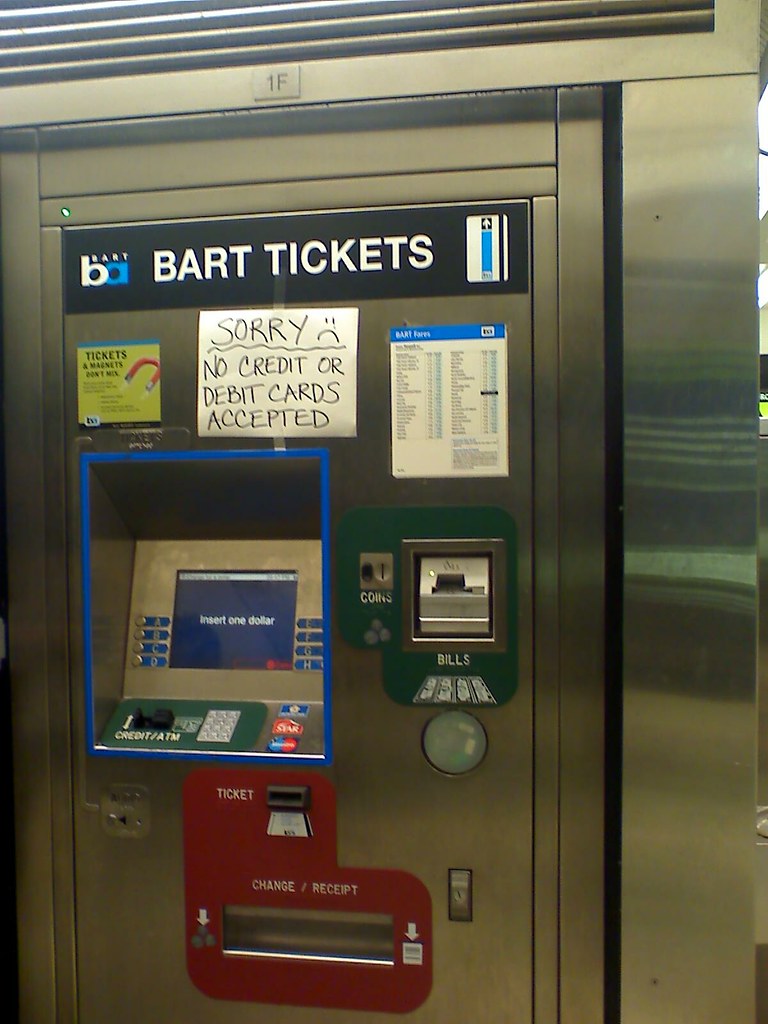
BART Ticketing Machine with Clipper card add value option

Pocket change, the worst enemy of my pockets. It’s heavy and just sits in a jar at my home all day long while it gets bigger and bigger.

Ever had one of those times where you wanted to just get rid of your pocket change, but tired of packing your own coin rolls or going to a local supermarket to use one of those change sorting machines where you pay ten cents for every dollar?

Well, here’s the easiest way to dump your change with no surcharge, it’s for paying your public transportation. No, I’m not encouraging you to dump tons of nickels into a bus farebox, that just holds up the bus and you get that awkward stare from fellow passengers. Just feed it to your Clipper card's e-cash purse.

There’s one easy way to do this, just go to any BART station’s ticketing machine. The nice part about BART ticketing machines and Clipper is you can put as little as five cents onto the card and up to 30 coins per transaction. Once you put in 30 coins, the machine locks out additional coins, and you just confirm the value and tag the card to update the balance for instant use. If you have more coins, just do the transaction again.

Some of you may be asking, can I do this at a Muni metro or Golden Gate Ferry ticketing machine? You can, but the software will first ask you what specific amount you wish to input into the machine before you are allowed to feed coins. Always select the lowest amount because the machine will lock you out at the 30th coin, but you can still feed bills into the machine to fill in the gap. Be warned, the machine will only give a maximum of $4.95 in change if you overpay, so have dollar bills handy, and not a $20.

There is one big weakness for both of these options: They won’t take pennies.  Why not add more e-cash to your Clipper card and get rid of most of your pocket change?

Wednesday, August 22, 2012

New Clipper Card Fee $3 - How to Not Pay It

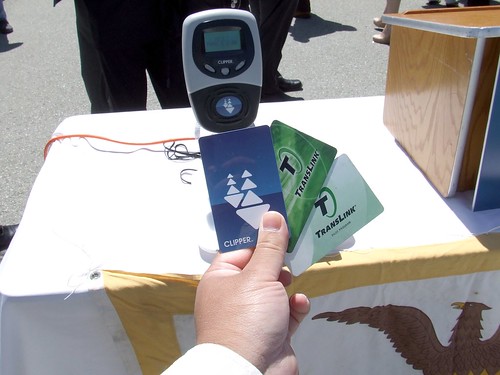
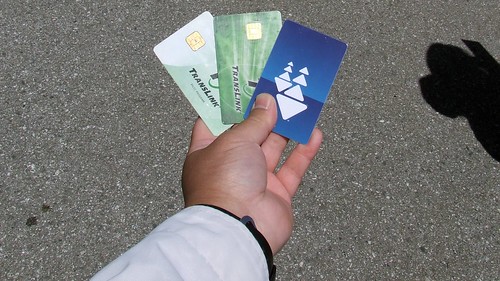
Three Generations of Transit Cards (TransLink Pilot, TransLink, and Clipper) Widescreen
Three Generations of Transit Fare Cards
The MTC has announced the Clipper card will no longer be given out for free starting September 1st.  The new card acquisition fee will be $3 in which they claim will be to cover the costs associated with the procurement of the cards.

Why an acquisition fee?
The acquisition fee has been a hotbed of controversy because the MTC originally proposed the card fee to be $5.  But after filing a required report under Title VI of the Civil Rights Act of 1964, they decided to drop it down to $3.  It was right in the middle for the agency, it didn't heavily impact people that are disadvantaged, but also didn't give out the cards for free.

The other controversy has been the cards have been treated as an item that can be thrown away.  As you may recall, some people who take longer and more costly trips on public transit have been abusing the system by taking advantage of the card's negative balance policy.  A passenger adds very little money to a card with $0 acquisition fee and riding transit that costs more than what was funded to the card; once it goes negative, the passenger just throws the card in the trash.  Because some people abuse the system this way, the MTC and public transit agencies lose a grand total of $700,000 in transit fares and card procurement costs.  One solution being implemented in the future is to force BART passengers to add funds to their Clipper card at the exitfare machines if there's not enough to cover the ride.

$3 fee to be a failure
In my own opinion, the $3 acquisition fee might be able to stop some people from abusing the negative balance policy, but the MTC is still going to lose money from those who can still take advantage of it.

Here's how simple it is.  Assuming BART is out of the picture, the most expensive transit fare is Caltrain at $12.75 one-way from zones one to six.  If Clipper also implemented a $10 minimum e-cash add on per new card, a passenger must pay $13 ($10 e-cash and $3 new card fee).  That means that while the passenger's one-way ride on Caltrain is paid in full, the passenger still has 25 cents left, therefore he/she can ride any other agency (except BART) for just 25 cents and dump the card in the trash.

UPDATE: Oops, I screwed up.  The new card fee doesn't make the e-cash total $13, it's still $10.  Therefore, if a passenger rides the $12.75 Caltrain ride, the passenger dumps their card in the trash after the first use of the card.

As I've just shown, people can still "save" money while transit agencies lose money.

How not to pay the $3 fee
The MTC is advising people to get the fee waived by ordering their card online and enrolling in the autoload program.  But as we all know too well, autoload has problems, just like the recent report of people whose money was loaded back in 2010 never got charged until just days ago.   So who wants to trust the MTC and Clipper on a piece of junk program?

Of course, the other way to avoid the fee is to get your new Clipper card now until September 1st, but how about after September 1st?

There's still a way to avoid the fee and it takes a little ingenuity.  Just obtain your card online, register a credit card under autoload, and as soon as you get your new card, CANCEL AUTOLOAD.  You see, you get a free card registered under your name (protection in case you lose your card), and you dumped autoload like dumping your date after a horrifying dinner.

Talking about dating... Akit's single!  Ladies, want to date a blogger?  :-)

Thursday, December 8, 2011

Cool Clipper Card Statistics & More

Three Generations of Transit Cards (TransLink Pilot, TransLink, and Clipper) Widescreen

The MTC's Operations Committee is meeting this Friday morning and Clipper will be a topic of discussion.

Let's get onto the lead story today, some cool stats from the folks at Clipper:
The documentation from the committee shows a comparison of usage from October 2011, September 2011 (prior month), and October 2010 (page 4 of PDF document). Some are well expected (like the increase of growth and usage), while others show a great improvement in how Clipper is operating:

As of October 2011, Clipper has surpassed the average number of weekday transactions goal of 500,000. The number of transactions has doubled in just one year.
--October 2011: 571,532
--September 2011: 555,273
--October 2010: 226,160

There are over one million active Clipper card accounts as of October 2011. This has nearly tripled in the last 12 months.
--October 2011: 1,058,312
--September 2011: 991,253
--October 201: 315,551

Interestingly, the number of registered Clipper cards has dropped dramatically. Last year, nearly 80% registered their Clipper card for benefits like balance restoration. But with the growth of the Clipper card and people making the decision to use their card anonymously, the number has dropped by nearly half.
--October and September 2011: 43% of Clipper cards in use
--October 2010: 77%

Have you ever wondered, how many people use the autoload program? The statistics show that less than 40% are enrolled in the program, even though the number of users has increased and mandatory enrollment for those who transitioned from BART's EZ Rider HVD ticket program. But while the percentage of users is very slowly growing from a year ago, the number of autoload transactions has doubled.
--October 2011: 39% of cards enrolled w/autoload, 219,568 autoload transactions for month.
--September 2011: 39%, 209,674
--October 2010: 36%, 92,018

Just how many people call customer service in a month? It's over 30,000, but there was a huge spike in September 2011 of phone calls. What's really interesting is that back in October 2010, there was three times less Clipper cards in active use, but maintained the same number of phone calls in comparison to October and September 2011.
--October 2011: 37,820 customer service representative calls
--September 2011: 42,124
--October 2010: 36,051

You may think that's a hell of a lot of phone calls, but if you crunch the numbers, it is actually getting better month by month:
--October 2011: 0.08 customer service calls per unique card used
--September 2011: 0.09
--October 2010: 0.16

In summary: Clipper continues to grow as passes and tickets switch over, but it is good to see people are not calling customer service as often for help. I'm guessing the population is getting used to using their Clipper card, knows where their nearest retailer is, and improved maintenance of the service. In a shameless move, I should also get credit for informing the public too, right?

As for other Clipper related stuff in the committee's agenda...
They are planning to approve to renew contractors for public relations firms. The public relations firms the MTC hires does the publications, promotions, tabling, educating, sign-ups, and others.

Um... can I get a contract too for blogging on Clipper? I'm low cost!

Akit's Opinions
This is just a usual meeting for Clipper. I don't think there will be much new news these days as Clipper advances towards their next goals: Transition of all Samtrans passes and BART HVD tickets to Clipper only.

Tuesday, November 1, 2011

Clipper (Cubic) Hits a New Low - Exposing E-Mail Addresses

Muni New Faregates - Civic Center Station Secondary Gates (Edited)

Ladies and gentlemen, we have a party foul. In the news today, Clipper and the MTC are apologizing for releasing the e-mail addresses of over 1,700 card users. This happened when an e-mail was sent to customers whose credit card registered with autoload was going to expire. The employee whom works for Cubic (MTC's contractor for Clipper) sent the mass e-mail to those applicable customers, but forgot to place the contacts in the BCC (blind carbon copy) address list, therefore a ton of people got it.

But that doesn't end there, people outraged about it also hit the "reply to all" button on their e-mail service to let out a rant, but to also annoy those who became victims and didn't want any part of this mess.

You can review these news sources: SFGate/Chronicle and Muni Diaries.


Akit's Opinion
Clipper is hitting new lows, and this one is another kick to the nuts.

I don't get it, why doesn't Clipper/Cubic use automatic e-mail notifications for this? Why does an employee need to dig-up the e-mails, copy and paste it (in this case, incorrectly), and send off a mass message like this? Shouldn't the website automatically know when a credit card is about to expire and automatically shoot-off an e-mail?

Automation for Clipper has been slow at times, they used to manually e-mail reports when people requested it, then was able to automate it by having users log into the website and just clicking on a couple of links to instantly view the report.

Some are saying "yeah yeah, at least it wasn't as bad as the MyBART incident." But if you are a victim getting all that junk anger mail from other Clipper card users who hit the "reply to all" button, you'd be pissed too.

Clipper really needs to clean-up their reputation. There's a lot of positive stuff that shines good on the agency, but there's a lot of things that really doesn't make a lot of sense. Other than not automating e-mails, they also haven't done the following to fix or improve:
  • Allowing all BART ticket machines to sell all e-passes and e-ridebooks for all agencies, other than just letting people load e-cash only. If you are at Daly City BART where Muni and Samtrans also stops at, wouldn't you want a place to buy your bus passes?
  • Installing Clipper add value machines at more than just a few Caltrain stations (which are not yet operational).
  • Finding other ways for people to fix autoload problems causing the card to be blocked, whether it be going to an automated machine or the in-person customer service centers to resolve it.
  • Finding decent methods to stop people from exploiting the negative balance feature.
  • Toning down Clipper's trademark beep sound. You can sometimes hear it a block away, on a noisy street!
  • Why does youth who ride AC Transit need a Clipper card with their photo so they can be eligible to buy a youth pass? All the other agencies doesn't require a photo Clipper card to obtain a youth pass. When a youth passenger loses their specialized card from AC Transit, they have a bigger hassle than those with a uniform policy of no photo.
  • BART passengers who wants to pay for their parking without obtaining a special EZrider hangtag by just tagging their card and punching in their parking stall number.
  • BART doesn't like the idea of adult passengers being able to buy HVDs at their ticketing machines or a vendor, everyone must use autoload (which many hates to use).
  • Caltrain's stupid policies on 8-rides and monthly passes on Clipper.
  • Want to add one to this list? Leave a comment!

Tuesday, October 11, 2011

October 2011 Clipper Card Updates from the MTC's Operations Committee

Three Generations of Transit Cards (TransLink Pilot, TransLink, and Clipper) Widescreen

The MTC's Operations Committee will be meeting this Friday, October 14th, and as usual, Clipper will be a well discussed topic for this de facto Clipper Board of Directors.

Here's the highlights from their agenda documents:

Last month's meeting minutes:
  • The committee has chosen the ferries to be next with the Clipper 'phase three' implementation.
  • The Clipper program's Title VI report was mentioned. While I won't get into all the dirty details on this blog entry (you can read about it here), the one thing I will mention is they will have public comment sometime during the Fall.

Updating the Transit Coordination Implementation Plan
A lot of the material is scratching out the old the name "TransLink" to its current name "Clipper."

The most useful information is the pass/ticket transition dates:
  • All AC Transit, Caltrain, and Golden Gate passes/tickets completed.
  • BART must complete transition of blue high value, red, and green tickets by December 31, 2011. BART's student orange ticket is up for debate as there is no current date of transition.
  • Muni has delayed transition of all Muni visitor passports until a usable substitute (e.g. Limited Use Ticket) can be used.
  • Samtrans will complete transition of all passes to Clipper on December 31, 2011.
  • VTA's monthly passes scheduled to transition on June 30, 2012 as long as VTA has a 'day pass accumulator' active by January 15, 2012.
Transfer changes:
  • Daly City BART's free Muni transfer scheduled to transition March 1, 2012.
  • Muni transfers scheduled to be Clipper only on June 30, 2013.

BART's Ticket Transition (More gritty info)
  • BART has closed many of their ticket retailers to prepare people for the Clipper transition at the end of the year. There are far fewer locations where the magnetic stripe tickets are sold and will be closed at the end of the year.
  • MTC and BART has done outreach and are giving away Clipper cards with $2 preloaded to encourage usage.
  • 1 out of 3 BART passengers currently pay for their rides with Clipper, and 40 percent of card users are enrolled in autoload.
  • Blue high value tickets will only be available through autoload with no intention to offer it for sale at vending machines and vendors. This causes a hardship for transit passengers that pays for tickets with commuter benefit paper vouchers; MTC claims offering it at vendors and vending machines is "cost-prohibitive and would result in slower Clipper transaction speeds at BART's fare gates." MTC is encouraging all employers to offer employees a debit card, or consider Clipper Direct which will offer HVDs starting Spring 2012.
  • $150,000 is proposed to be spent on an educational and advertisement campaign for BART's transition to Clipper.

Akit's Opinion
BART's transition is the most concerning to me.

For the Daly City station free Muni transfer going Clipper only, there's a big issue for SF State students who utilizes the free shuttle provided by SF State. If the paper transfer is eliminated, those who pays for BART with Clipper and takes the shuttle gets their free return ride on Muni's 28 line to BART voided because of the 1 hour policy to ride Muni to be eligible for the return ride back. Read more about this odd quirk.

I totally disagree with MTC's policy that all adult blue high value tickets (HVDs) on Clipper must be on autoload only. This does not meet the demands of the general public who are not comfortable with linking a credit card to their Clipper card (read why autoload is not recommended). People pay cash for their paper HVDs at retailers, so it's hard to believe that the MTC says it's "cost-prohibitive" and would slow down the BART gates if alternate methods are not going to be available. If youth and senior Clipper cardholders automatically gets the discount without the need to buy red and green tickets (with a high value), why can't us adults also get the automatic 6.25% discount we are entitled to? Or, why doesn't the station ticket machines offer adult HVDs to purchase?

Lastly, I hardly believe Muni will ever eliminate paper transfers. With no decent proof of payment enforcement, it's going to be free rides for everyone.

Monday, September 19, 2011

Update: Golden Gate Ferry Makes Changes after Akit's Report

Golden Gate Blue Gold Clipper

In a previous blog entry in July, I mentioned that Blue & Gold Fleet passengers boarding the ferry at Sausalito was paying for the wrong boat. This was due to a change in Golden Gate Ferry's policies where the trip from Sausalito to San Francisco (Ferry Building) changed from pay on board the boat (give ticket upon exit), to a prepaid system. This caused confusion as Blue & Gold's policy is to pay on the boat and surrender the ticket upon exiting. Due to all the confusion in policies, there were people paying Golden Gate, tagged their paper Clipper card upon entry, and boarded the Blue & Gold boat not realizing they'll have to pay an extra $10.50 to the cashier on the boat because they paid for the wrong one.

Just a couple of days ago, I took the Golden Gate's Sausalito ferry for a nice day trip and I noticed some drastic changes at the Sausalito dock:
  1. The Clipper card readers at the dock's gate is now locked-out unless if a Golden Gate employee tags a special Clipper card to activate the readers. This means that if a Blue & Gold passenger accidentally buys a Golden Gate ticket, at least their ticket will still have a ride stored on it for a future trip.
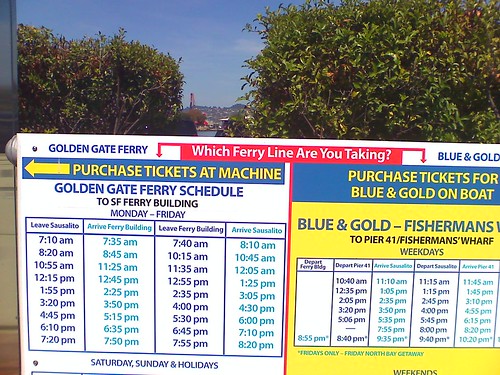
  2. The huge time table at the dock clearly tells passengers how to pay for their ferry ride back to San Francisco.
  3. Golden Gate Ferry honors the Blue & Gold Fleet's paper vouchers to those who rented a bicycle from one of the vendors around Fisherman's Wharf.
Still, they can make one improvement that's good for everyone: The automated machines at the Sausalito dock should ask passengers what ferry they plan to take to make sure people don't buy the wrong ticket. It's an improvement in the right direction, but I feel that both ferry companies can always strive to do better.

On a final note, I found out the transfer policy for Golden Gate & Muni passengers has changed. The new benefit, it allows Muni pass users to save 50 cents on their boat ride.

The old policy (which is similar to BART-Muni transfer):
  1. Using a Clipper card, you exit Golden Gate Ferry and board Muni and receive a 50 cent discount if used within 90 minutes. No credit/discount for Muni pass users.
  2. For the return trip to Golden Gate within 24 hours, tagging the same Clipper card on Muni receives a 50 cent discount on the Muni ride. No credit/discount for Muni pass users.
The new policy:
  1. Using a Clipper card, you exit Golden Gate Ferry and ride Muni to receive a 50 cent discount within 90 minutes. (same policy as #1 above). There's no credit/discount for Muni pass users.
  2. For the return trip to Golden Gate, you don't get the discount for Muni, but by taking Muni, your card gets encoded and you get a 50 cent discount on the ferry boat ride. This means no more 24-hour limit rule (especially great for commuters that doesn't ride on weekends). This even works if you have a Muni pass, you still save 50 cents on the ferry boat ride.

Thursday, September 15, 2011

Lost Your Clipper Card? How to Get a Replacement Fast

Nat Ford, CEO SFMTA (Parody 2)

One of the cool quirks of the Clipper card is if you ever lose your card, you can get a replacement card with your balance restored, as long as you meet some very basic criteria.

With paper passes and BART tickets, if you lose it, it's highly unlikely you'll ever see it again.

In order to get a replacement Clipper card with your e-cash balance, ride books, and/or passes restored, you need to have one of the following:
  1. Clipper card registered under your name.
  2. Clipper card enrolled with autoload (your name is automatically registered).
If you are not participating in autoload AND you didn't register your card (anonymous card), you can stop reading this blog entry because do not have the right to have the balance restored.

What you need to do first...
Inform Clipper about a lost or stolen card so that you get protected from any unauthorized usage of the card, and puts card readers on alert to rewrite the missing card as invalid. You can give them a call or login to your account online; the other option is to fax the form.

Fastest Method to Get a Replacement Card
If you want to get a card replaced immediately, go to the Clipper customer service center at either the Embarcadero BART station or the Bay Crossings booth at the Ferry Building. If you filed a report online or by phone, a card will be ready for you the next day. But typically, if you lost your card, just walk up to them and they should be able to do it on the spot (without first calling, going online, or faxing). UPDATE: A recent comment said that you must report it lost first; going to the counter without a lost card on file will not get a card issued immediately. Can Clipper please verify this?

Not Willing to Go to Downtown SF?
You will need to inform Clipper that you want your replacement card to be sent in the mail. It can take up to five days for a new card to be mailed. They won't reimburse you for the days you lost your balance or days you can't use your pass.

Got a Youth Card with your Picture on it?
If so, you have a card issued by AC Transit and you are eligible to purchase AC Transit youth 31 day passes; other youth cards (without the photo) can't buy the 31 day pass, but are still eligible for the youth cash fare. To get a replacement, call Clipper; the downtown service centers cannot issue new cards because they don't have the machinery to add a photo.

Replacement Fees
  • Clipper does charge a $5 replacement fee for a new card if you want the balance restored and you don't have autoload.
  • If you have autoload, the card's balance will be restored for no charge.
  • If your card has less than $5 balance, your card won't be restored because there's no point of paying a $5 replacement fee. Just get a new card at a local vendor.
Akit's Opinion
Having the option to restore your products is a good idea and at least is better than the old days when forking $50+ a month for a paper pass and losing it meant buying another. Losing a card sucks and it comes with a $5 fee, so always remember to keep your card in a secure location and don't drop it down onto the BART tracks.

On a final note...
Congratulations to CLAYCORD and the Richmond SF Blog for winning the Most Valuable Blogger awards for Local Affairs!

Friday, September 9, 2011

Countering Against the Bay Citizen's Anti Clipper Card Article


Contrary to popular belief in a Bay Citizen/NY Times Local article, there's a lot of people who are not having problems with their Clipper card on public transit.

Everyone knows that if 99%+ is having no problems, there's always that 1% or less that will have problems, and some of that group will whine and scream like uncontrollable children that poisons the huge majority experiencing no or very minor issues (e.g. self service bill feeder not functioning) and that the problems are worse than it should be.

From reading the Bay Citizen article, I feel it's one sided and only targets certain isolated incidents. In the beginning of the article, it mentions about a single BART gate that would read the card, but the gates wouldn't open for people. That's just an isolated incident because it doesn't happen anywhere else on the BART system based on my own experience, it's likely a malfunctioning gate that refuses to open.

There's other things I want to dispute about the article:
There's a mention that there was 38,000 calls to the "customer service hotline" during the month of August. Well, does that mean 38,000 calls to speaking to a customer service agent, or does that also include calls for people using the automated system to find out their card's balance? Let's also remember that there's been a huge campaign push by Muni and AC Transit to get students on Clipper cards due to a mandatory switch from paper passes to Clipper cards, and parents wants to call to find out how do to it; students during August went back to school and the need to get their specialized Clipper card to get to school. When Caltrain switched to Clipper only, they had a high number of calls to customer service, but that has died down as people understood how it worked and investment in a PR campaign at Caltrain stations, even though the use of monthly passes and 8-rides is stirred with complexity.

500K transactions daily: Author points out it is not 500K passengers. No shit, Sherlock. "Transactions" means how many Clipper cards was scanned in one day. If you asked Clipper how many passes was sold, they'd be able to give you a rough number of regular passengers using transit on a normal weekday (not including e-cash passengers). If you know that around 35% of BART passengers uses Clipper, do some math: Ask BART how many passengers on a weekday, and use a calculator. Also, since nearly all Golden Gate passengers uses Clipper due to the automatic discount for all card users, that wouldn't be so bad to find the round figure.

Caltrain is mentioned about when there's an incident holding up passengers on the trains, but noting that passengers have four hours and can't tag-off in time is just isolated incidents that can be resolved by just asking for a proper credit from Clipper. Clipper had to set a four hour limit from the tag-in at a Caltrain reader, which is FAIR for a passenger to complete a one way journey.

There's a mention about Muni's alleged electrical irregularities causing Clipper readers to crash. The author says it happens "regularly," but I don't see it that often happening, and especially that Clipper readers also have a backup battery for power problems or bus engine shut downs. I live near a major bus line terminus where drivers are required to shut down their gas engine, but the Clipper readers run normally without depending on the engine. Muni had common problems in the past with the historic streetcar fleet as the electricity was sometimes inadequate (ever seen the lightbulbs flash when crossing a wire junction?), but was able to resolve it with a software update. It's very RARE for the readers to fail for that particular reason. Muni rules state if a reader is broken, operators are required to report it immediately and rides are free (equivalent to a broken cash fare box).

Is there any proof that Clipper cards are to blame for the drop in on-time service for Muni? A different cause could be a change in ridership due to the rising gas prices and with the economy tanking, and students returning to school. It could also be the upset Muni operator's union who had their ass kicked by Proposition G by pissing off the public by unofficially slowing the system down.

Lastly, some passenger accuses Clipper for losing $80 for a card that "failed to work." Okay, so, what's the full story on that and why is it failing? Just saying you can't resolve the lost $80 doesn't mean there's something Clipper is always to blame.

I will mention one thing that most would agree upon:
If you have the option to not use Clipper's Autoload program, DON'T USE THE PROGRAM. The biggest complaints I hear is their credit card is rejected and blocked; sometimes on a weekly basis. I don't know what to say is the cause of all the rejections, but the easiest way to avoid this is to not link your credit card to your Clipper account. Just spend five to ten minutes every week or two and load Clipper e-cash or buy your passes at an in-person vendor, self service machine, or a transit agency's ticket sales booth. I never had my Clipper card blocked because I don't use Autoload; I remind myself on a monthly basis to visit a Walgreens or drop by a metro station to buy my monthly Muni pass. Read more about why I don't recommend Autoload.

Finally...
On a final note, why isn't Clipper or the MTC doing some better PR? They rarely put out press releases or talk to the public while other agencies like SFMTA/Muni has full-time staff dedicated to giving information to the general public and the press.

I enjoy blogging about Clipper as a hobby to the point where people trust me for info and advice more than Clipper itself. The Bay Citizen should have interviewed me for a perspective, but my bets are the author wanted to make it an anti Clipper article and not take the opinions and views of someone who knows the program better and writes more about it than any blog or newspaper in the Bay Area.

Wednesday, September 7, 2011

Answer to Why Clipper Cards are Still Free (No $5 Acquisition Fee)


Ever since Clipper started in mid June 2010, the cards have been distributed for free to the public to use. Over the past year, Clipper had to change the rules as local news media told the public how to abuse Clipper's negative balance policy (read my reaction to it) with just a brand new card with $2 on it. Clipper decided to raise the minimum new card balance requirement to $5, but never pursued a $5 card acquisition fee.

It wasn't until the new Muni gates came in and I learned that the card acquisition fee would be waived until June 30, 2011. This meant the end of free cards. Now that it is September, the MTC, nor Clipper has taken any action to tacking on the $5 fee, and now I found out why.

If you don't want to read all the material, go to the "Quick Summary" section near the bottom of this blog post.

The Title VI Draft Document
The MTC published their findings as they are required to do so under Title VI of the Civil Rights Act of 1964 to make sure they are not discriminating against people protected under it while the Clipper card program is in use and transitioning passes and tickets to the blue card. If you don't know what could happen if Title VI is not done, just look at BART's AirBART people mover project, they lost millions in federal dollars by not doing an analysis and now will have to absorb that cost themselves.

While this is only a draft to be reviewed by the Operations Committee this Friday, it does give insight into why the $5 fee has continued to be waived after their established deadline of June 30, 2011. Read the document here (PDF file).

A little history...
Back in 2006, TransLink (this was prior to Clipper) was in full operation on AC Transit and Golden Gate Transit & Ferry. The new dark green card had an acquisition fee of $5 for any passenger interested in a card. The fee was used to offset the cost of acquiring the card from the manufacturer and defeated the purpose of abusing the card's negative balance policy of $5. The card was issued for free to those signing-up for autoload or had it connected to a pre-tax commuter benefit program (since the card was linked to someone's name, they knew who owed a debt to TransLink). They also set aside a quarter of a million cards for transit agencies to give out as free promotional items.

In April 2010 (just two months prior to changing name to Clipper), the MTC and members of the TransLink consortium agreed to a three month free period for people to obtain cards (no $5 acquisition fee), and also agreed to waive the fee permanently for all seniors and youth transit passengers.

In August 2010 (a month after changing to Clipper), the MTC agreed upon giving out Clipper cards with no $5 acquisition fee until the end of the fiscal year (June 30, 2011) to promote people to switch, and especially their plans to have all transit passes go Clipper only would cause possible hardship to passengers not willing to fork $5 for a card.

Today...
Sometime in June or July 2011, the MTC was going to reinstate the fee, but had to hold back because of Title VI. The MTC feels that reinstating the $5 acquisition fee "could present a barrier to acquiring Clipper cards for persons protected by Title VI, and the reviews recommend eliminating the fee permanently." (Page 16 0f 30 of the draft document).

The MTC argues the $5 fee is necessary to address these six objectives for the program (directly quoted from the document, page 16 of 30):
  1. Cover the cost of the cards;
  2. Discourage fraudulent abuse of the negative balance feature;
  3. Discourage the casual disposing or loss of cards;
  4. Discourage hoarding of cards;
  5. Minimize potential barriers to adoption of Clipper; and
  6. Continue to support/encourage customer adoption of the Clipper card.
But they also had to take these two points into consideration as well in deliberating of reinstating the $5 fee:
  1. Since the Clipper card is reusable and will last at least three years with good care, a regular transit rider would use it enough times to justify most of its cost (compare a transit agency's cost of purchasing from a company that produces its monthly passes vs. how much it costs for the MTC to obtain a card that costs more than one paper pass, but can last years).
  2. For business reasons, having the card fee would help people to retain their cards, offset the cost of procuring them, and stops the abuse of the negative balance feature.
The MTC also noted that the Clipper program has some substantial benefits in the interest of the public that a $5 would just be a barrier to deny people. Some of them include automatic e-transfers, riding multiple agencies with one card, universal cash fund, multiple passes, etc.

Waiving the $5 fee did come with some harsh realities...
1: Hoarding the cards was a problem because the cards was initially free with no minimum purchase required to obtain one. Managers at Walgreens locations said people asking for free cards with no initial value loaded was taking away their staff's time. The MTC instated a $2 minimum e-cash load for every new card obtained by the customer. Hoarding also became a problem with abusing the negative balance feature, as noted below.

2: Abusing the negative balance feature came at a heavy cost when the news media told people now to abuse the negative balance feature at the expense of taxpayers. People could obtain a new card with just $2 of e-cash and ride any transit agency that cost more than the value on the card's chip and just throw it away. The MTC debated on what to do, including eliminating the negative balance policy, but instead decided to raise the e-cash minimum to $5. Deciding to raise it to $5 was a good idea as the abuse started to go down.

The MTC's plan...
The proposal is to change the acquisition fee to $3 ($2 less than originally proposed) and a $2 minimum load requirement ($3 less than what is current). This means a minimum of $5 will need to be handed over by the customer to obtain a card and get a starting e-cash balance.

The commission believes this is an appropriate adjustment that's right in the middle: The card's not free, nor will it have a big impact to those covered under Title VI. The MTC wants to make people change their minds about Clipper by not making the cards something easily disposable, but make it worth of some kind of value (the $3 acquisition fee). Clipper has already given away 1.1 million cards for free, by treating it as a throw away product, it's not sustainable and costly to taxpayers. The new fee and minimum balance would support the operational needs.

In order to comply with Title VI, the MTC will have to go out into the communities and conduct research to see if the $3 fee is feasible. After compiling the feedback, the MTC will make the final call on the fee.

Quick Summary
For those of you not wanting to read all the details, here's just a quick one you can read:
  1. The $5 acquisition fee for Clipper has been waived for a long time.
  2. MTC wants to activate the fee because of people abusing the Clipper cards (e.g. negative balance benefit).
  3. The $5 fee and an existing $5 minimum e-cash balance (total of $10) may be a negative impact on certain people covered under federal law.
  4. Continuing to give it for free will be very costly to taxpayers.
  5. MTC takes the middle ground, wants to charge $3 for new card, plus a $2 minimum e-cash purchase (total of $5). Helps to cover the cost of procuring the cards and any other operational costs.
  6. MTC can't take action until they do community outreach.

Akit's Opinion
I'm no fan of giving out plastic Clipper cards for free. The negative balance policy and abusing it is the worst problem of all as that encourages people to buy multiple cards with the minimum value and forces us taxpayers to pay more. Plus, issuing over a million cards when a portion gets thrown away after one use is not very sustainable.

Sure, I understand that Title VI is important and charging a high fee to obtain a card would not be feasible. I initially suggested the acquisition fee should be the highest one-way transit fare for whichever agency is participating in the program, but Title VI would kick that straight in the ass.

The mentality of people needs to change by making people value their cards and should keep them. Even at SF State, students, faculty, and staff value their campus ID because the fee is $22 to obtain a replacement, and the card is used in so many ways, from borrowing library books to accessing the campus swimming pool. Clipper can't charge a high fee for obtaining the cards, so they are going with something in the middle, $3 card fee and $2 minimum e-cash load.

The $3 card acquisition fee will cover the procurement of the cards valued at $2.22 a card, but will only cover 78 cents of $1.31 for the distribution of them (as per MTC documents, page 17 of 30). This means by taking the middle ground, they will recover most of the cost of the card, but a small amount will be paid by us taxpayers. Even then, the little remaining cost can be written off if a passenger uses it for the multi-year life expectancy of the card when compared to cost a transit agency must pay to procure and distribute monthly passes and paper transfers in a same time period.

Even then, I still believe people will continue to abuse the negative balance policy because they'll feel that while there is a $3 acquisition fee and just $2 in e-cash, as long as the passenger takes a one-way trip that costs more than $5, the card is just another one in the trash.

If the MTC wants to take true action, yes, enforce the $3 acquisition fee with a minimum balance to meet Title VI, but only allow people who register their card with Clipper to be allowed to have the negative balance. This keeps track of who abuses their card privileges and makes people become responsible for paying that negative balance, or if it gets too high with multiple cards, the MTC can act like FasTrak abusers, making them go through collections. For BART, it's easy to stop the negative balance policy by modifying their exitfare machines to force those passengers to pay-up the difference before being allowed to exit the system.

Tuesday, September 6, 2011

Big Fact: Clipper Loses Nearly $700,000 a Year Because of Negative Balance Feature

Muni New Faregates - Civic Center Station Secondary Gates

$700,000, what can you do with that kind of money? Who is responsible for this huge money waste? You can blame the MTC for the idea, but also members of the general public who enjoys "saving money" at the expense of honest taxpayers who doesn't cheat Clipper.

Here's the whole situation: Clipper cards have a negative balance policy where passengers can allow their card funds to go into the red, but the card won't be usable until the funds are replenished. This was to benefit passengers taking long distances but accidentally ran short in their e-cash purse. This got exploited by people when they realized that they could buy a Clipper card with a very minimal value of e-cash and use the card just once for a ride valued at more than the e-cash balance, and just throw the card away.

This problem went into high gear when news media outlets started telling people how to cheat Clipper. My argument on a previous entry on my blog is the media has the right to free speech and press, but should have suppressed it on moral grounds noting that doing so will cost every taxpayer more money to cover the abuse. Only one news station at least said live on air that the people at the station had a debate if it should be aired or not on moral grounds, but tagged along with other news agencies to spread the word.

The MTC had to do something to stop the widespread abuse costing them a lot of money, and they decided to raise the minimum e-cash value from $2 to $5 for new cards. That did reduce the abuse, but still, abuse is rampant as seen below...

How did I find out? Here's what you need to know:
In a recent draft report for the Operations Committee, it states:
"...approximately 8,000 additional cards with new negative balances each month, and the aggregate negative balance amount increases at a rate of roughly $30,000 per month." (Page 18 of 30, paragraph two of the draft report).

Note: This calculation was provided AFTER the minimum e-cash was raised to $5.
If you like cracking numbers...
  1. $3.75 average negative balance per card.
  2. $360,000 of transit fares a year due to exploiting Clipper.
  3. 96,000 cards per year in the trash.
  4. $3.53 per card's procurement and distribution costs.
  5. $338,880 worth of cards thrown in the garbage (procurement/distribution cost multiplied by 96,000 cards)
GRAND TOTAL: $698,880 of taxpayer money wasted per year due to cheaters.
Or basically $700K.

Now that I've crunched the numbers, will the MTC and Clipper finally find a solution to stop the negative balance policy? There's plenty of ways to stop the abuse:
  1. For BART, exitfare machines are modified to force Clipper users to pay the difference before being allowed to exit.
  2. For Golden Gate Ferry, no boarding the ferry unless there's an equal or higher amount balance on card. Anyway, there's add value machines just feet away from the ferry terminal gates at all three locations.
  3. All card users who wants to use the benefit must register their card with Clipper.
  4. Reduce the negative balance to $5.
  5. Restrict a card going to the red once or twice in a month. People should learn a lesson.
  6. Add a card acquisition fee. No more free handouts of cards.
  7. Or just no negative balance allowed. This might complicate things for tag-on and tag-off agencies like BART, Caltrain, and Golden Gate Transit, but they'll find a solution.

Akit's Opinions
In my opinion, people who abuse and exploit Clipper's negative balance policy are scumbags; actually, worse than scum, to a level that I'm not going to describe. This feature was for the common good for everyone, and now is costing us taxpayers nearly $700,000 a year.

That $700K could help Clipper do a lot, from purchasing new machines for the public to use, paying a contractor to add additional features to BART ticketing machines, getting the smaller transit agencies up and running, or having Clipper representatives at major transit hubs and stations for a year.

Coming up tomorrow at Akit's Complaint Department: Why didn't Clipper enforce a $5 card acquisition fee starting on July 1, 2011?

Saturday, September 3, 2011

Clipper to Expand to Smaller Agencies & 500K Transactions in One Day


The MTC's Operations Committee will be meeting on Friday, September 9th and will be talking about the Clipper card program. They didn't have a meeting in early August, therefore I'll be covering a lot of info provided in the publicly available documents posted on their website.

Based on their July 8th meeting minutes, here's some key points:
  1. Members of the MTC did a field trip to tour Clipper related facilities, including the new customer service locations, the Golden Gate Ferry's self-service machines, and a Muni yard where vehicles can get their updates.
  2. TransLink became Clipper in June 2010 and the program processed 2 million transactions a month. This has ballooned to 12.5 million transactions a month after just a year.
  3. Clipper intends to retrofit existing ticketing machines to also issue new Clipper cards. While the minutes didn't mention what agency that would be, it's likely going to be BART.
  4. Clipper wants to expand to the smaller agencies of the Bay Area, which are not part of the Clipper consortium at this time.
In item three to be discussed at the meeting, here's the highlights:
  1. On August 18th, Clipper hit an all time high with 502,000 transactions in just one day. But the average covering late July to late August was only 488,000 per day. In a recent video, the MTC admits their estimates was to reach 500K transactions sometime after Labor Day, not two weeks earlier.
  2. Muni has completed their mandatory transition of youth passes to Clipper only. For August, 7,345 was sold.
  3. Cable Car conductors now have the ability to deduct e-cash payment for rides, and update transactions when passengers purchases their Clipper media online, phone, or participates in autoload.
In item five of the meeting, here's highlights:
  1. The MTC was forced to do a Title VI assessment to see if the use of Clipper and pass transitions is negatively impacting minorities and the less fortunate.
  2. To make sure they are not discriminating, they have done some big projects, such as added multilingual services to customer phone centers, outreach by tabling, pamphlets in Chinese and Spanish, reviewed the authorized vendors and expanded as necessary to provide additional coverage, and continuing to waive the $5 card fee.
  3. It's a long multi page analysis I won't cover too much in detail, but it shows the deficiencies of the program and what MTC and Clipper will do to mitigate it.

Big news: Clipper wants to expand to the smaller transit agencies (Phase III)
In item three of the agenda, the report shows their plans to expand Clipper. Interestingly, all these smaller transit agencies combined only accounts for just 5% of the entire Bay Area's public transit usage.

Clipper is using the lessons they learned from the past several years of expanding the program to the big transit agencies as there was some huge problems back then: Significant increased cost, unique transfer policies for each agency, the transfer of "legacy" passes and tickets (this means, the rules of the paper passes is the same as Clipper), and other huge complications.

The goal of making the smaller agencies participate is to simplify the program. They will do it in these phases:
  1. The transit agencies will be divided into sectors, each covering the area they operate. There will be one just for the ferries, 101 corridor, East Bay, and Napa/Solano counties. It's like consolidation, but the transit agencies won't become one agency. By making it into sectors, when installation happens, the equipment will be installed at the same time for the whole sector, not just one agency, and a year later, another one.
  2. Clipper wants to standardize the fare structure, thereby making fares simple (local and express), the end of zones, simplified transfer policies, monthly passes (no more day and weekly passes) and many other ideas. The goal is to make it simple enough to understand how it works, reduce the operating costs of Clipper, and reduce the number of phone calls of confused patrons to Clipper customer service. Caltrain's rules are so complicated because they allowed "legacy" passes and 8-rides to work on Clipper, when a simpler structure such as an automatic 15% discount would have worked better.
  3. The MTC rated each sector to see how efficiently they can install the equipment and get it running. One problem they have is they don't have enough equipment to install on all the buses, thereby they will need to order new ones. They also looked at cost as doing such a project can be high. WETA (the folks who runs most of the ferries) agreed to pay for the project to get the ferry boats to accept Clipper, and they are recommended to be the first to get installation. As for the remaining three sectors, the MTC has a tough choice to decide what sector will go next. Some of the agencies have fareboxes that can accept RFID cards, thereby just a hardware and software upgrade reduces costs instead of ordering new Clipper equipment. Certain sectors are picked based on how often transit is used.
  4. It is highly likely the MTC will approve the ferry services to get Clipper first. If they don't install the equipment by January 2012, it will have a negative impact on the new Oakland/South SF service. Ferries will be the easiest to install because the equipment is installed at terminals, which means around two card readers per terminal.

Akit's Opinion
Reaching a goal of 500K is outstanding, but a lot of the credit goes to the mandatory transition from paper passes to Clipper only in just the past twelve months. Muni has been a big player in this as they have the highest number of transactions per day, and the integration of all passes (except Lifeline) is likely the largest contributor.

The Title VI report is huge, but when reading it, you'll understand why there's a lot of improvements needed by the folks at Clipper to assure that everyone gets fair access to the program, no matter your income, ethnicity, and language barriers.

Lastly, the expansion to the smaller agencies is going to be the final part to completing the Clipper network. They know, they don't want to screw-up like they did when the major agencies joined the consortium, that's why there's the idea of expanding by sectors, and using a better assessment of what they have available to make the transition easier.

One big criticism will be if the transit agencies will cooperate with changing their fare structures, passes, transfer agreements, and others. Although all the small agencies combined makes just 5% of all public transit usage in the Bay Area, transferring all the "legacy" fare products, passes, and transfer agreements will make Clipper even more complicated. By going with a streamlined and standard policies for all the small agencies, it will make it much easier to run Clipper at a lower cost, and better for the passengers. But simplifying could hurt the transit agencies financially, especially if they operate by a zone system, have complicated pass rules, and transfer policies with fellow agencies.

Clipper has thousands of fare structures, thousands of pass rules, and thousands of transfer policies, to which makes the transferring of all those legacy media to Clipper a huge laughing joke. Standardizing is the first step to making Clipper more customer friendly, and possibly a future unlimited use monthly pass valid on all Bay Area agencies.

Think about this, how many of you ride Caltrain and hate the fact that the old paper pass and 8-ride rules still apply to Clipper? Why just 8-rides instead of making it ten? Why tag-on and off? Why not just have a streamlined fare and pass structure? If you use AC Transit, why a 31-day pass when Muni and Samtrans uses a monthly pass? Complicated rules = complications with Clipper and headaches for passengers.

Clipper has learned their lesson and wants to make the system more simple for everyone to use. But they are only targeting the transit agencies remaining to participate. Why not also target the big transit agencies in the Bay Area to help simplify?

Friday, August 19, 2011

What Now Clipper Card?


The Clipper card has grown a lot in just a matter of a year, especially with the absorbing of most paper passes to be on electronic form only. There's little changes here and there these days, but we haven't seen anything huge or at least I don't see any new progress as of late.

My concern is, how long until we get the smaller and private agencies to join the consortium? We currently have all the major transit agencies in the Bay Area using the universal card, why can't the card grow?

Ever since the birth of TransLink, Muni, BART, Golden Gate, AC Transit, VTA, and Caltrain was the first agencies to start the pilot program with very limited usage. It was over a decade until in 2010 and 2011 where SamTrans joined the group when the name was changed to the Clipper card.

But even then, where's the new growth? If we are to be truly a one card system, wouldn't it be fair that we include everyone, even the smallest agencies? When will Clipper expand to non public transportation realms such as paying for parking meters, city parking garages, and maybe your next snack at your local convenience store?

There is so much potential for the Clipper card to become even more helpful for our daily lives. Heck, the Japanese are kicking our asses because you can even order ramen out of a vending machine with the touch of your transit fare card.

I'm somewhat confident the folks at the MTC can push through and make it easier for citizens in the Bay Area to take public transit, but it seems Clipper's reputation is somewhat scarred. I still notice those who just thinks it sucks, and there's so much confusion and oddball policies (such as Caltrain's) that things won't get easier until people take action to make changes.

What will it take to clean-up Clipper? What will it take to expand the system? And what will it take to eliminate stupid policies that is either pointless (e.g. selling Muni ridebooks with no discount) or so complicated you'll want to pull your hair out (like Caltrain's idiotic monthly pass policy)?

I challenge the MTC to use their brains and push things along. If you want input from the people, ask the people what they want and give recognition to suggestions and changes on what is fair and good for the public. Convince transit agencies that change is a good thing:
  • Tell Caltrain to end the stupid 8-rides and go with an across the board 15% discount
  • Tell Muni to stop selling tokens on Clipper cards because it costs the same to ride if paid with e-cash.
  • Tell BART to start selling high value discount tickets for Clipper cards at all station ticket vending machines.
  • Make Caltrain stations have Clipper add value machines.
  • Offer people an 'all Bay Area' pass with unlimited access to all Bay Area transit agencies for one flat price, or offer a choice package where people can choose the agencies they need and the more they pick, the better the savings.
  • Offer e-cash paying passengers the opportunity to 'earn' a transit day pass after reaching a certain goal within 24-hours.
  • End the stupid $2 monthly fee to those who automatically loads their e-cash and/or passes via Commuter Check and similar employer programs.
  • Give people a decent incentive to use Clipper. New York gives a bonus to passengers who adds a certain amount to their MetroCard.
How long until MTC takes these ideas and runs with it? They do know they can withhold funds to agencies for not meeting goals (like when they threatened BART), so why not use it as leverage to make changes on behalf of the customers?

--------------------

Sorry for rambling on, I just needed to vent today.