"Akit is the man. He knows Clipper." (spenta)
"It’s a fantastic blog for any San Franciscan."
(Kevin)
"Your blog is always on point, and well researched!" (Nina Decker)
"Everyone's favorite volunteer public policy consultant..." (Eve Batey, SF Appeal)
"You are doing a great job keeping on top of Translink stuff. Keep up the good work!"
(Greg Dewar, N Judah Chronicles)
"...I don't even bother subscribing anywhere else for my local public transportation info. You have it all..."
(Empowered Follower)
"If anyone at City Hall wants to make public transit better for all San Franciscans, it would be wise to follow Akit religiously...
or, better yet, give him a job."
(Brock Keeling, SFist)
Showing posts with label BART. Show all posts

Monday, September 15, 2014

Clipper Card on iPhone's Apple Pay Service - Could it Really Happen?


Greetings readers, it's been a while since I've blogged.  I'm still happy and well, but I've been sticking to my public social media accounts on Twitter and Instagram more often.  I thought I'd write a blog entry today because of what's been happening in the news for the past week.

The announcement of the next generation of iPhones, in particular Apple Pay, is really attracting a lot of news these days as the next cool way for people to pay for stuff at their favorite big retailers without pulling out their plastic credit card.  And while the Android platform has been using their NFC chips for a good while to be able to pay with credit cards and read NFC tags, with Apple playing along, that puts a huge chunk of the smartphone market able to now use NFC technology.

But what really intrigues me about the big evolution of NFC to be capable on Apple devices is the opportunity for public transportation to play a role in being a part of it.  Simply put, will the Clipper Card be an option for Apple Pay and Android?

Here's the pros if the Clipper Card was available as an option for people to scan their phone to a Clipper Card reader:
  1. No more carrying a plastic Clipper Card in your wallet.  Just put your phone to the reader to handle your fare/pass transaction.
  2. Be able to instantly view your card's balance, transfers with the time it expires, and your passes.
  3. Be able to instantly view your ride history, and have instant proof of payment on hand for fare inspectors.
  4. Using the Clipper Card app, be able to add card value or buy passes using a linked credit card with instant available use, without the horrible five day waiting period currently in use for people who buy online for their plastic card.  Read about the five day rule here.
  5. Also, using the Clipper Card app, people can also purchase day passes like for Muni.  Muni does sell the passports for Clipper, but people still prefer the scratch-off ones or buying it from the Cable Car conductor.
  6. Also, there could be an option for people to not use a Clipper Card, and instead use a registered credit/debit card to make their one-time transit fare payment.  It might be a cool perk for those with pre-tax commuter benefit debit cards to simply tap their phone and just deduct the balance from the card; no more need to load the money to a Clipper card, just touch and pay.
But there are some cons:
  1. It may not be possible to have Clipper do this.  The Clipper Card system itself was one of the first smartcard systems ever in the United States, and as of today, the system is outdated when compared to other agencies using smartcards.  When Clipper first started, it started as the TransLink card program which the MTC awarded a contract to ERG, a leader in smartcard technology for transit systems.  But many years later, Cubic, a titan in the transit technology market, bought out ERG and took over its contracts, including TransLink/Clipper.  The folks at Cubic had an uphill battle to get their products to properly function with the thousands of ERG cards and technology in use, such as the BART and Muni fare gates (Cubic products).  Cubic had to take the right route, they couldn't remove the ERG products already wired and installed and start from scratch (that would cost a ton of money), so they made a hybrid system so both ERG products and Cubic products work together.  Since the Clipper system is outdated, it may not be able to take mobile phone payments. 
  2. If the above is true, we may have to wait until 2019-2020 for the next generation of Clipper Card technology to have the features.  The expected end of life for the currently installed technology is to end roughly around 2019 and that's when the contract with Cubic is to expire.  The Metropolitan Transportation Commission intends to put in the next generation of Clipper by starting from absolute scratch, instead of preserving the old infrastructure.  A simple way of thinking is, the MTC may be able to save money by delaying smart phone implementation until the 2nd generation system is functional.  Click here to read about the second generation of Clipper plans.

Akit's Opinions:
In my opinion, I wish the Clipper Card was available as a smartphone function to just tap the phone to a card reader to ride public transit, or even just allowing people to use a linked credit card to just tap and pay for their rides would be wonderful.  Also, with the ability to order passes or load more cash value from your phone means your virtual card on your phone will have instant available use of your pass or funds, without the terrifying five day waiting period or running to your Walgreens or train station to load-up.

But looking at all of the cons, this may be something the MTC may not want to pursue, especially if the Clipper Card program is to be in a coffin by 2019 and a new program will be functional by then.  The technology being used today is outdated but functions as expected.

If there has to be a compromise, here's my recommendation:
I feel this may be an opportunity for Clipper to work with Apple and Google to allow Clipper card users to get an app that utilizes a plastic Clipper card and an NFC capable phone to let people scan their card to read their ride history and review their balances on their card (currently, the FareBot 3rd party app for Android can do this).  This may also be an opportunity for people to order their passes, add cash value, etc. on their phone, and tag their card to their phone to update the card's data with the new information so people can instantly use the card with the new information.

What's your thoughts on this?  Leave a comment.

Thursday, July 3, 2014

New Change to BART to Muni Transfer Policy using Clipper Cards

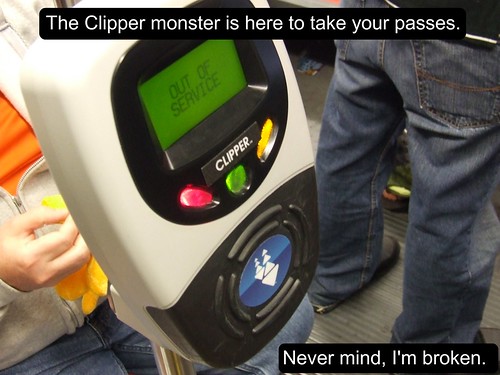
Clipper Monster Reader FAIL

If you use your Clipper card to transfer from a San Francisco BART station to a Muni vehicle or metro, there's a change in policy regarding the transfer rule.

The old rule:
When exiting BART from any station between Embarcadero and Balboa Park, you have one hour to transfer to Muni.  When tagging the same card you exited with BART and use it on Muni, you get a 25 cent discount on your Muni ride.  When you are ready to take your next ride on Muni (after the Muni 90 minute transfer expires and its less than 24 hours from the time you exited BART), your next Muni fare transaction is 25 cents off.  This is the exact policy just like when BART stations issued paper discount transfers which gave the same benefit.

The new rule:
When exiting BART from any station between Embarcadero and Balboa Park, you have one hour to transfer to Muni.  When tagging the same card you exited with BART and use it on Muni, you get a 50 cent discount.  There is no discount for a second ride.

Note: This policy is not valid if you have a Muni monthly pass.  It must pay in Clipper e-cash funds.  As always, if you have a Muni monthly pass on your card, Clipper always seeks the best deal, instead of yanking $1.50 out of your pool of funds.

Also, this policy is not in use at the Daly City BART station.  Passengers still get a free ride on any Muni line that serves Daly City BART.

How did I notice the change?
When I go to baseball games at AT&T Park, I have to take BART and Muni metro to and from the park.  I noticed when I tagged my card on the Clipper card reader to get back after the game, I had to pay full fare.  When I got home, I reviewed my Clipper card records online and found out that there was that change in transfer policy.

Akit's Opinions:
It's a simple change that makes it more simplified for Clipper card users.  Instead of wondering if the return ride 25 cent discount works, you just get the full 50 cents off in the first Muni ride away from BART.  I like it.

Reference to policy: https://www.clippercard.com/ClipperWeb/muni/fares.do

Tuesday, October 1, 2013

No More Negative Clipper Card Balance to Exit BART - Starting October 5th


If you recall from a few years back, the Clipper card allowed BART passengers to enter the system with a minimum value on their card and exit the system with a negative balance.  If the card was unregistered, the card can be easily thrown in the trash and the taxpayer takes the brunt for the lost money.  Thanks to some news reporters exposing this problem, it exploded to the point where tens of thousands of dollars was being lost per month because people could cheat the system.  I tried to help mitigate the problem by encouraging people not to cheat the system.

Back in September 2011, the MTC estimated the loss due to people dumping their Clipper cards with negative balances was $360,000 in lost fare revenue, and when combined with the cost to procure the Clipper cards, the grand total was $700,000 a year.  It wasn't until June 2012 that the MTC had the guts to get the paperwork signed-off to get that loophole closed for the BART system.

The New Official Policy:
Over a year after the MTC approved the funding, BART made an announcement yesterday (September 30th) on their websiteIt basically says that starting October 5, 2013, passengers will not be able to exit the system with a negative balance on their Clipper card.  Passengers with a card balance not enough to exit the system, will need to use an exitfare machine to add funds in order to be able to exit the system.

But there's a few catches with using the exitfare machines:
(1) You can only pay in cash to add additional funding to your card.  No credit or debit cards.
(2) It will only top-off to the amount necessary to exit the system.  That means once you paid the amount to the machine and exit BART, your card balance will be zero.
(3) The maximum amount of change the machine will return is $4.95.  Only have a $20 and you owe BART a dollar?  You just got screwed.

Two easy tips to avoiding the exitfare machines:
(1) If you have autoload (in which I personally do not recommend), you don't have to worry about using an exitfare machine because your card will automatically reload funds at a set tolerance limit.
(2) If you do not use autoload, keep an eye on your Clipper Card balance and make sure you add additional funds as necessary at any BART ticketing machine.

Thursday, July 4, 2013

BREAKING: BART Strike is OVER, Service Resumes Friday 3PM

Great news: The BART strike is OVER!

BART workers are back on the job, but trains won't be able to operate until 3PM on Friday as it takes about 18 hours to get everything back in operation.

I can't embed the video clip from the state mediator, so you can review it here: http://instagram.com/p/bX4Y5rP7wI/#

and here: http://instagram.com/p/bX52IFP7x9/#

I'm happy, but I know that people may swear BART off and take alternative ways for the rest of their life.

I also just forgot to mention, while watching KTVU, it mentioned BART management spent $400,000 on a labor negotiator.  Where did they get this kind of cash to do this?

Tuesday, July 2, 2013

BART Strike Day Three - Ferry Fare Discounts & Tips for Stress Relief

While I am typing this blog entry, day three of the BART strike is highly likely.

Assuming if both sides can hash out a deal very soon, BART won't be able to run at full force for at least a full 24 hours, which means whatever day they restart service, only some trains are going to run.

So while most of you have been hassling through alternatives like AC Transit, ferry boats, and casual carpool, I feel the need to provide just a few tips to get you some relief:

Discounts for Oakland, Alameda, and Harbor Bay Ferries
If you are paying cash for the ferry boats listed above, you are paying more than you should.  Instead, pay with a Clipper card and pay discount prices.  Here's what you will pay:

Oakland/Alameda: $4.75 paid with Clipper.  You'll pay $6.25 with cash.
Harbor Bay: $5 paid with Clipper.  You'll pay $6.50 with cash.

Also, if by using your Clipper card, you'll also get a 50 cent discount to take Muni.  Simply use the same Clipper card and you'll pay $1.50 for the Muni ride.  When you take your return trip on Muni back to the Ferry Building, you'll also save 50 cents.

Discount for Larkspur Ferry
Similar to the discount with the above ferry services, if you take the Larkspur ferry, you'll also get a discount.  You'll pay $6.25 on Clipper, versus paying $9.50 in cash.

You also receive a 50 cent discount for Muni as well.  Take Muni away from the Ferry Building with the same Clipper card and pay $1.50.  When you return on Muni, you pay full fare ($2), but you'll get a 50 cent fare discount (on top of the $6.25 discount fare) upon entry to the Golden Gate Ferry system.

Stress Relief from Commute Hell
I got some positive Twitter reactions from these suggestions.  Why not try them out?

Talk like a pirate, dress like a pirate, and be a pirate on the ferries!


Sing some simple classic songs to ease that anger!  Hopefully others can sing along too!

Monday, July 1, 2013

Dear BART Management and its Unions...

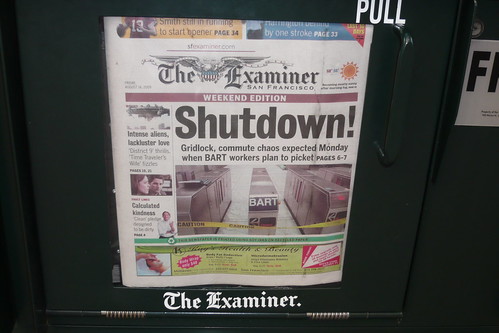
This is the front page from four years ago.

Dear BART Management and its Unions:

You all suck.  That's right, you all suck.  How do you screw up this badly and now there's a transit strike?

Every four years, we the public go though this BART union contract emotional drama.

I'm going to say it right now: I'm tired of this crap.  Get your ass back to that bargaining table and I'll personally chain and padlock the damn doors until it's finished.

A few hundred strikers and some management folks versus 400,000+ daily BART passengers.  Guess who is going to kick your ass.

As one twitter user suggested: Let's mail our gas receipts to the SEIU, ATU, and BART Management and demand reimbursement for their poor judgment.

[Dis]respectfully,
Akit and a hell of a lot of angry transit passengers

Wednesday, June 26, 2013

From an Angry Citizen: Don't Threaten Us with a BART Strike

Today should be a great day for everyone in the Bay Area.  The Defense of Marriage Act has been ruled unconstitutional, and Proposition 8 has been struck down by making same sex marriage legal in California.

But someone had to leave a huge sour note in our mouths today, and that's the BART employee unions.

As a result of the authorization to strike votes, over 98% of employees have given their authorization to leadership to call a strike, which may happen as early as Monday, July 1st when their contracts expire at 12:01AM on Monday.

If a strike happens, this transit agency who carries more than 400,000 people a day will make the entire Bay Area transportation system of roads, highways, and other transit agencies go into submission.  The MTC has worked out a war plan for such a worst case scenario, but with a possible AC Transit strike also looming, it could also turn into the perfect storm.

Governor Brown has the ability to call a 60 day cooling off period, and other resources such as mediators are at the disposal of BART management and the unions if something doesn't work out.

Akit's Opinions
Every four years, there's always a threat of a strike from the BART unions.  Those employees know, with a strike, they can cripple the entire Bay Area, and they will always win what they want, every single time.

On this round, they want a 23.2% raise over three years, and that's because they have the leverage to screw the public.  I'm a public employee making much less than the average BART worker and I haven't received a raise in five and a half years.  If I had a shot at a raise by reclassification of my job, I'd likely get a five percent bump.  If we were to strike, we wouldn't cripple the entire Bay Area, we'd just make a handful of people upset and frustrated.

It's time for us, the people of the Bay Area to finally stand-up to BART's strike threats with threats of our own:
  1. Stop using us as bargaining chips.
  2. Stop making threats of a strike every four years.
  3. We will perservere if you strike.
  4. You will never be forgiven if you strike.
  5. Jerry Brown, you have the power to order that 60 day cooling-off period, DO IT.

Thursday, February 7, 2013

Clipper Card's Plans for Expansion & Improvements in 2013


The Metropolitan Transportation Commission's Operations Committee (a.k.a. the defacto Clipper Card Board of Directors) will be meeting this Friday to discuss about Clipper card matters.

In a recently released agenda (PDF document) for the meeting, it mentions about what is planned for the Clipper card program for the year.  Here's the list:

First half of the year:
  1. They will enhance the website to make it easier to use.  If you log into your account, it's more streamlined.  They will also introduce a mobile phone friendly website in the near future.
  2. Youth and seniors will be able to apply via mail instead of going to an in-person location.
  3. The Clipper card will be accepted at five San Francisco parking garages.
Second half of the year:
  1. The end of Clipper card cheats on BART when the exitfare machines at every BART station will be functional to add value to cards.  This means passengers can't exit BART with a negative value on their card.
  2. Limited use tickets for social service agencies to distribute.
  3. Modifying Clipper's back end systems for more efficient and reliable processing.
  4. Preparing for expansion of program to smaller transit agencies not part of the current consortium.
  5. Working on long range plan for Clipper, including meeting with other transit agencies and other technology innovations.
Lastly, the board is reviewing a possible change in state law regarding personal information stored for transit rides after a recent controversy of how long Clipper and MTC keeps rider information data.  The law proposed in the legislature would make the maximum to six months.

Akit's Opinions
A lot of these goals they listed is pretty reasonable.  They are already working on the website and a mobile version will be quite helpful.  An Android and iPhone app would be great too.

I believe the most significant change will be accepting the Clipper card at city parking garages.  The only concern I have is how will this work; the problem is that Clipper card funding can be considered toxic if the e-cash purse is funded with pre-tax commuter dollars, therefore using it for parking, other than proper work transportation purposes is considered illegal.

Wednesday, November 21, 2012

Clipper Card Readers Beeping Too Loud?

Now that everyone is used to using their Clipper card to ride public transportation, one annoying issue I've been noticing more often since I moved to the Inner Sunset where public transit options are more available to me, is how loud the card readers are.

For those who tags their card on the Clipper card readers (except those at BART and Muni metro stations), that little card reader can sure screech a loud sound to confirm your proper card tag.  Depending on other background sounds being generated, I can typically hear a card reader beep from a Muni bus a half a block away (roughly 500 feet) or even a block from the bus stop.

Back when the TransLink program was in their pilot program (nearly a decade ago), the card readers didn't make the loud beep, it was a lot more quieter and a lower tone ("boop!").  Worked fine for those tagging their cards and even the error tone sounded more like a buzzer than a screeching three rapid beeps.

It is truly necessary for today's Clipper card readers to be so loud that it can be heard from a decent distance?  That sound should only be loud enough for the passenger to confirm the card has been tagged.  There are no safety reasons that warrants the use of a loud Clipper card beep (e.g. buses with kneeling features must make a loud beep when kneeling and raising).  I believe the tone much quieter so it isn't as bothersome and annoying.

Thoughts?  Suggestions?  Leave a comment.

Friday, November 2, 2012

Clipper Card Glitch Screws Passengers Again - When Will it Stop?

Broken readers is just one of many problems.
If you have a Clipper card, you may have been a victim of glitches or problems that are not your fault.  Throughout the years that I've been blogging about Clipper, I've written my fair share of issues and try to get MTC, and Cubic Transportation Systems (the contractor running the Clipper card) to get it fixed.

And while they do admit to their errors and fixes them as soon as they can, the problems continue to persist, like this most recent issue:
Starting on June 1st, Muni decided to end the paper version of the free ride transfers for those who exit Daly City BART and switches to the Clipper card handling the transactions.  This matter was concerning to commuters who used the SF State free shuttle as the transfer policy requires the passenger to ride the 28/28L line bus away from the station within the first hour of exiting the station; by taking the SF State shuttle, the transfer on the Clipper card is void and a return trip from SF State to BART will be charged at regular price.

Muni and SF State worked out a plan, effective August 1, 2012, instead of the one hour policy, it was extended to 23 hours for the first Muni ride.  The reason behind this is students that take the campus shuttle away from the campus, and can still ride the 28/28L line going back to BART with no fear of being charged a $2 fare (as long as it's within 23 hours of exiting BART).  Read story about the change in transfer policy.

But things didn't work out as planned.  As reported by the Golden Gate Xpress, the supposed reprogrammed transfer policy had a glitch and students who took the campus shuttle away from Daly City, was charged a $2 fare for their return to BART when taking a Muni bus.  Muni admitted the error and promised to have a fix by October 26th and Clipper will refund any passenger affected by the glitch.


The problem I have with this is, why do these glitches keep cropping up, and why isn't the contractor (Cubic Transportation Systems) not making sure it works perfectly the first time, every time?

It's not an isolated problem for Cubic, it's a chain of failures due to idiots programming the stuff without testing it.  Here's a list of their failures for the past few years:
  1. In August 2012, there was a discovery that happened in 2010 when their cards enrolled with autoload funded their cards, but didn't charge their credit card at the time of the reloading of funds. Passengers were finally charged in August 2012 on their credit cards for the reloaded funds.
  2. Back in May 2012, AC Transit passengers complained that when they rode an AC bus, transferred to BART, and took another AC bus, they were overcharged on their fare.  This glitch was the same problem Muni passengers faced before (see below).
  3. At the same time, passengers who rode Muni, took BART, and transferred to Muni was also overcharged.  I originally reported on the problem back in June 2011 and while Clipper promised to get it fixed, people were still getting screwed until May 2012.
  4. A software glitch delays the implementation of Clipper on Samtrans.  MTC fails to notify public until I broke the news.
  5. In October 2010, I reported on the Clipper card readers beeping like crazy and it wasn't fixed until February 2011.
  6. In early August 2010, those who linked their Clipper card with Wageworks was very angry when a glitch in the system resulted in pre-tax transit benefit users not getting their passes or funds loaded to their card in a timely manner. (Via my blog and SF Appeal)
  7. On one day in July 2010, a software update to Clipper card readers on Muni failed to work properly resulting in disabled Clipper card readers.
  8. April 2010, software update disables TransLink (pre-Clipper era) card readers.

I think I've made my point clear.  MTC needs to force Cubic to wise up and make sure that whenever there's a software or firmware update, that everything is throughly tested BEFORE the public uses it.  For every mistake or problem, people lose money from their Clipper card from errors or overcharges, transit agencies don't generate the correct revenue, and the time wasted for fixing the errors and issuing refunds to those affected.

Tuesday, October 30, 2012

Simple Tips on Taking Public Transit to Giants World Series Parade

This Wednesday at 11AM is going to be a great day for San Francisco when everyone is getting Halloween candy and watching the San Francisco Giants at the World Series ticker tape parade.

If you plan to go to the parade, are you prepared to take public transportation?  Taking your car into downtown SF is going to be the worst idea ever with traffic, tons of people, and limited parking.

Public transit is your BEST option!  At the 2010 World Series parade, tons of people took Muni, BART, Caltrain, and the ferries to get to the city to watch our team celebrate, now it's 2012 and tens of thousands of fans will flood the city again.

Being prepared is the best way to make it through public transportation.  Here's my simple tips on how be ready:
  1. If you ride BART, buy your round-trip BART ticket TODAY.  Do it on Wednesday and wait in a long line for a ticket.  By having a ticket ready for entry, you can get through the gates quicker.
  2. If you ride Golden Gate Ferry, you can also purchase your round-trip ferry fare early by visiting one of the Golden Gate ticket machines at the terminals.
  3. For other transit agencies that utilizes cash fares, make sure you carry enough dollar bills and coins to cover your rides.  Nobody likes people who holds up a bus when they are digging for that remaining quarter in their pocket.
  4. If you really need a seat on BART, you may want to take a train going the opposite direction and board the train deeper in their system, such as Richmond station.
  5. Parking at stations can be a problem on Wednesday.  Some parking lots allows you to reserve a space, so do your research and be ready.  Many BART stations with parking allows you to pre-pay for parking and you get a reserved parking space.  I suggest you do it.
  6. As always, my best tip of all, GET A CLIPPER CARD.  Clipper cards are valid on all the major transit agencies going to San Francisco.  While there's a $3 new card acquisition fee, that will pay off when you don't have to suffer waiting in a ticket machine line; it's like the express pass to getting on that boat, bus, or train.
Clipper, the express pass to skipping waiting in line for tickets.

Wednesday, October 17, 2012

Opinion: It's Time to Simplify the Clipper Card

One of the big problems with Clipper cards is that all the rules regarding the use of paper passes, transfers, and particular rules for the paper fare medias was transferred to exactly mimic onto Clipper cards. For many of us long time Bay Area residents, we all know about the 3-day grace period with Muni passes, or the 25 cent fee to transfer one time onto AC Transit...

But to tell you the truth, it's way too complicated. Think about it this way, Clipper's programming rules are so complex when someone tags their card, it needs to know if the person rode the same agency recently (e-transfer), rode a partner transit agency (inter agency e-transfer), has a valid pass, has a ride ticket book, or just has e-cash. Clipper had to grandfather all the old rules on the books for decades and now we're paying the price.

Clipper's plan for the smaller agencies (5% of all Bay Area transit ridership) will be to simplify the rules because they've admitted in writing that they made a big fat mistake with grandfathering the old rules and resulted in taking too many years to establish Clipper on all the major agencies.

Here's examples of the complex rules on fare products:
  1. Transfers within a same agency: Muni is 90 minutes with unlimited transfers. AC Transit is 25 cent fee upon boarding second bus, must be within 90 minutes of boarding first bus, and only one transfer ride allowed as third ride would be full fare. Golden Gate Transit/Ferry, automatic calculation upon tag-on and tag-off. Samtrans and VTA requires a day pass to be purchased.  All other agencies: No transfer policy.
  2. Passes: Muni is monthly with 3-day grace period and various types to also cover local BART service. AC Transit is 31 day pass. Caltrain is monthly pass with two zones or more gives free rides on Samtrans and VTA. VTA and Samtrans has monthly pass with no grace period. Some agencies don't offer passes (e.g. BART and Golden Gate) doesn't offer passes.

The miracle solution would just be one fare can get you everywhere and all transit agencies are combined into one agency, but that's a far fetched dream, yet, would be easy to run Clipper.

Why not just simplify the operating rules for Clipper? My proposal to be used on all agencies:
  1. E-cash payment of fares: Stays the same.
  2. Ride books/10-Rides/8-Rides/High Value Discount Tickets: Eliminated in favor of a across the board discount for paying in e-cash.
  3. Transfers within same agency: Passengers get e-transfer valid for 90 minutes for no fee and good for as many transfers within the window of time. Not necessary on BART and Caltrain because transferring is just waiting on same train platform/station.
  4. Passes: No pre-purchasing of passes needed, all passengers pays rides with e-cash and "earns" their pass when reaching a certain e-cash threshold within that monthly period (a.k.a. pass accumulator).
  5. Inter-agency transfers: Transferring to any neighbor agency is automatic 25 or 50 cent discount.
  6. Inter-agency passes (e.g. Caltrain 2+ zone monthly pass): Old agreements honored.

Tuesday, October 9, 2012

Loose Pocket Change? Feed it to Your Clipper Card

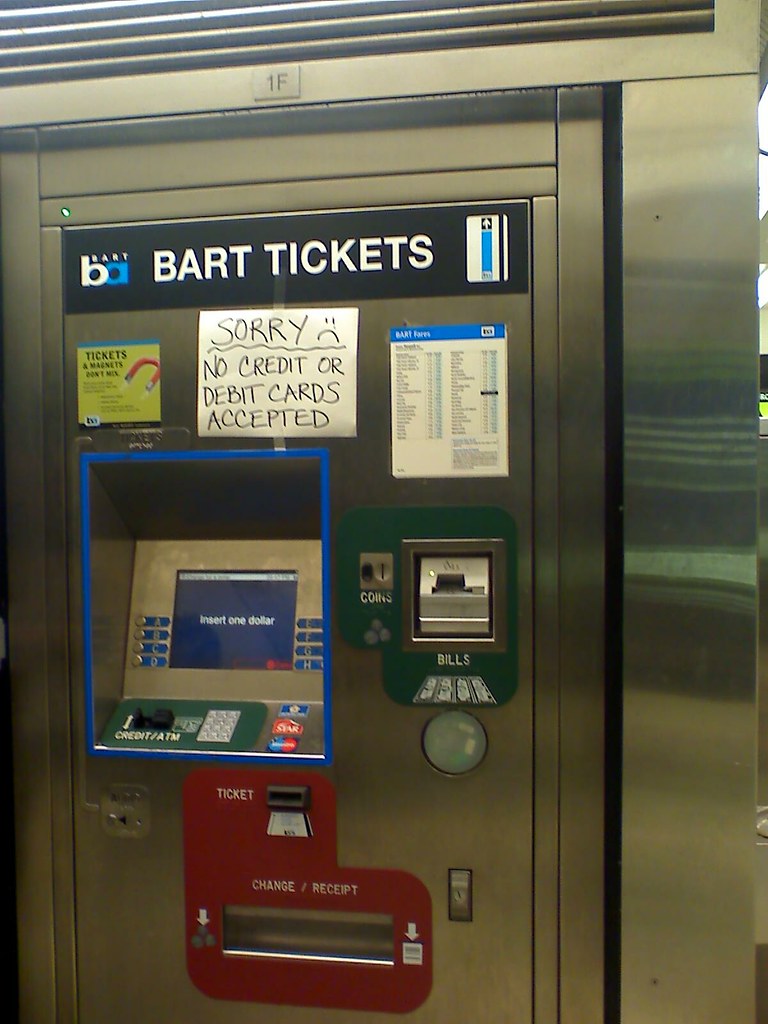
BART Ticketing Machine with Clipper card add value option

Pocket change, the worst enemy of my pockets. It’s heavy and just sits in a jar at my home all day long while it gets bigger and bigger.

Ever had one of those times where you wanted to just get rid of your pocket change, but tired of packing your own coin rolls or going to a local supermarket to use one of those change sorting machines where you pay ten cents for every dollar?

Well, here’s the easiest way to dump your change with no surcharge, it’s for paying your public transportation. No, I’m not encouraging you to dump tons of nickels into a bus farebox, that just holds up the bus and you get that awkward stare from fellow passengers. Just feed it to your Clipper card's e-cash purse.

There’s one easy way to do this, just go to any BART station’s ticketing machine. The nice part about BART ticketing machines and Clipper is you can put as little as five cents onto the card and up to 30 coins per transaction. Once you put in 30 coins, the machine locks out additional coins, and you just confirm the value and tag the card to update the balance for instant use. If you have more coins, just do the transaction again.

Some of you may be asking, can I do this at a Muni metro or Golden Gate Ferry ticketing machine? You can, but the software will first ask you what specific amount you wish to input into the machine before you are allowed to feed coins. Always select the lowest amount because the machine will lock you out at the 30th coin, but you can still feed bills into the machine to fill in the gap. Be warned, the machine will only give a maximum of $4.95 in change if you overpay, so have dollar bills handy, and not a $20.

There is one big weakness for both of these options: They won’t take pennies.  Why not add more e-cash to your Clipper card and get rid of most of your pocket change?

Monday, September 17, 2012

Muni Considers Ending BART Plus Relationship - Another Nail in the Coffin?

Last week Friday, the SFMTA had a hearing to consider ending Muni's relationship in the BART Plus program.  While this is not yet official, it would still have to go under the Board of Directors for a final vote.

For those of you not familiar with BART Plus, here's how it works:
BART Plus is a combination of a BART ticket with privileges to ride neighboring public transit agencies (a flash pass).  The ticket has varying price points and is sold on a twice monthly basis with the "A" and "B" tickets valid for the first fifteen days and the last fourteen to sixteen days.

Passengers using BART Plus gets some nice perks: The 'last ride' bonus will let passengers with less than enough credit on their BART ticket funds get to ride one last time regardless of how much the fare is; the ticket is returned to the passenger so it can be used as a flash pass.  The flash pass portion is valid with multiple transit agencies as a local fare credit.

AC Transit Killed Their Relationship
The biggest hit to BART Plus was the end of acceptance on AC Transit in 2003; a major connection for BART passengers within the East Bay.  The only discount BART and AC Transit passengers receives today is the 25 cent discount when transferring from BART to AC and vice versa using a Clipper card.

Muni's Relationship is Tender
Muni is one of the busiest transit agencies in the entire Bay Area, especially when comparing the high number of passes sold every month versus other agencies that operates in larger counties.  BART Plus and Muni plays a vital role for passengers to save money while being able to commute just using one ticket.  This is especially true for passengers that may have to ride more than just Muni and BART to get to work by combining everything into one.

But How About Clipper?
BART Plus can never convert to Clipper until all the agencies under the Plus ticket can have Clipper card readers installed, so the old fashioned ticket will still be in existence.  Muni claims that they have to end their relationship because of the agency's goal to end paper passes and convert everything into Clipper.

Akit's Opinion
BART Plus is the first of its kind to be a multi-agency transit pass integrated with BART access.  If you are to compare other agencies with their pass agreements, the second best is Caltrain with their 2+ zone monthly pass giving passengers access to Samtrans and VTA at no extra charge, and an optional discounted Muni pass.  Other agency agreements like Muni's "A" pass only gives Muni passengers access to BART.

It's been the MTC's dream for a Clipper card monthly pass that can access ALL transit agencies for one flat price, but that dream may never come to fruition because of the numerous transit agencies running in the Bay Area.  BART Plus' old agreements makes that dream real for passengers and saves them tons of money to get around the Bay Area with relative ease, even though it's not compatible with the Clipper card.

Ending Muni's relationship will be a major setback for BART Plus.  Losing AC Transit was bad enough, but Muni may kill BART Plus, or at least put another nail in the coffin.  I think Muni's statement about trying to end all paper passes is a bunch of junk; they will make plenty of BART Plus passengers angry and the public knows Muni is being greedy by asking for people to fork over more money.

Why can't we all just get along with each other?  The Bay Area transit agencies should be playing nice with each other with generous transfer and pass agreements making it easier for everyone to ride one agency to another.  Instead, each one wants to be Mr. Tough Guy and force us passengers to pay more.  A lot of the transfer agreements is a bunch of crap; 25 cents here, 50 cents there; it's not much.  Caltrain, Samtrans, and VTA have a really cool transfer agreement for those who rides Caltrain with 2+ zone monthly pass, so why can't other agencies work on an decent agreement that works for their passengers?

Lastly, here's a reason why the Clipper card goes through so much hell and is probably one of the most complicated fare card systems in the entire nation or possibly the world; each individual transit agency has their own fare rules, transfer rules, inter-agency rules, and pass rules that makes it so much more difficult for tourists or possibly the average citizen to understand.  The MTC made one huge mistake: They allowed the Clipper card to absorb the grandfathered rules that makes no sense, such as the 8-ride Caltrain ticket, instead of working on better solutions like changing it to a 10-ride or an across the board 50 cent fare discount whenever you transfer between one agency.

Maybe if transit agencies played nice with each other, they can help get more cars off the road, and with increasing passenger loads, show to the state and federal governments that they need more funding to meet demand so more buses and trains can be operating.

Wednesday, August 22, 2012

New Clipper Card Fee $3 - How to Not Pay It

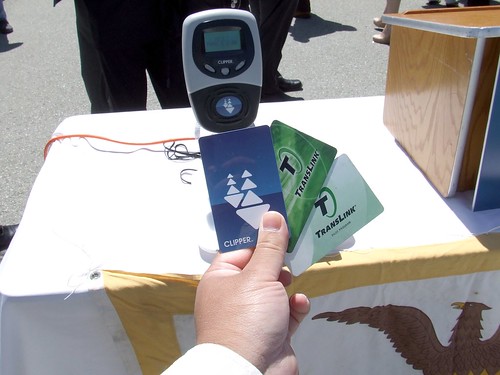
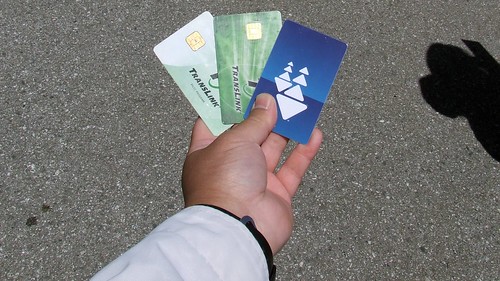
Three Generations of Transit Cards (TransLink Pilot, TransLink, and Clipper) Widescreen
Three Generations of Transit Fare Cards
The MTC has announced the Clipper card will no longer be given out for free starting September 1st.  The new card acquisition fee will be $3 in which they claim will be to cover the costs associated with the procurement of the cards.

Why an acquisition fee?
The acquisition fee has been a hotbed of controversy because the MTC originally proposed the card fee to be $5.  But after filing a required report under Title VI of the Civil Rights Act of 1964, they decided to drop it down to $3.  It was right in the middle for the agency, it didn't heavily impact people that are disadvantaged, but also didn't give out the cards for free.

The other controversy has been the cards have been treated as an item that can be thrown away.  As you may recall, some people who take longer and more costly trips on public transit have been abusing the system by taking advantage of the card's negative balance policy.  A passenger adds very little money to a card with $0 acquisition fee and riding transit that costs more than what was funded to the card; once it goes negative, the passenger just throws the card in the trash.  Because some people abuse the system this way, the MTC and public transit agencies lose a grand total of $700,000 in transit fares and card procurement costs.  One solution being implemented in the future is to force BART passengers to add funds to their Clipper card at the exitfare machines if there's not enough to cover the ride.

$3 fee to be a failure
In my own opinion, the $3 acquisition fee might be able to stop some people from abusing the negative balance policy, but the MTC is still going to lose money from those who can still take advantage of it.

Here's how simple it is.  Assuming BART is out of the picture, the most expensive transit fare is Caltrain at $12.75 one-way from zones one to six.  If Clipper also implemented a $10 minimum e-cash add on per new card, a passenger must pay $13 ($10 e-cash and $3 new card fee).  That means that while the passenger's one-way ride on Caltrain is paid in full, the passenger still has 25 cents left, therefore he/she can ride any other agency (except BART) for just 25 cents and dump the card in the trash.

UPDATE: Oops, I screwed up.  The new card fee doesn't make the e-cash total $13, it's still $10.  Therefore, if a passenger rides the $12.75 Caltrain ride, the passenger dumps their card in the trash after the first use of the card.

As I've just shown, people can still "save" money while transit agencies lose money.

How not to pay the $3 fee
The MTC is advising people to get the fee waived by ordering their card online and enrolling in the autoload program.  But as we all know too well, autoload has problems, just like the recent report of people whose money was loaded back in 2010 never got charged until just days ago.   So who wants to trust the MTC and Clipper on a piece of junk program?

Of course, the other way to avoid the fee is to get your new Clipper card now until September 1st, but how about after September 1st?

There's still a way to avoid the fee and it takes a little ingenuity.  Just obtain your card online, register a credit card under autoload, and as soon as you get your new card, CANCEL AUTOLOAD.  You see, you get a free card registered under your name (protection in case you lose your card), and you dumped autoload like dumping your date after a horrifying dinner.

Talking about dating... Akit's single!  Ladies, want to date a blogger?  :-)

Thursday, June 14, 2012

BART's Transbay Tube is Shut Down - How to get to U.S. Open Today

BART Train Map

UPDATE: BART is back open.  Good work BART repair crews!
 
Bad timing for BART today.  An early morning fire spread to the tracks near the West Oakland station causing possible damage to the rails or the structure.

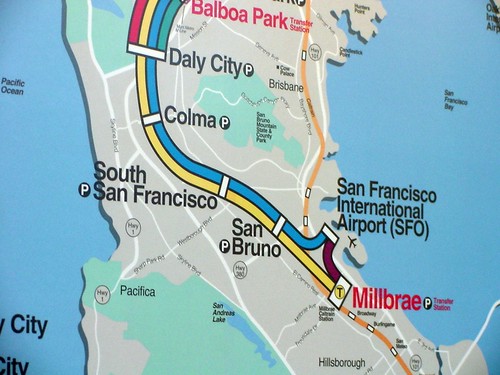
Due to the fire, BART has completely shut down the transbay tube, no service is being provided between San Francisco and Oakland at this time.  BART will run two different systems, a service between SFO/Daly City and Embarcadero, and lines within the East Bay.  Read BART's press release.

With no transbay tube service, it's already a mess on the roads.

There's thousands of people who can't get to the U.S. Open via BART, unless if you are in a hotel in downtown SF, you got extra lucky.

How to Get to the U.S. Open without BART:

Option 1: Drive
Get across the bay via the Bay Bridge or San Mateo Bridge and take 101 to Candlestick Park.  Park your car at the stadium's parking lot and take the shuttle buses to the U.S. Open.

You can also take the San Mateo Bridge and park your car at Millbrae or San Bruno BART, pay the parking fee, and take BART to Colma for the golf shuttles.

Option 2: Ferry
Take the Oakland/Alameda ferry and walk to Embarcadero BART station.  Take BART to Colma station and take the golf shuttle.

Option 3: Transbay Bus
Take one of the AC Transit transbay buses, get off at Transbay Terminal and walk to a BART station.  Take BART to Colma station for the golf shuttle.

Option 4: Just stay home
If you don't want to stress it, eat your ticket money and just stay home today.  Sorry.

--------------------

A reminder:
For those of you searching for parking, please don't attempt to park near the event area.  Parking is extremely limited and in many areas, heavily restricted to time limits, special permits, or heavy security presence blocking entrances to private parking lots (such as the churches on Brotherhood Way).  Like I said earlier, your best bet is Candlestick Park.

Sunday, June 10, 2012

Your Survival Guide to the USGA's 2012 U.S. Open at SF's Olympic Club

NOTICE: Taking BART to the U.S. Open on Thursday?  READ THIS.

Another big golf event means raking in the tax dollars for the city, but also means headaches for us locals just trying to go on our merry way.

So here's my survival guide to you, the average citizen who doesn't care about golf.

The USGA's 2012 U.S. Open will be held at the Olympic Club, located in the very deep southwest corner of San Francisco and straddles between the borders of San Francisco and Daly City.

The location of the course is surrounded by four major streets/roads: John Muir Drive (North), John Daly Boulevard (South), Lake Merced Boulevard (East), and Skyline Boulevard/Highway 35 (West).  While the Olympic Club is closed to the public as it is a private club for the wealthy, the U.S. Open will make it open to the public with the purchase of a ticket.

The tournament is scheduled to go from Monday, June 11th to Sunday, June 17th with practice rounds on the first few days, and the rest as the tournament.  Crowds and major media attention is likely going to peak during the last final days, especially during the weekend.

Traffic Problems
From what is currently known from the U.S. Open, an article from SFGate, and SFMTA/Muni's websites, there are some key road closures that will definitely put a dent in your commute.

Skyline Boulevard (Highway 35) in the northbound direction will be closed from John Daly Boulevard to John Muir Drive from approximately 5AM to 10PM during every operating day of the U.S. Open.  The southbound direction will have one lane closed between the two streets, but the other lane will remain open.

John Muir Drive, which borders the northern end of the golf course, is closed to traffic.  It is scheduled to close starting at 6AM on Sunday, June 10th and will remain closed until 6AM on June 18th (as per SFgate).  However, contradictory to what the Chronicle is saying, the 18-46th Avenue bus line will still be able to go eastbound on John Muir (as per SFMTA), but is unable to go westbound.

There is also the likely possibility of a traffic jam on the east side of the golf course along Lake Merced Boulevard.  Between John Muir Drive and John Daly Boulevard is the community park and will be the staging area for all taxis and limos as drop-off and pick-up points.

Better alternate routes:

Take 280 and 19th Avenue:

Take Sunset Boulevard which changes to Lake Merced Boulevard, Brotherhood Way, and 280.  UPDATE: This is not a great route, southbound Lake Merced Boulevard can get jammed by heavy traffic all the way from Font, but once you make the turn to Brotherhood, traffic flows fast.  An alternative is to make a left turn onto Winston towards Stonestown and turn right onto 19th Avenue.


Parking Problems
As there will be incompetent people on the road looking for a sweet parking space to go watch golfers stroke their [three] wood and wash their [golf] balls, expect major parking problems in the surrounding areas.

As always, there will be those golf spectator idiots who thinks parking in a private parking lot such as Burger King's or the Westlake Shopping Center is a great idea.  I'll tell you, it's not, and expect a nice tow truck to haul the car away.  They probably have extra security watching over the lots.

Here's a list of areas where parking might get hard, and these are areas where it's "close" to the entrance on John Muir Drive.  BUT in reality, parking in one of these areas means one hell of a long walk.
  • South end of the golf course, such as near Joe's of Westlake (they do make a great Steak a la Bruno).
  • Lake Merced from Winston to Font.
  • SF State and Parkmerced area (most parking is limited to one hour).
  • Merrie Way (Janet Pomoroy Center).

One way to definitely piss-off a lot of people is to park in the SF State garage.  If you have no university related business, stay the hell out.  You seriously don't want to mess with students, faculty, and staff; the lot is for them so they can go to or teach class, or do their jobs as university officials.

UPDATE: Golf spectators with a special permit to park in the SF State garage is permitted to do so.  If you don't have one of those permits, you'll be turned away.  SF State students, staff, and faculty should be prepared to show their campus ID, employee parking permit, or have a legitimate reason to park on-campus.

Public Transit Problems:
There's only two bus lines that runs close to the action: Muni's 18-46th Avenue and Samtrans 122.

Samtrans may encounter traffic, but Muni will feel the pain.  All 18 line service going from Legion of Honor to Stonestown will operate normally.  All 18 line service going from Stonestown to Legion of Honor will have to be re-routed.  See maps below.

This is the normal route the 18-46th Avenue line takes to go from Stonestown to Legion of Honor (via westbound John Muir):

This is the detour the bus must take due to the westbound John Muir closure:

If you are trying to get to the event...
The parking lot is at Candlestick Park.  You think I'm kidding?  No.  There will be luxury shuttle buses transporting people to and from the stadium's lot to the golf course.

For those of you riding BART, take the train to Colma station (NOT DALY CITY) and board a shuttle to the golf course.  Please remember, parking in Colma station to ride the shuttle is a violation of BART parking policy and will be cited and/or towed; it is only for BART passengers.  Park at a different BART station, pay the parking fee (if applicable), and take the train to Colma.  Go to BART's website and get information about parking and how to get a reserved parking space permit.

For more information, please visit:
USGA Spectator Guide (Transportation Info)
SFMTA/Muni 18-46th Avenue affected routes
SFgate article on U.S. Open

Wednesday, June 6, 2012

MTC and Clipper to Close Loop on Negative Balance Feature for BART

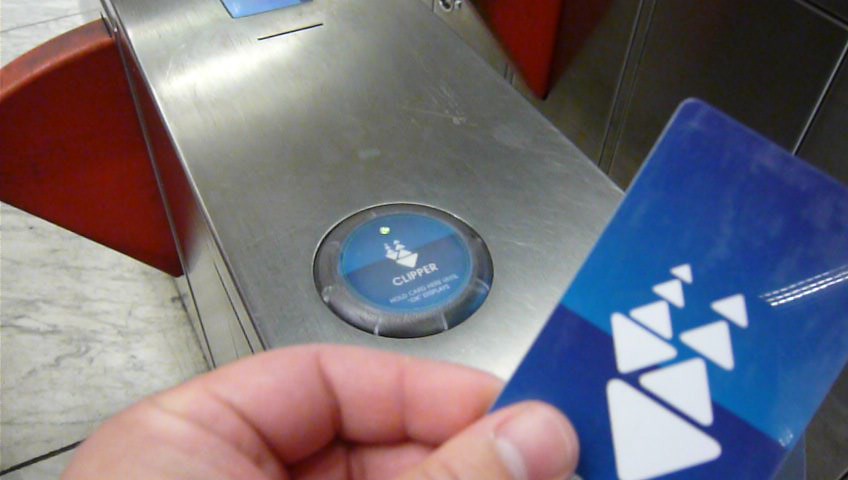
BART Gate & Clipper Card

The history of the Clipper card program (formerly known as TransLink) has always permitted card users to allow their card to go into the negative if there's at least $0.01 [positive] credit on the card; but once it goes into the negative, the card cannot be further used until replenished with money back to positive balance.  The idea behind the negative balance policy is both a honor approach for people to promise to keep their cards and replenish when negative, but also for agencies that operates on a distance based or zone system: Clipper cannot accurately charge the proper fare upon the initial tag when boarding a bus (Golden Gate Transit) or at a train station (BART and Caltrain); therefore the negative balance policy will have to remain indefinitely.

When things went insane...
However, back in November 2010, the can of worms that has been kept stable for nearly a decade suddenly exploded when Streetsblog SF, and other major news stations exposed the negative balance policy.  It suddenly changed from a policy with good intentions, to an easy way for passengers to  cheat transit agencies of transit fares with literally no risk of getting caught.  The way to do it was simple, purchase a new Clipper card with the required minimum balance and use it on a transit agency where the fare was higher than the balance placed on the card.  Back in 2010, all a person had to spend was $2 to get a new card and a $2 e-cash balance, and the passenger simply rode any transit agency whose fare was more than $2.  After ending the ride, simply dump the card in a trash can and go through the cycle again.  It was easily untraceable if passengers paid in cash for a card and did not register the card with Clipper.

MTC and Clipper fought back, by raising the minimum e-cash balance to obtain a card to $5, but did not enforce a policy to pay an additional fee to obtain a new card, but even with $5, there are still a bunch zone/distance rides that costs more than $5 one-way, such as taking the BART train to SFO.

In the long run, the negative balances started adding up into the six figures per year, and that does not include the cost per card to replace the ones dumped in the trash.  Back in September 2011, I reported the negative balance feature on Clipper cards was being abused at a rate of $360,000 per year in lost transit fares, and when including all the costs of procuring cards, the MTC spends a grand total of nearly $700,000 per year.

The solution?
The MTC is planning to spend some money in order to plug up one agency that has racked-up 60% of all negative balances, and that's BART.

This Friday, the Operations Committee will have a meeting to vote if the commission should spend $625,000 to end the negative balance problem for BART.

How?  Simple, the contractor (Cubic Transportation Systems) will be paid to upgrade all the exitfare machines in the BART system to force passengers with insufficient funds to add more money to their Clipper card before being allowed to exit.  It's just like the old school magnetic stripe tickets so people don't pay the minimum fare to obtain a ticket, and exit at a station for a ride costing $10.

By doing this, the MTC will save an estimated $216,000 per year in negative balances (or $420,000 per year if you include cost of procuring new cards).  Even though the contract to upgrade the exitfare machines is over $600,000, in the long run, the investment will pay off in a matter of a few years.

While this still does not plug-up the holes with the remaining 40% of other transit agencies still taking negative balance abuse, at least plugging up the worst offender (BART) is a step in the right direction.

Another feature of upgrading the exitfare machines?
As the MTC is planning to allow the exitfare machines to accept Clipper cards, this could also be the next step for passengers who utilizes paid BART parking lots to also use their card to pay for their parking fees.  Instead of a mirror hang tag (that is used today), it would be the same as using a BART mag stripe ticket to insert into a exitfare machine to punch in the parking stall number to pay their parking.

Thursday, May 31, 2012

Clipper Card FAILS to Fix Problem They Promised to Fix a Year Ago - Muni & BART Transfers

Clipper Card Fail

UPDATE: Clipper responded to Mimi's message:
Hi Mimi. We are in the process of correcting this problem and these transfer rules will be changed within the next month. You - and anyone else - in this situation should contact Clipper Customer Service (custserv@clippercard.com or 877.878.8883) to request a refund.
While satisfactory for Mimi's problem, it still shameful that Clipper failed to fix the problem for nearly a year.

Original Blog Post:
Nearly a year ago, I mentioned about John Murphy's experience of using his Clipper card to ride Muni and BART within a 90 minute period.

Mr. Murphy did the following:
  1. Took Muni to a BART station in SF.
  2. Took BART to a different station in SF.
  3. Transferred to Muni.
The correct way this is supposed to work is that Mr. Murphy should have paid $3.75 because:
  1. He paid $2 to ride Muni.
  2. He paid $1.75 for the BART ride.
  3. His next ride on Muni [within 90 minutes of boarding first Muni bus] is free.
But... he was charged incorrectly, he paid $5.50:
  1. He paid $2 to ride Muni
  2. He paid $1.75 for the BART ride.
  3. He paid $1.75 because his Muni transfer was erased in favor of the "BART to Muni" discount e-transfer which gives a 25 cent discount on the next Muni ride.

Clipper's response to Mr. Murphy's inquiry nearly a year ago stated the following:
You're correct - you should not have been charged for the second ride.

This was an incorrect implementation of Muni's transfer policy and MTC has been working with our contractor to fix the issue.

We encourage customers to access their online transaction history records to determine if they were overcharged for this transfer trip. Customers who are affected by this issue should contact Clipper Customer Service to request a refund for the $1.75 that they were overcharged.
--------------------

Basically, Clipper and the MTC promised nearly a year ago to fix the problem.  Did it get fixed?  NO.

The Problem Still Exists
Just yesterday, a person by the name of Mimi Chan posted a statement on Clipper's Facebook page mentioning the same exact problem that John Murphy experienced a year ago.  She paid $5.50 instead of $3.75. 

On AC Transit too?
And just to take this home, just a few weeks ago, the SF Examiner reported a similar Clipper card failure regarding people using AC Transit, transferring to BART, and having their AC Transit transfer voided to pay the "BART to AC Transit Bus" transfer discount.


Akit's Opinions:

I have two big issues with Clipper FAILING in resolving this process:
  • They made a promise to fix the problem and didn't do it.  I don't like people who do not keep their word, especially those who serve the public.
  • Clipper and MTC better be ready for a class action lawsuit.  People can only research their Clipper card records online for up to 60 days.  People will start demanding to look at their records ever since 2009. 

Here's a FACT: Clipper (known as TransLink back in the day) started allowing all BART stations to have their card readers active as of August 3, 2009.  AC Transit and Muni has been a part of TransLink/Clipper ever since they started their pilot program back in early 2000.  I'm betting thousands of people have been victims of this particular transfer problem, and they all have a right to a proper refund.


There's no place to hide Clipper and MTC.  You screwed up and the public demands answers.

Tuesday, May 22, 2012

Warriors Coming to SF - Expect Muni Nightmares

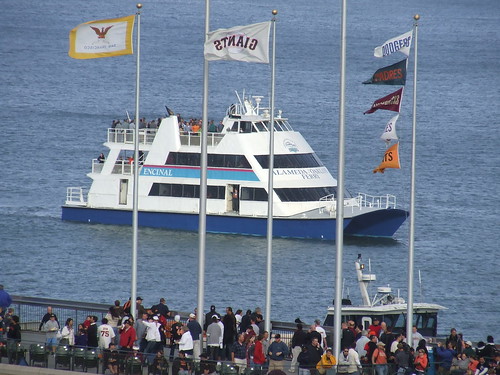
AT&T Park - Ferry Boat waiting for dock space

There's now word from the city the Golden State Warriors will have their new home at Piers 30/32 here in San Francisco and be open in 2017.  While sad for Oakland, it's great news for our city to get sales tax money and have a large indoor sports arena for our city.

Surely this is exciting news, but being a local resident of the city, I have fears of a big nightmare.

As we all know, AT&T Park is not far away from the new arena site and if you have ever gone to a Giants home game, you know how bad traffic and transit can be.  Traffic before and after games is slow or just a standstill.  If you ride Muni metro to the ballpark, you know about the passenger crush loads on every single train.  For Caltrain and BART, they are also busy shipping baseball fans to and from the game.

But with the Warriors in town, the worst nightmare will be when both the Giants and Warriors plays on the same day at the same time.  I don't think Muni metro will be able to take on the huge loads of passengers going to both games.

Muni was smart when they built the platforms along the Embarcadero, they are so long, you can fit at least three train cars.  But Muni metro has a few big problems:
  1. They can't operate three car trains anywhere on the surface or subway (something about running in "tow mode").  The more trains, the better the capacity.
  2. The passenger loads are already at crush loads for Giants games.
  3. The passengers living along the T-Third line will continue to experience hell because it's both one-car trains and for many, can't get on the train to get home.
  4. There's always a backup of Muni metro trains after an event because they line-up trains on the revenue track.  Passengers from Caltrain and the T-Third gets stuck waiting for trains ahead to clear-out.
  5. There's usually a back-up of inbound metro trains at Embarcadero before Giants games.  Why?  Muni officials holds the ballpark bound trains longer at the platform and fill them to capacity while other non-ballpark bound trains are waiting in line.
I think Muni can at least start the planning stages on how to handle the Warriors crowds.  Let's remember there's not much parking around the area and more will be depending on public transportation to get people to and from the games.

Here's a few of my ideas for Muni:
  1. Realign the metro tracks along the surface route nearest to have three tracks.  The outer tracks are revenue tracks and the middle track can be a staging area for extra trains so they don't block regular service provided by the N-Judah and T-Third lines.
  2. Provide express bus service from Embarcadero station to Warriors arena.
  3. Find a way for Giants fans to utilize the future Central Subway while Warriors fans uses the Howard street Muni platform.

Just a few other random transit ideas (more of a dream):
  1. Definitely more ferries with bigger capacity.  Extra boarding/disembarking doors on the boats will help.
  2. Utilize AT&T Park's parking lot for vehicle parking with a nearby ferry dock to provide frequent high speed ferry service to and from the Warriors arena.
  3. Disneyland style multi car trams to major transit stations (is that even street legal?).
  4. Bore another subway tunnel to serve the arena and ballpark.
  5. Offer incentives for people to take transit, such as buy a game ticket and get half-price fares on public transit.
  6. How about a monorail?  "Monorail, monorail, monorail!  Mono... D'oh!"