"Akit is the man. He knows Clipper." (spenta)
"It’s a fantastic blog for any San Franciscan."
(Kevin)
"Your blog is always on point, and well researched!" (Nina Decker)
"Everyone's favorite volunteer public policy consultant..." (Eve Batey, SF Appeal)
"You are doing a great job keeping on top of Translink stuff. Keep up the good work!"
(Greg Dewar, N Judah Chronicles)
"...I don't even bother subscribing anywhere else for my local public transportation info. You have it all..."
(Empowered Follower)
"If anyone at City Hall wants to make public transit better for all San Franciscans, it would be wise to follow Akit religiously...
or, better yet, give him a job."
(Brock Keeling, SFist)

Saturday, January 18, 2014

Muni Substituting Diesels on Trolleybus Lines on Sunday - Major Delays to Happen


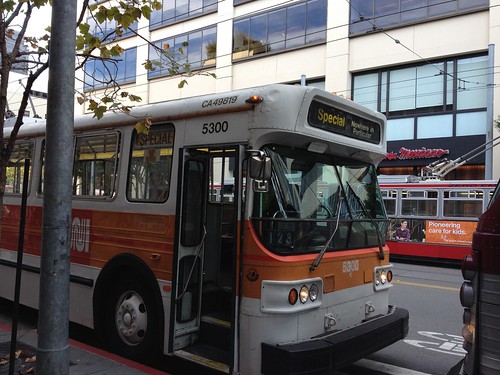
This Sunday is the big NFC championship game where the 49ers are traveling to Seattle to face the Seahawks.  But the more troubling issue is why Muni is not allowing any trolleybuses to run in the city, and instead substituting it for diesels all Sunday.

From the Chronicle, the reason why the trolleybuses are being locked in the garage is a precaution in case there's fans rioting in the streets.

Riots?  If citizens wants to riot, they'll vandalize or destroy any Muni bus they please, regardless if it is diesel or electric.

The truth of the matter is, if Muni takes all the electric trolleybuses off the streets on Sunday, you will experience severe delays on all trolleybus lines.  There are not enough diesel buses to make-up for a huge loss.

And how do I know of the delays?  Last week Saturday, Muni switched all electric lines running along Market street to diesel only (excluding the 14-Mission), but they had a legitimate excuse, there was major road construction on Market and it blocked the overhead wires and the tracks used by the F-Market.  I ride the 6-Parnassus, but the diesel buses ran too far apart, with wait times of 30 to 40 minutes; normally the wait with trolleybuses is about 15-20 minutes.  Even the bus substitution for the F-Market was terrible, I was waiting 25 minutes for a bus that was sardine packed; after that point, I turned around and went home.

But wait, there's more.  This Sunday, Muni is cutting-off all Cable Car and F-Market service and they are also going on diesel as well.  For the entire three day weekend, the N-Judah will not run trains from Duboce and Church to Ocean Beach, and instead run much slower and smaller capacity buses.  This means that all the diesel lines will be STRETCHED THIN.

I seriously question the SFMTA's choices of cutting-off all the trolleybus lines for diesels.  Like I said earlier, with all the lines being forced to diesels, there is not enough diesel buses to make-up a huge gap like this.

Monday, January 6, 2014

Don't Anger the Casino Junket Buses in San Francisco

The local news is reporting about a plan for the city government to charge shuttle bus companies who pick-up their passengers at public transit stops to pay a fee every time the company uses the stops.

In my opinion, it's a fair compromise that would then sanction/legally allow private shuttle companies to use the stops to pick-up commuters and take them to their technology company jobs.  A lot of people enjoy this shuttle service perk because they don't have to drive, and one single bus can take dozens of cars off the congested roads and highways.

On the other hand, protesters have made two points, the use of public transit stops for other than public transit buses is illegal, and that it's driving-up the costs of housing in San Francisco.  I can understand the illegal use of a transit stop, but I'm not against tech folks finding residence here in San Francisco; they have the money, so let them spend on what they want.  Living in San Francisco is a great experience with tons of cultures and world class food; how boring would it to be living in some city with a not so interesting neighborhood?

If the city just kept giving a blind eye on the illegal use of a transit stop, shuttle bus companies have a couple of choices: Either risk the $271 fine for parking in a transit stop, or double park as the double park penalty is much lower than a transit stop violation.

But there's a bigger question out there: How about the gambling buses?

Way before technology companies made it big with shuttle buses picking-up passengers, the casino junket buses was driving people up to Cache Creek casino on a regular basis by using transit bus stops and double parking on the streets.  Now with even more casinos within a reasonable vicinity of San Francisco, I see more of them daily.

I feel the city is still going to give a blind eye on the casino junket buses and protesters wouldn't dare to block the casino buses.  Why?  Simply my dear, it's the angry old Chinese ladies.  If you know about the ones who shove their way into a Muni metro vehicle at Powell station, good luck blocking a casino bus while the pink bag ladies will kick their asses.  It may sound amusing, but it's the fear factor that keeps the city government and protesters away.

Thursday, November 21, 2013

Youth Clipper Card Applicant Process Streamlined - Photo Requirement Eliminated for AC Transit 31-Day Pass Eligibility

New word from the Metropolitan Transportation Commission is all youth Clipper card users can now obtain their AC Transit 31-day passes without the need to have a specialized Clipper card with their photo on it (only issued by AC Transit).  This also allows all youth card applicants to be able to apply through any transit agency's ticket office, email, or fax.

The Commission stated the AC Transit Board of Directors eliminated the photo on card requirement because it was a hindrance to all youth in the transit service area to get a specialized card to be eligible to purchase the 31-day pass.

In the Past
Before the change in this policy, any youth needing to purchase a 31-day pass for AC Transit must obtain a special Clipper card that's only issued by AC Transit.  The special card requires the youth to have their photo taken by AC Transit staff and put on the card.

For youth without the special AC Transit endorsed Clipper card, the passenger did not have the option to purchase a 31-day pass on their card, but was still eligible to pay the youth single-ride fare with e-cash.

For youth needing the specialized card, this was a frustrating process for them.  No other transit agency required youth card applicants to go through the additional hoops, and that caused massive delays for AC Transit, upset parents who could not get the cards in time for the school year, and youth forced to pay cash fare and spend more money than the price of a pass.

Also, for any youth cardholder that lost their card, the card can only be re-issued by AC Transit, unlike the various and easier methods to obtain a replacement for non-AC Transit youth card users.

Akit's Opinions
It's a great step to streamlining the process, but the question I want to ask AC Transit is: Why did you create a policy to put a photo on each youth card?  They knew the Clipper card program will be reaching millions of Bay Area citizens and the number of applicants was going to explode when the 31-day youth mag stripe pass was to be eliminated and only be sold on Clipper cards, and other transit agencies don't take a photograph at all.

What was really the point?  Prevent parents from stealing the card and riding the buses for cheap?  Like the bus drivers even care to look at one's card or ask questions.  They hear the single beep, and all is well.

The possibility of card abuse is real.  But by not streamlining the youth card applicant process that's universal with other transit agencies, it definitely outweighs the number of adults abusing the youth card's special privileges.

Monday, October 28, 2013

Muni's 10-Ride Ticket Books (Tokens) Finally Gets a Grave


Bothersome thingsQuietly announced this morning, the people at the SFMTA announced the upcoming end of sales of Muni 10-ride ticket books sold for Clipper cards.  The sales will end starting on January 1, 2014 and any person who has in possession a 10-ride on their card must use them no later than July 1, 2014.

Why are the 10-ride ticket books going to extinction?  It's elementary, Watson; you see, the 10-ride books was not sold at a discount, so it's the equivalent as paying in cash or Clipper e-cash.  10 ride books costs $20, but the regular adult Muni fare is $2 a piece, so the ten-ride book basically dug itself its own grave.


A Little History About Multi-Ride Books and Why it's Dying a Horrible Death
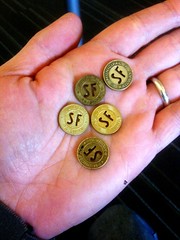
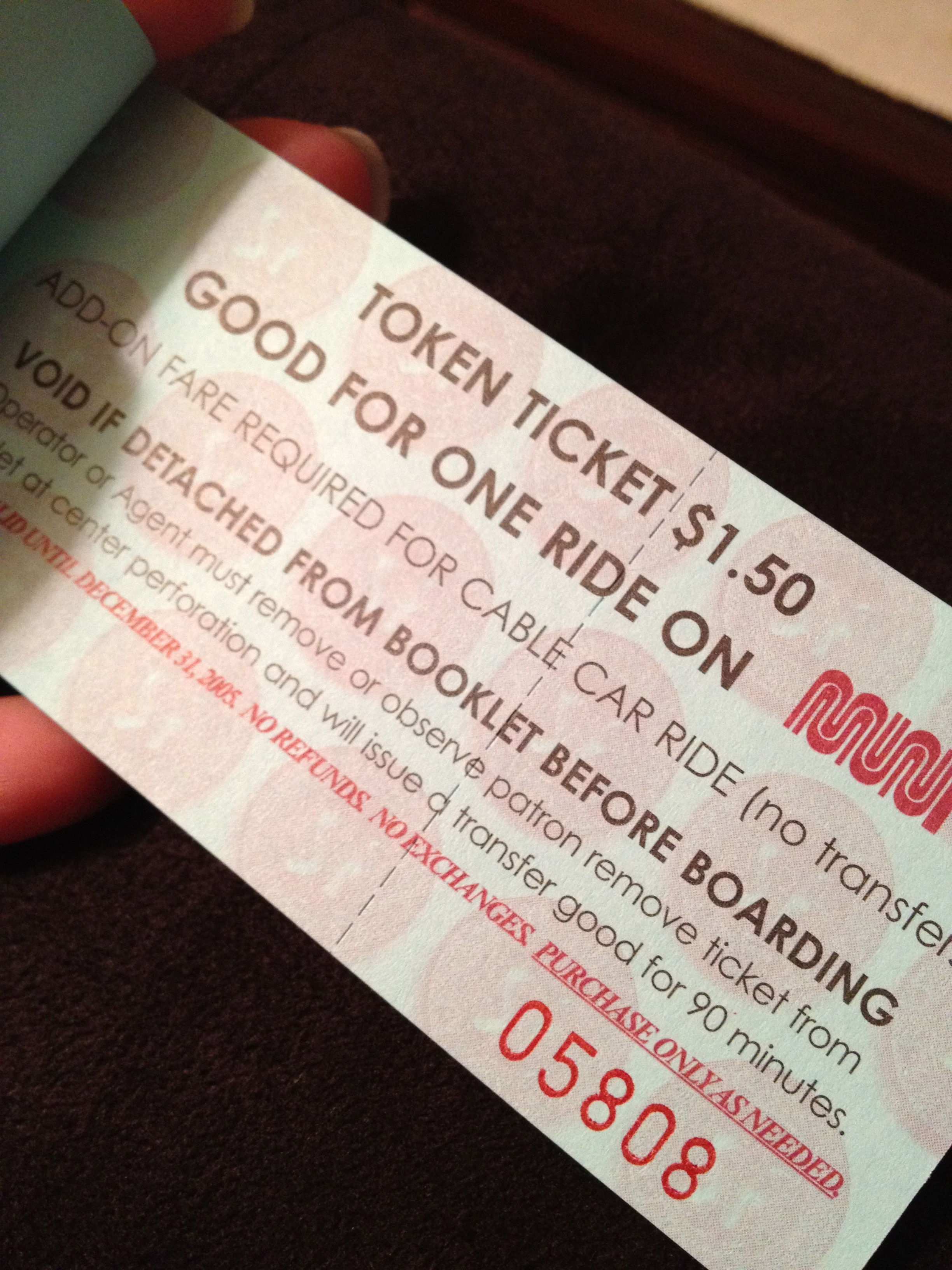
Back in the 'good old days' of Muni, they sold tokens in bags of ten.  The little coins was sold in bulks of ten so passengers can save 25 cents per ride.  It wasn't until 2005 when a fare hike from $1.25 adult cash fare went up to $1.50 caused the little coin's demise.

For a yet to be determined project: old sf muni tokens.

Since the regular cash fare and passes was going up, people wanted a fare product that was resistant to the hikes, and that was the Muni token.  People decided to hoard them by buying as much as they can, that Muni was starting to run short of the coins, had to limit customers to how many bags they could buy, and decided to not produce more coins because it costs more to produce them.

Muni transitioned during that time from actual metal tokens to paper token tickets to meet demand.  But with a new policy of no discounts, people who decided to buy them had to spend $15 for a 10-ride ticket book; this meant a very small population of San Franciscans and commuters could use the ticket books because of programs like Commuter Check which had to be spent on physical transit media, like the 10-ride books.  This program continued for a long time until the Clipper card came to life.

Strangely, when the Clipper card debut and the new Muni metro station ticket machines opened-up, Muni stopped selling the actual paper 10-ride tickets in favor of having passengers load them onto Clipper cards.  But since there were no discounts for buying in bulk, the demise of the 10-rides was going down the drain even more.  People who used commuter benefits programs are now able to transfer their benefit funds into Clipper e-cash funds that was universal money good on many transit agencies.

Basically, with Muni's decision to not provide bulk discounts for buying transit rides in advance is the primary reason in my opinion that the ten-ride books are finally being executed by a firing squad.

If you want to learn more about the history of Muni tokens and it's eventual death, read a past blog entry I wrote three years ago.

Akit's Opinions & The Future?
I think it's fine for Muni to finally end the 10-ride books.  The end of the books means that the Clipper card sales options will be one less, therefore simplifying the already complex Clipper card program crammed with various types of passes, transfer rules, and many other transit agency policies.

But how about Muni taking on the lead like AC Transit by offering passengers paying e-cash with Clipper to get a discount?  AC Transit proposed to passengers that if you pay with Clipper, you will save 10 cents from the adult fare, so instead of feeding a cash box $2.10, you just pay $2 with Clipper.  Muni should provide this carrot on a stick to encourage passengers to use Clipper to reduce delays because of passengers paying in cash.

Photo of Muni ticket book by Flickr user: cbcastro using a Creative Commons License.
Photo of Muni tokens in hand by Flickr user: joe.moore using a Creative Commons License.
Wednesday, October 23, 2013

A Look Into Fare Change Proposals for AC Transit

This afternoon, AC Transit is going to have two hearings about their proposed fare changes to let the general public learn about it and give an opportunity to give their opinion about the matters at hand.  The AC Transit board will officially vote on the changes on November 13th, and if approved, will be in effect on July 1, 2014.

Here's their proposed changes:

Local fares:
  1. First ride fare remains the same.
  2. 25 cent fee for transfer eliminated.
  3. Instead of a transfer, a day pass is offered.
  4. The day pass can be purchased at the farebox when boarding first bus, or Clipper card users simply 'earn' their day pass after reaching the fare threshold for that day.
Transbay service:
  1. No day pass to be offered for transbay.
  2. No more paper transfers issued.  Clipper cards will be only way to process transfers.
Bus Passes:
  1. For adults, the price of the 31-day pass will be reduced from $80 to $75.
  2. For youth, the price of a 31-day pass will increase from $20 to $23.
  3. For seniors and disabled, the price of a monthly pass will increase from $20 to $23.
Fare Discount for Paying with Clipper Card:
  1. Adults will pay 10 cents less than cash fare for local rides.
  2. Youth, seniors, and disabled will pay 5 cents less than cash fare for local rides.

Akit's Opinions
What's the results of these changes?  Let's take a deep look into them.

Ending the 25 cent transfers would hurt passengers who ride only the bus a couple of times, but for those who have to transfer multiple times to buses, the day pass is a benefit that saves money.  Having Clipper cards offer the day pass when reaching the threshold is a nice benefit as there's no need to worry if a passenger should just pay cash to the farebox or use their Clipper card instead.

Encouraging passengers to use a Clipper card for transbay service is practical common sense.  If a passenger intends to transfer to/from a local bus, using the Clipper card automatically determines if the transfer is valid or not, and it saves the agency on paper and trash waste.

It's quite unusual to see bus pass fares drop for adults while everyone else pays a little more.  But their explanation that they want to make the pass prices fair for everyone makes sense.  They want to make the pass the price of taking the bus 36 times in a 31 day period, therefore necessitating the need to make it even across the board.

Offering a fare discount for paying with Clipper is one of the best ideas ever.  It's a great incentive to help board passengers faster because it only takes a second to tag your Clipper card, versus the time it takes to feed dollar bills into a fare box.  If AC Transit can run their buses quicker because of Clipper, everyone wins.

Wednesday, October 2, 2013

What's Worse Than Nail Clipping on Muni? Using Your Speakerphone

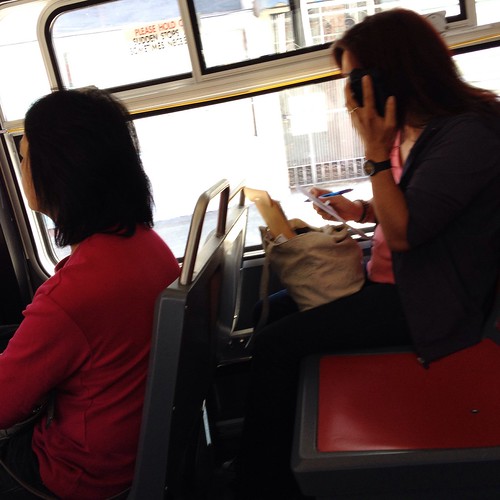
The annoying ass perp in pink.
I've blogged in the past about people who have done some annoying stuff on Muni (see questions and thoughts while riding Muni).  Number one was nail clipping because the sound is so irritating, but I think I found my new number one annoyance while riding Muni.

If you've watched the season premiere of South Park, it showed an irritated Kyle who is frustrated at Eric Cartman for having conversations on his cell phone by using his speakerphone everywhere he goes.

But while that happened in the animated television world, it happened on Saturday early afternoon when I was taking the 44 bus going northbound.  When the bus was in Golden Gate Park to stop in front of the Academy of Sciences, I saw a woman pull out her smartphone and was making a phone call.  All seemed normal at that point until I started hearing the automated telephone greeting through her speakerphone.

The entire back half the bus can hear the automated message on her phone and she was able to connect to a telephone operator to ask questions and get responses.  To make matters even more amusing, it was a conversation with the operator that would be confidential or a private matter, such as calling your credit card company or your doctor.  She continued having the conversation back and forth between the operator, and I can hear the conversation while I was listening to music with my headphones.  I snapped a couple of pictures of her so I can humiliate her on my blog, Twitter, and Instagram accounts.

Get off the bus and chat.
The people around me was rolling their eyes at her while the conversation kept going on, and it finally stopped when she exited the bus at 6th Avenue and Geary.  Thank my patience for not outbursting and telling her to shut the hell up or stop using the speakerphone, because I was getting close to doing just that.

Are some people so oblivious these days they'd pull a stunt like that on public transit?  It's a private conversation you fool!  Even the automated message on the bus reminds passengers to refrain from using their cell phones to prevent crime; it should also be a crime to yack on your cell phone with the speaker on.

Tuesday, October 1, 2013

No More Negative Clipper Card Balance to Exit BART - Starting October 5th


If you recall from a few years back, the Clipper card allowed BART passengers to enter the system with a minimum value on their card and exit the system with a negative balance.  If the card was unregistered, the card can be easily thrown in the trash and the taxpayer takes the brunt for the lost money.  Thanks to some news reporters exposing this problem, it exploded to the point where tens of thousands of dollars was being lost per month because people could cheat the system.  I tried to help mitigate the problem by encouraging people not to cheat the system.

Back in September 2011, the MTC estimated the loss due to people dumping their Clipper cards with negative balances was $360,000 in lost fare revenue, and when combined with the cost to procure the Clipper cards, the grand total was $700,000 a year.  It wasn't until June 2012 that the MTC had the guts to get the paperwork signed-off to get that loophole closed for the BART system.

The New Official Policy:
Over a year after the MTC approved the funding, BART made an announcement yesterday (September 30th) on their website.  It basically says that starting October 5, 2013, passengers will not be able to exit the system with a negative balance on their Clipper card.  Passengers with a card balance not enough to exit the system, will need to use an exitfare machine to add funds in order to be able to exit the system.

But there's a few catches with using the exitfare machines:
(1) You can only pay in cash to add additional funding to your card.  No credit or debit cards.
(2) It will only top-off to the amount necessary to exit the system.  That means once you paid the amount to the machine and exit BART, your card balance will be zero.
(3) The maximum amount of change the machine will return is $4.95.  Only have a $20 and you owe BART a dollar?  You just got screwed.

Two easy tips to avoiding the exitfare machines:
(1) If you have autoload (in which I personally do not recommend), you don't have to worry about using an exitfare machine because your card will automatically reload funds at a set tolerance limit.
(2) If you do not use autoload, keep an eye on your Clipper Card balance and make sure you add additional funds as necessary at any BART ticketing machine.