"Akit is the man. He knows Clipper." (spenta)
"It’s a fantastic blog for any San Franciscan."
(Kevin)
"Your blog is always on point, and well researched!" (Nina Decker)
"Everyone's favorite volunteer public policy consultant..." (Eve Batey, SF Appeal)
"You are doing a great job keeping on top of Translink stuff. Keep up the good work!"
(Greg Dewar, N Judah Chronicles)
"...I don't even bother subscribing anywhere else for my local public transportation info. You have it all..."
(Empowered Follower)
"If anyone at City Hall wants to make public transit better for all San Franciscans, it would be wise to follow Akit religiously...
or, better yet, give him a job."
(Brock Keeling, SFist)
Showing posts with label Japanese American. Show all posts

Tuesday, March 9, 2010

Japanese Americans Interned during WWII to be Honored at SF State's Commencement 2010


This blog entry is dear to my heart and my cultural heritage. Japanese Americans who were forcefully sent to the internment camps during World War II and had their higher education disrupted, are eligible for an honorary degree from the University of California, California State University, or the Community College systems. If the person has passed away, a family representative is able to accept the honorary diploma on their behalf.

My alma mater and employer, SF State will be one of the select CSU campus honoring those students who had their lives disrupted by one of the most disturbing civil rights violations in modern United States history. Other CSU campuses holding ceremonies: Dominguez Hills, Fresno, San Diego, San Jose, and Cal Poly SLO.

Each campus honors those who currently live within their region or the closest to their current home; for SF State, they will honor those currently living in the Bay Area, even if the person attended a different CSU campus.

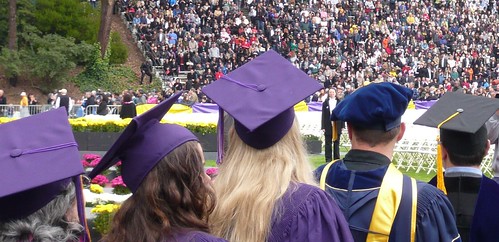
SFSU Commencement 2008 - Liberal Studies and Special Majors

For more information, please visit: SF State's Commencement page dedicated to the Nisei project - http://www.sfsu.edu/commencement/nisei.htm

If the student attended any CSU campus, please contact (562) 951-4723 or e-mail: nisei@calstate.edu

If the student attended a California Community College, or University of California campus, please review this info sheet (PDF) and contact the representative of the Japanese Cultural and Community Center of Northern California.

My wish came true, SF State President Robert Corrigan and other CSU campuses will give the honorary degrees at their commencement ceremonies. SF State will host their 109th Commencement on May 22, 2010.

Wednesday, September 23, 2009

BREAKING: Cal State University to Issue Bachelor Degrees to Japanese Americans Interned in WWII

This is truly a bittersweet moment to hear:

The Trustees of the California State University system will issue honorary bachelor degrees to any CSU student who was forcefully sent to internment camps during World War II (1941 to 1943).

The SF State Golden Gate [X]Press reports that all trustees voted in favor bill AB 37.

There are many Japanese American CSU students who were in college at the time of the war and had no choice but to leave when President Roosevelt signed Executive Order 9066 that forced all Japanese Americans on the west coast to evacuate to assembly enters, and eventually internment camps.

Executive Order 9066 is considered one of the worst modern day violations of civil liberties and human rights in the United States. It always puts tears in my eyes when the U.S. government finally said they are so sorry for committing such an atrocity and hardship on the interned Japanese Americans, and compensated them with $20,000.

It took the efforts of the JACL, NCRR, and advocates like my late grandmother, Tsukayo "Sox" Kitashima to campaign the government to issue a formal apology and designate funds to compensate the survivors, and that dream came true in 1989.

Today, in 2009, we can proudly say that the CSU system can now issue bachelor degrees to any surviving and posthumously students who had their lives shattered with the stroke of a President's pen.

It would truly be an honor to witness a commencement ceremony this year at SF State to have President Robert Corrigan issue that degree.

--------------------
If you know any individuals that should be issued their bachelor's degree, or need to inquire about the passage AB 37, please contact: (562) 951-4723.

Please make sure to advocate to the appropriate CSU campus President to also hold a ceremony at their commencement ceremony in May.

Wednesday, September 9, 2009

Time to say goodbye to the Nichi Bei Times

It's hard to believe the Nichi Bei Times will stop publishing this month after 63 years of printing their newspaper.

The Nichi Bei Times board has decided to shutter its doors on September 30th, and the last printed newspaper will be published tomorrow (Thursday, September 10th).

The Nichi Bei Times has been a staple of the Japanese Americans around the nation by keeping them in touch from particular issues or concerns, local community sports teams, major events, and the local churches. A lot of the material they publish targets the Japantown community of San Francisco and it allows everyone to be connected, regardless if a person visits the community every day or just occasionally.

Personally, I am very thankful for the Nichi Bei Times. They have helped me in so many ways, from publishing every "letters to the editor" I've ever submitted, publishing an article about my important thesis research on mixed heritage Japanese Americans, covering my work on the "Save Japantown" movement in early 2006 when the malls and hotels were put for sale, and honoring my late grandmother known as the "Godmother of Japantown."

Without their effors to inform readers about important topics and issues, it would have been much more difficult to secure redress for all surviving Japanese Americans interned in the camps during WWII.

For the Nichi Bei Times, publishing newspapers is becoming a dying breed. The internet and our web based cell phones can get news quicker and faster for free; printed media is becoming much more expensive with this economy: people are cutting back on their subscriptions, printing costs have skyrocketed, and paying for postage to mail the newspapers is so expensive. Look at AsianWeek, in just a flash, a nationwide newspaper disappeared.

--------------------

So, what is next for the Nichi Bei Times? The veteran staff are trying to start a foundation that will be a non-profit and supported by donations and grants, and they will face an uphill battle to get something in print. As I mentioned earlier, there are many cost factors going against printed news media. I hope they can raise enough money to keep this community newspaper going.

Friday, April 3, 2009

Not in Touch with the Japanese American Issues - The SF Cherry Blossom Queen Program


Featured in this week's Nichi Bei Times is the upcoming 2009 Cherry Blossom Festival, and will take over the neighborhood for two weekends on April 14, 15, 21, and 22. One of the major events of the Cherry Blossom Festival is the Queen program, which offers young adult Japanese American women an opportunity to participate in a "pageant" (however, I have been told this word is not used anymore) where the six candidates compete over the queen title. But more importantly, they learn about traditional (Meiji era) Japanese customs, the "spirit" of the Japanese American community, proper etiquette, and community service.

As part of my thesis work, I mentioned a lot about this queen program and how it affects the community with regard to the mixed heritage/ethnicity/race issues. One of my goals with my Master's thesis work is to share my research and opinions with the community, and I feel that now is the perfect time for you readers to get an insight into the controversy of the queen program and how its policies affect more than just women trying to win the title of "Queen."

---------------

As Asian American Studies experts know, the next generations of Japanese Americans are becoming much more mixed, with Census statistics showing over 50% of the 0-30 year old Japanese American population being mixed with another ethnicity or race. This is primarily due to a high outmarriage rate, as well as a lack of immigration of Japanese citizens to the United States today. In order for some Japanese American programs to survive, they created eligibility policies, which was enforced by the percentage of Japanese ethnicity.

The mixed heritage issue and topic has created a rift in the community, where some still have decided on a strict standard of enforcement by blood, while others have welcomed anyone, regardless of their Japanese American ancestry to participate. People's reactions are also a mixed bag, where some feel disgusted that there is even a mixed Japanese American population, others welcome it and are willing to discuss it openly, and there are many who are not interested in talking about it or don't even understand the potential issues, benefits, and problems.

---------------

What made me want to write this blog piece is with regards to the interview portion of the queen candidates in the newspaper. Everyone was asked the same questions, but this particular question I noticed hit a personal nerve:
  • "Given the high rates of intermarriage/outmarriage in the Japanese American community, and current rules and regulations, it may be possible that your children or grandchildren may be excluded from participation in such things as this Queen Program and some sports leagues. How do you feel about this prospect?"
The question the program organizers asked is in really poor taste with my personal view of the future of Japanese American communities. What they are trying to encourage is to keep enforcing this ethnic standard, in which we can allow or deny an individual access to programs and services in the Japanese American community in the future on the basis of their blood, but also on the way they look, and their personal feelings and attachment to the Japanese American culture.

The potential problem of the continual restrictions for people to access programs and services like the queen program and basketball leagues is that it starts tearing the community apart. The Japantown community and its population is shrinking; but when we add a growing population of mixed heritage individuals that will become even more diverse generation after generation, people will shy away from Japanese American communities because they are not welcomed.

Are the queen program/pageant organizers trying to put a fear tactic into the community saying that "your future children and grandchildren are not welcomed" if people marry someone other than a person of Japanese ancestry?

When we tell people that you are not "welcome" to a Japanese American community, the overall power of the community goes down. When the community faces troubling issues, only the "welcomed" individuals will step-up and fight for the community, but the consequence is that by excluding people, you also don't have as much power to fight back.

It should be noted: Japanese American sports teams used to enforce a 50% Japanese Ancestry rule, but have decided that since the kids participating are sometimes 25% Japanese American, that excluding them from opportunities to be part of the Japanese American community is inappropriate. The Queen program still enforces a minimum 50% ancestry rule.

---------------

So what am I proposing? I think Japanese American communities should drop the ethnicity policies for programs like the queen program.

The queen program has been extremely controversial. While on one end, having ethnicity regulations for eligibility helps preserve the program to be "Japanese," others can be disqualified if they are less than 50% Japanese American by ethnicity, REGARDLESS if they have a stronger sense of Japanese American identity over someone who may be 100% Japanese American by ethnicity.

If someone was only 25% Japanese American by ancestry, but feels 100% Japanese and participate in the Japanese American heavily, it's just not fair to exclude her from participating in a program that recognizes good people doing good things for their community.

Lastly, with a high population of mixed heritage individuals, a portion of our next generation of community leaders and organization high-ranking officers will be mixed. My thesis research shows that the leadership within the mixed Japanese American population: females will lead the community; but even more interesting is that women of Japanese-White ancestries will be more likely the leaders.

I know that I'm going to generate a lot of heat in Japantown for this blog posting when Cherry Blossom comes around. They all know where to find me.
Sunday, October 26, 2008

Why do people insult Ethnic Studies?


40 years ago, San Francisco State University was home to the longest student led strike in American history, and this created the school (now college) of Ethnic Studies, and is the only such "College" in the entire United States.

I respect that, regardless of the insane violence, police clashes, and everything else. SFSU is home to something really special.

Even for me, I thought I would go into a career of being an English teacher for the public high schools, but my new love came to Asian American Studies. I knew I had a great background way before college because of my deep connections to the Japanese American community (Japantown) in San Francisco, and the respect of the members of the community who believe my late grandmother is the hero of the community for being one of the major leaders of the Japanese American redress movement.

The 40th anniversary is a proud moment for SFSU, and it's not just history. The classes offered today provide a wide opportunity to learn about ethnic cultures (other than white/European American), and especially amazing is you can learn about one specific ethnicity in three different courses including history, psychology, and literature. Even more is that the interdisciplinary courses discover things like the film industry, how it relates to today's modern U.S. government, and even mixed heritage studies. And whether or not you realize it, some popular local celebrities were also part of our family, including Malou Nubla who attended Professor Dan Gonzales' class and also was head of PACE (Pilipino American Collegiate Endeavor), and comedian Rex Nevarrette who respects the college for giving him a career in comedy.

And I'm proud to be part of this wonderful group, not just a B.A. degree holder in Asian American Studies, but also I'm close to earning my M.A. in the same topic too.

Yet... out of all this great news and pride, comes the sour part to all of this. I recently posted a comment on the SFGate comment boards noting my appreciation for the College and its programs, but soon later got pelted by others saying that Ethnic Studies is an insult. Including one literally pointing out that I won't have any kind of career (stating that I will be working at some fast food joint).

It almost seems that Ethnic Studies in college today has to be defended every single day in this country.

So here's my arguments/defense towards those insults:
  • Yes, I do have a career. I work part-time as an Administrative Assistant while I work on my Master's degree. My knowledge in ethnic studies earns a high degree of respect in my field because of the uniqueness and very diverse population of people we work with.
  • James Hirabayashi was the first dean of the school of Ethnic Studies at SFSU, and he stated that as students and graduates of the Ethnic Studies program, it becomes our responsibilities to use the knowledge we received and apply that to our communities. So therefore, there is a career for people like me!
  • Elementary through high school teaches the Eurocentric point of view, and people rarely learn about the other views of so called "American history." Ethnic Studies gives that other view of history. Ethnic Studies also tells about the history that the Eurocentric view would never talk about, for example the International Hotel controversy in San Francisco's Manilatown, and why San Francisco's Chinatown looks "Oriental" when rebuilt after the huge fire after the 1906 earthquake.
  • Without Ethnic Studies, ethnic communities in the SF Bay Area would lack the leadership and proper knowledge about the history of the ethnic group(s) they represent. The Japantown community has leaders who are well versed in the topic of Japanese American culture, with many who have taken ethnic studies or have teached Asian American Studies to other students.
  • Without Ethnic Studies, who will teach their children (or future children) about their ethnic background(s)? I don't have a child, but if he/she asked me about their ethnic heritage, I would tell them the whole story about my Japanese and Chinese heritage, thanks to the folks of Ethnic Studies.
  • A particular example of passing on Ethnic Studies to the young is a program known as PEP. Volunteer students from SFSU teaches young Pilipino students in High School about their culture through a very unique teaching style that is being recognized nationally as a way to teach ethnic studies to people who are not of college age.
  • Research about ethnic groups (other than whites) is absolutely necessary today. The birth of Asian American Studies has spurred a lot of research in just the last forty years, investigating issues from Chinese Americans involved with Christianity, and how ethnic beauty pageants can be controversial.
  • Without an Asian American Studies background, I would have not been able to lead and defend Japantown in 2006 when major properties were put up for sale, equaling about 1/3 (one-third) of the entire community. Without my vast knowledge about Japanese Americans, I could not have started a petition drive that received over 16,000 signatures, and write empassioned messages to other ethnic communities asking for their help. For example: I contacted a bunch of my Pilipino American friends and explained to them that losing Japantown is just like losing the I-Hotel, and Japanese Americans were there when the I-Hotel was under attack by riot cops trying to evict the tenants.
  • Ethnic Studies is not a waste of a college's/university's money. It demonstrates that educational institutions needs to teach about other views of American history. One example: Eurocentric American history might just seldom mention about the Japanese American Internment Camps and a brief history about how they won redress. Asian American Studies focusing on Japanese American Studies gives their take to the whole camp and redress experiences through many readings and since it's specific to Japanese American history, can really focus on what makes this topic so important. Try asking detailed questions to a Eurocentric American history teacher... they might say "go see an Ethnic Studies professor for help" (then, they'd get fired for lack of knowledge).
There's my main points to this. If you still feel that Ethnic Studies is a waste of college resources and an insult to Universities, then come see me, and I'll drag your butt to people I know who will whip you into shape. I used a similar defense during the time when Japantown's festivals were recently threatened and noted that those people who wrote those mean spirited letters should come see me, and I'd let them meet the people in-person, the hard working volunteers that gets paid nothing other than seeing their community thrive and be proud. Some of them have been active in the Japantown community for over 40 years, now that's real respect and pride right there.

There's a reason why I quote Professor Dan Begonia on the bottom of my blog, I respect that guy for giving me the power to be a proud Asian American, and to continue on the tradition of promoting Ethnic Studies by leading our ethnic communities to a bright future.

(Photograph from left to right: Jon, Melissa, and myself. The three of us are part of the Master's program in Asian American Studies at SFSU.)