Welcome to Akit.Org, home to the Complaint Department and started on February 7, 2002. Featured on: SFist, Curbed SF, SF Citizen, N Judah Chronicles, SF Examiner, SFGate, Rescue Muni, SF Appeal, Pacific Citizen, NBC Bay Area, SF Weekly's The Snitch, Streetsblog SF, and Muni Diaries.
"Akit is the man. He knows Clipper." (spenta)
"It’s a fantastic blog for any San Franciscan." (Kevin)
"Your blog is always on point, and well researched!" (Nina Decker)
"Everyone's favorite volunteer public policy consultant..." (Eve Batey, SF Appeal)
"You are doing a great job keeping on top of Translink stuff. Keep up the good work!" (Greg Dewar, N Judah Chronicles)
"...I don't even bother subscribing anywhere else for my local public transportation info. You have it all..." (Empowered Follower)
"If anyone at City Hall wants to make public transit better for all San Franciscans, it would be wise to follow Akit religiously...
or, better yet, give him a job." (Brock Keeling, SFist)
"It’s a fantastic blog for any San Franciscan." (Kevin)
"Your blog is always on point, and well researched!" (Nina Decker)
"Everyone's favorite volunteer public policy consultant..." (Eve Batey, SF Appeal)
"You are doing a great job keeping on top of Translink stuff. Keep up the good work!" (Greg Dewar, N Judah Chronicles)
"...I don't even bother subscribing anywhere else for my local public transportation info. You have it all..." (Empowered Follower)
"If anyone at City Hall wants to make public transit better for all San Franciscans, it would be wise to follow Akit religiously...
or, better yet, give him a job." (Brock Keeling, SFist)
Showing posts with label newspaper. Show all posts
Wednesday, October 26, 2011
Fail Alert: Does the San Francisco Chronicle Cost Just 3/4 of a Cent? [Photo]
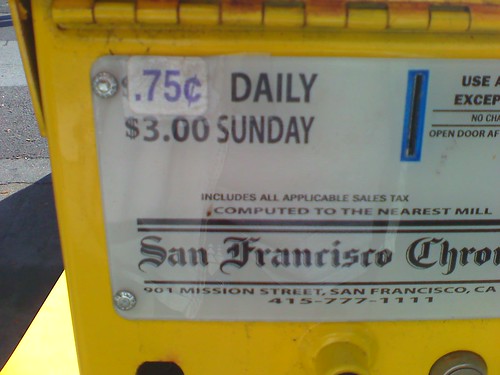
Here's a peculiar photo I took a few weeks back. I was having a nice scoop of sherbet at Joe's Ice Cream and was looking at the newspaper machines just in front of the establishment. The Chronicle's yellow machine said the price of a Monday-Saturday newspaper is just ".75¢" which made me think about that price.
.75¢ means 3/4 of one penny (or $0.0075); if you remove the dot, 75¢ means $0.75 or 3/4 of one dollar.
If you seem confused, so was I. Here's an easier way to think of it: Let's say the sticker price on the machine said 1.75¢, then that would mean it would be one cent plus 3/4ths of a cent to buy a newspaper.
Hmmm, I wonder if I cut a quarter of a penny and drop it in the machine, would I get a newspaper? Okay, it's just a fun question and blog post, and we all know it costs $0.75 to buy a paper, and the machine doesn't accept pennies.
Even then, some crazed-up lawyer could think about suing the Chron for misleading customers by not selling the paper for the advertised price.
I have a good eye to seek out fails!
Friday, September 9, 2011
Countering Against the Bay Citizen's Anti Clipper Card Article

Contrary to popular belief in a Bay Citizen/NY Times Local article, there's a lot of people who are not having problems with their Clipper card on public transit.
Everyone knows that if 99%+ is having no problems, there's always that 1% or less that will have problems, and some of that group will whine and scream like uncontrollable children that poisons the huge majority experiencing no or very minor issues (e.g. self service bill feeder not functioning) and that the problems are worse than it should be.
From reading the Bay Citizen article, I feel it's one sided and only targets certain isolated incidents. In the beginning of the article, it mentions about a single BART gate that would read the card, but the gates wouldn't open for people. That's just an isolated incident because it doesn't happen anywhere else on the BART system based on my own experience, it's likely a malfunctioning gate that refuses to open.
There's other things I want to dispute about the article:
There's a mention that there was 38,000 calls to the "customer service hotline" during the month of August. Well, does that mean 38,000 calls to speaking to a customer service agent, or does that also include calls for people using the automated system to find out their card's balance? Let's also remember that there's been a huge campaign push by Muni and AC Transit to get students on Clipper cards due to a mandatory switch from paper passes to Clipper cards, and parents wants to call to find out how do to it; students during August went back to school and the need to get their specialized Clipper card to get to school. When Caltrain switched to Clipper only, they had a high number of calls to customer service, but that has died down as people understood how it worked and investment in a PR campaign at Caltrain stations, even though the use of monthly passes and 8-rides is stirred with complexity.
500K transactions daily: Author points out it is not 500K passengers. No shit, Sherlock. "Transactions" means how many Clipper cards was scanned in one day. If you asked Clipper how many passes was sold, they'd be able to give you a rough number of regular passengers using transit on a normal weekday (not including e-cash passengers). If you know that around 35% of BART passengers uses Clipper, do some math: Ask BART how many passengers on a weekday, and use a calculator. Also, since nearly all Golden Gate passengers uses Clipper due to the automatic discount for all card users, that wouldn't be so bad to find the round figure.
Caltrain is mentioned about when there's an incident holding up passengers on the trains, but noting that passengers have four hours and can't tag-off in time is just isolated incidents that can be resolved by just asking for a proper credit from Clipper. Clipper had to set a four hour limit from the tag-in at a Caltrain reader, which is FAIR for a passenger to complete a one way journey.
There's a mention about Muni's alleged electrical irregularities causing Clipper readers to crash. The author says it happens "regularly," but I don't see it that often happening, and especially that Clipper readers also have a backup battery for power problems or bus engine shut downs. I live near a major bus line terminus where drivers are required to shut down their gas engine, but the Clipper readers run normally without depending on the engine. Muni had common problems in the past with the historic streetcar fleet as the electricity was sometimes inadequate (ever seen the lightbulbs flash when crossing a wire junction?), but was able to resolve it with a software update. It's very RARE for the readers to fail for that particular reason. Muni rules state if a reader is broken, operators are required to report it immediately and rides are free (equivalent to a broken cash fare box).
Is there any proof that Clipper cards are to blame for the drop in on-time service for Muni? A different cause could be a change in ridership due to the rising gas prices and with the economy tanking, and students returning to school. It could also be the upset Muni operator's union who had their ass kicked by Proposition G by pissing off the public by unofficially slowing the system down.
Lastly, some passenger accuses Clipper for losing $80 for a card that "failed to work." Okay, so, what's the full story on that and why is it failing? Just saying you can't resolve the lost $80 doesn't mean there's something Clipper is always to blame.
I will mention one thing that most would agree upon:
If you have the option to not use Clipper's Autoload program, DON'T USE THE PROGRAM. The biggest complaints I hear is their credit card is rejected and blocked; sometimes on a weekly basis. I don't know what to say is the cause of all the rejections, but the easiest way to avoid this is to not link your credit card to your Clipper account. Just spend five to ten minutes every week or two and load Clipper e-cash or buy your passes at an in-person vendor, self service machine, or a transit agency's ticket sales booth. I never had my Clipper card blocked because I don't use Autoload; I remind myself on a monthly basis to visit a Walgreens or drop by a metro station to buy my monthly Muni pass. Read more about why I don't recommend Autoload.
Finally...
On a final note, why isn't Clipper or the MTC doing some better PR? They rarely put out press releases or talk to the public while other agencies like SFMTA/Muni has full-time staff dedicated to giving information to the general public and the press.
I enjoy blogging about Clipper as a hobby to the point where people trust me for info and advice more than Clipper itself. The Bay Citizen should have interviewed me for a perspective, but my bets are the author wanted to make it an anti Clipper article and not take the opinions and views of someone who knows the program better and writes more about it than any blog or newspaper in the Bay Area.
Thursday, October 29, 2009
Hokubei Mainichi Newspaper Shutters Friday
It's shocking to hear the Nichi Bei Times disappeared not long ago, but it's even worse to hear that the second major Japanese American newspaper institution, the Hokubei Mainichi is going to end their news service with it's last edition tomorrow (Friday).
These newspapers are the lifeblood of the Bay Area Japanese American communities, especially San Francisco's Japantown. People rely on these newspapers for important information about events around their communities and important community issues.
This doesn't leave us with many media options out there. The Rafu Shimpo is the Buddhist Church's newspaper, and the Pacific Citizen is a newspaper operated by the Japanese American Citizens League with their primary news office in Southern California.
Sure, the Nichi Bei foundation is trying to get themselves going, but it lost a lot of its readership after the last edition of the Nichi Bei Times notified people that their current subscription is to abruptly end and they must pay to subscribe to the "foundation's" newspaper.
On a final note, I do miss the Nichi Bei Times and Hokubei Mainichi. Without their efforts to spread the word about the redress movement to get compensation and an apology from the federal government for sending Japanese Americans to internment camps, the effort would have been even more difficult. I appreciate their hard work to cover the news on projects I have helped lead that have made a difference to the Japantown community, including the "Save Japantown" movement and to fight back from mean criticism from the folks at 1600 Webster.
These newspapers are the lifeblood of Japantown, please don't go away forever.
These newspapers are the lifeblood of the Bay Area Japanese American communities, especially San Francisco's Japantown. People rely on these newspapers for important information about events around their communities and important community issues.
This doesn't leave us with many media options out there. The Rafu Shimpo is the Buddhist Church's newspaper, and the Pacific Citizen is a newspaper operated by the Japanese American Citizens League with their primary news office in Southern California.
Sure, the Nichi Bei foundation is trying to get themselves going, but it lost a lot of its readership after the last edition of the Nichi Bei Times notified people that their current subscription is to abruptly end and they must pay to subscribe to the "foundation's" newspaper.
On a final note, I do miss the Nichi Bei Times and Hokubei Mainichi. Without their efforts to spread the word about the redress movement to get compensation and an apology from the federal government for sending Japanese Americans to internment camps, the effort would have been even more difficult. I appreciate their hard work to cover the news on projects I have helped lead that have made a difference to the Japantown community, including the "Save Japantown" movement and to fight back from mean criticism from the folks at 1600 Webster.
These newspapers are the lifeblood of Japantown, please don't go away forever.
Wednesday, September 9, 2009
Time to say goodbye to the Nichi Bei Times
It's hard to believe the Nichi Bei Times will stop publishing this month after 63 years of printing their newspaper.
The Nichi Bei Times board has decided to shutter its doors on September 30th, and the last printed newspaper will be published tomorrow (Thursday, September 10th).
The Nichi Bei Times has been a staple of the Japanese Americans around the nation by keeping them in touch from particular issues or concerns, local community sports teams, major events, and the local churches. A lot of the material they publish targets the Japantown community of San Francisco and it allows everyone to be connected, regardless if a person visits the community every day or just occasionally.
Personally, I am very thankful for the Nichi Bei Times. They have helped me in so many ways, from publishing every "letters to the editor" I've ever submitted, publishing an article about my important thesis research on mixed heritage Japanese Americans, covering my work on the "Save Japantown" movement in early 2006 when the malls and hotels were put for sale, and honoring my late grandmother known as the "Godmother of Japantown."
Without their effors to inform readers about important topics and issues, it would have been much more difficult to secure redress for all surviving Japanese Americans interned in the camps during WWII.
For the Nichi Bei Times, publishing newspapers is becoming a dying breed. The internet and our web based cell phones can get news quicker and faster for free; printed media is becoming much more expensive with this economy: people are cutting back on their subscriptions, printing costs have skyrocketed, and paying for postage to mail the newspapers is so expensive. Look at AsianWeek, in just a flash, a nationwide newspaper disappeared.
--------------------
So, what is next for the Nichi Bei Times? The veteran staff are trying to start a foundation that will be a non-profit and supported by donations and grants, and they will face an uphill battle to get something in print. As I mentioned earlier, there are many cost factors going against printed news media. I hope they can raise enough money to keep this community newspaper going.
The Nichi Bei Times board has decided to shutter its doors on September 30th, and the last printed newspaper will be published tomorrow (Thursday, September 10th).
The Nichi Bei Times has been a staple of the Japanese Americans around the nation by keeping them in touch from particular issues or concerns, local community sports teams, major events, and the local churches. A lot of the material they publish targets the Japantown community of San Francisco and it allows everyone to be connected, regardless if a person visits the community every day or just occasionally.
Personally, I am very thankful for the Nichi Bei Times. They have helped me in so many ways, from publishing every "letters to the editor" I've ever submitted, publishing an article about my important thesis research on mixed heritage Japanese Americans, covering my work on the "Save Japantown" movement in early 2006 when the malls and hotels were put for sale, and honoring my late grandmother known as the "Godmother of Japantown."
Without their effors to inform readers about important topics and issues, it would have been much more difficult to secure redress for all surviving Japanese Americans interned in the camps during WWII.
For the Nichi Bei Times, publishing newspapers is becoming a dying breed. The internet and our web based cell phones can get news quicker and faster for free; printed media is becoming much more expensive with this economy: people are cutting back on their subscriptions, printing costs have skyrocketed, and paying for postage to mail the newspapers is so expensive. Look at AsianWeek, in just a flash, a nationwide newspaper disappeared.
--------------------
So, what is next for the Nichi Bei Times? The veteran staff are trying to start a foundation that will be a non-profit and supported by donations and grants, and they will face an uphill battle to get something in print. As I mentioned earlier, there are many cost factors going against printed news media. I hope they can raise enough money to keep this community newspaper going.
Subscribe to:
Posts (Atom)
