"Akit is the man. He knows Clipper." (spenta)
"It’s a fantastic blog for any San Franciscan."
(Kevin)
"Your blog is always on point, and well researched!" (Nina Decker)
"Everyone's favorite volunteer public policy consultant..." (Eve Batey, SF Appeal)
"You are doing a great job keeping on top of Translink stuff. Keep up the good work!"
(Greg Dewar, N Judah Chronicles)
"...I don't even bother subscribing anywhere else for my local public transportation info. You have it all..."
(Empowered Follower)
"If anyone at City Hall wants to make public transit better for all San Franciscans, it would be wise to follow Akit religiously...
or, better yet, give him a job."
(Brock Keeling, SFist)
Showing posts with label Japantown. Show all posts

Friday, January 11, 2013

Strange Observation About the SF Parking Meters - 25 Cents an Hour?

Parking in San Francisco can be a challenge, and those pesky parking meters can empty your pockets of quarters in no time.

Even the city owned garages have odd prices.  Now they charge more for times when parking is in high demand, but gives a nice lower price during less demand.

I've had an interesting experience today when I had to go to a dental appointment this morning in Japantown:

Since my appointment was at 9AM, I arrived too early in the neighborhood, so I parked in a parking space just across the street from the dental office.  The meter said starting at 9AM, the parking fee would be $2 per hour.

Since I had some time to burn, I got back in my car since it was cold and played around with the SFpark iPhone application.  It was correct that the parking would be $2 an hour, so I toyed around with the application to see how much it would cost to park somewhere further.

Around the corner from where I parked, the 9AM price was $1.50 an hour.  Not bad for a small 50 cent savings, but how about on Geary Boulevard?  I found out the parking on Geary Boulevard is just 25 CENTS PER HOUR from 9AM to noon.  What a heck of a bargain and it was just an extra couple of minutes walk from where I was currently parked.

Really?  Just 25 cents?  That's a huge difference than on Post Street where it would have cost me $2 a hour.

Also, one of the perks of parking at one of those smart looking meters is I can pre-pay the meter.  Since my appointment was at 9AM, I put 50 cents in the meter for two hours at 8:45AM, and the meter won't deduct the money until 9AM, therefore the meter would expire at 11AM.


The SFpark app sure did help me save some money on parking.  It's good when you are looking for cheap parking in the morning when there are few cars, but if it's a busy day and parking is pretty bad, the app won't help you because you'll take any parking space you'll find and pay whatever price it says. (Disclaimer: Don't use the app while driving)

I highly suggest purchasing a SFMTA Parking Card.  It's accepted at all city parking meters, and it's better than a credit card because not all city meters accepts Visa or MasterCard.

Tuesday, April 19, 2011

Warm Fuzzy Feelings at the Cherry Blossom Festival


I'd like to give a big thanks to everyone attending the Northern California Cherry Blossom Festival at SF's Japantown over the weekend. The weather was a little windy, but everyone had a great time with the parade and all the fun booths selling all kinds of goodies.

One thing I'm especially proud about is the people who generously donated to the earthquake and tsunami relief fund during the festival.

On Saturday, the Teriburger booth had one of those donation cans on their counter, but hardly received any donations. I thought to myself, why don't I solicit donations as part of my duties at the booth?

It worked out! I'm the street barker for Kimochi's Teriburger booth and I was advertising our burgers and also asking for donations by holding onto the donation can. Donations kept coming in, just within the first 30 minutes, I had several people drop their coins and dollar bills in the can. At other times, I had people feeding $20 bills. On multiple occasions, the can got so full, I had to push down the bills as far as I can just to accept more cash.

It's also nice to hear some of the great stories from people:
  • A child donated all of her piggy bank savings.
  • A second child sold baked goods in front of her home and donated all the proceeds.
  • One said she already donated $80 and donated more out of kindness.
In the end, word has it the festival generated $200,000 in donations to help Japan. The Japanese Cultural and Community Center of Northern California already received over $1,000,000 donations and the extra $200K will do great help.

Thanks for a great weekend!

Friday, April 15, 2011

Come on Down to the SF Cherry Blossom Festival This Weekend - Maybe Meet Akit In Person!


This weekend is the second weekend of the Northern California Cherry Blossom Festival in San Francisco's Japantown. If you went to last weekend's, you'll notice this weekend will be more crowded and more popular...

Why? The big parade is this Sunday afternoon with approximately 45 groups marching in the parade from Civic Center to the heart of Japantown. Don't forget the Taru Mikoshi which is the exciting climax of the parade when 100 individuals carry a huge portable shrine down Post Street.

But as always, my personal favorite part of the festival is all the great food! Who can resist all the tasty temptations? There's so much for everyone's tastebuds: Japanese beer, shaved ice, udon noodle bowls, riblets, spam musubi, and the famous Teriburgers (there's plenty more than this short list).

Don't forget, all the food booths are for great causes. No, you are not feeding money into some for-profit company; each booth supports a great community non-profit organization, including childcare centers, senior services, cultural programs, Boy Scouting, churches, and for earthquake relief to those affected in Japan. To make it even sweeter, all the people working the booths are volunteers, including some of my family friends who have done it for over 30 and sometimes 40+ years.

Want to meet me at the festival? I'll be volunteering in the food booth area on both days for my favorite organization, Kimochi.

Tuesday, August 31, 2010

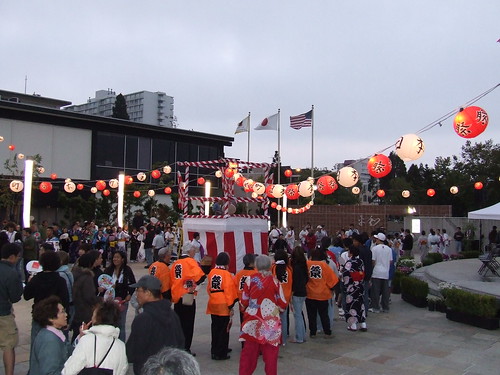
Disappointed at Sunday's Japantown Lantern Festival

On Sunday, August 29th, Japantown hosted the Lantern Festival which celebrated the 150th anniversary of the arrival of Japanese ship the Kanrin Maru to San Francisco Bay.

This event may have been a substitute for the neighborhood's annual Fall Festival where the Peace Plaza was used to for Obon line dancing and programs, however in previous years, the annual event was held in October.

I was excited to visit the place I call "home" to meet all my friends, but I was very disappointed with the event when I arrived to watch the last few hours.

There was several problems with the event that disappointed me and many other people from the community, including one of my friends who is an editor for the Nichi Bei Weekly (formerly known as Nichi Bei Times):
  • Lack of advertising of event.
  • Lack of planning and preparation for event.
  • Lack of participation.
  • Master of ceremonies was a terrible public speaker. Did not give clear instructions to the Obon dancers.
  • Lantern parade was an embarrassment to our honored guests from Japan.
  • Huge gaps in the Obon line dancing. People did not spread-out evenly and refused to follow the chalk lines to make it look orderly.
If the Japantown community wants to host another similar festival like this, keep it at the Peace Plaza. It's more intimate in a smaller venue than literally using an entire city block.


Friday, April 9, 2010

Visit San Francisco's Cherry Blossom Festival 2010


Horray! It's the return of SF Japantown's favorite festival, the Cherry Blossom Festival!

Why am I in such a great mood? It's the time for Japantown to show its best to everyone. From cultural performances, live bands, homemade arts and crafts, and amazing food supporting great community organizations.

Likewise, I wish I could title this posting: "Meet Akit at the Cherry Blossom Festival" because I'm the guy for over 10 years at every J-Town festival holding the Teriburger sign, but I can't be there this year. For the past month, I've been suffering through three different foot injuries (two to my right and one to my left), and it's too risky to be standing for up to 10 hours per day. It's a sad moment for me, but I know the world won't collapse because I can't be volunteering.

On the brighter end, I hope you can drop by to Japantown for the festival. As always, you'll try such amazing food from all kinds of great Japantown community organizations, and you'll know that every dollar you contribute goes to great causes, because that's the spirit of our community festivals.

I know there's so much going on around the city this weekend (Sunday Streets, baseball, etc.), make sure to drop by J-Town for a little bit of fun too!

For tips on a great time at the festival, read this previous entry from my blog.

Good info:
  • First weekend: April 10 and 11.
  • Second weekend: April 17 and 18.
  • Operating hours: Approximately 10:30AM to 5PM (sometimes 6PM).
  • Main festival areas: Post St. between Laguna and Fillmore, Webster between Geary and Sutter.
  • Parade on Sunday, April 18th from Civic Center to Japantown. Starts around 1PM.
  • More information: http://www.nccbf.org/

Wednesday, November 25, 2009

Akit's Furlough Adventure #7: Japantown


Being on furlough this week is sort-of boring and I'm trying to find things to kill time. I thought it would be fun to go to one of my favorite neighborhoods, Japantown!

San Francisco's Japantown is home to a lot of great Japanese restaurants, non-profit community organizations, great hotels, and a heck of a shopping experience.

I know if you have gone to J-Town, you have been to Ichi Ban Kan, a place full of housewares, food products, personal grooming supplies, and ice cold beverages for a low price. They even carry unique items from Japan like Hi-Chews in a larger pack than the ones made for the United States distributors. They even carry unique flavors including peach.

Daiso recently opened-up in Japantown as well, and they are a huge Japan based worldwide chain store famous for items at a low price. Around the stores in the United States, they sell 95% of their products for only $1.50. One of their popular items are the keychain lights (in photograph) that retail at places like Brookstone for about $15, but it's only $1.50 at Daiso. The store in Japantown is SMALL and the one in Serramonte is huge with a big variety of items.

Between the two places, I like Ichi Ban Kan better with the large food variety. But I will admit that I like Daiso for the affordable plastic containers and such, and I prefer the one in Serramonte over the Japantown location because they accept credit cards.


As for lunch, a hearty meal for under $10 at Mifune includes cold soba (buckwheat) and udon (rice) noodles with tempura and their famous dipping sauce.

Have a happy Thanksgiving! If you are going out for Black Friday shopping, get there early and dress warmly.

Thursday, October 29, 2009

Hokubei Mainichi Newspaper Shutters Friday

It's shocking to hear the Nichi Bei Times disappeared not long ago, but it's even worse to hear that the second major Japanese American newspaper institution, the Hokubei Mainichi is going to end their news service with it's last edition tomorrow (Friday).

These newspapers are the lifeblood of the Bay Area Japanese American communities, especially San Francisco's Japantown. People rely on these newspapers for important information about events around their communities and important community issues.

This doesn't leave us with many media options out there. The Rafu Shimpo is the Buddhist Church's newspaper, and the Pacific Citizen is a newspaper operated by the Japanese American Citizens League with their primary news office in Southern California.

Sure, the Nichi Bei foundation is trying to get themselves going, but it lost a lot of its readership after the last edition of the Nichi Bei Times notified people that their current subscription is to abruptly end and they must pay to subscribe to the "foundation's" newspaper.

On a final note, I do miss the Nichi Bei Times and Hokubei Mainichi. Without their efforts to spread the word about the redress movement to get compensation and an apology from the federal government for sending Japanese Americans to internment camps, the effort would have been even more difficult. I appreciate their hard work to cover the news on projects I have helped lead that have made a difference to the Japantown community, including the "Save Japantown" movement and to fight back from mean criticism from the folks at 1600 Webster.

These newspapers are the lifeblood of Japantown, please don't go away forever.

Wednesday, September 9, 2009

Time to say goodbye to the Nichi Bei Times

It's hard to believe the Nichi Bei Times will stop publishing this month after 63 years of printing their newspaper.

The Nichi Bei Times board has decided to shutter its doors on September 30th, and the last printed newspaper will be published tomorrow (Thursday, September 10th).

The Nichi Bei Times has been a staple of the Japanese Americans around the nation by keeping them in touch from particular issues or concerns, local community sports teams, major events, and the local churches. A lot of the material they publish targets the Japantown community of San Francisco and it allows everyone to be connected, regardless if a person visits the community every day or just occasionally.

Personally, I am very thankful for the Nichi Bei Times. They have helped me in so many ways, from publishing every "letters to the editor" I've ever submitted, publishing an article about my important thesis research on mixed heritage Japanese Americans, covering my work on the "Save Japantown" movement in early 2006 when the malls and hotels were put for sale, and honoring my late grandmother known as the "Godmother of Japantown."

Without their effors to inform readers about important topics and issues, it would have been much more difficult to secure redress for all surviving Japanese Americans interned in the camps during WWII.

For the Nichi Bei Times, publishing newspapers is becoming a dying breed. The internet and our web based cell phones can get news quicker and faster for free; printed media is becoming much more expensive with this economy: people are cutting back on their subscriptions, printing costs have skyrocketed, and paying for postage to mail the newspapers is so expensive. Look at AsianWeek, in just a flash, a nationwide newspaper disappeared.

--------------------

So, what is next for the Nichi Bei Times? The veteran staff are trying to start a foundation that will be a non-profit and supported by donations and grants, and they will face an uphill battle to get something in print. As I mentioned earlier, there are many cost factors going against printed news media. I hope they can raise enough money to keep this community newspaper going.

Monday, August 10, 2009

Nihonmachi Street Fair 2009 Recap (It's Not Good)

The 36th annual Nihonmachi Street Fair in San Francisco's Japantown went well, and thankfully, no grouchy condo developers and tenant board presidents going after the event this round.

There was a decent crowd this year, but if you try to compare Cherry Blossom to Nihonmachi, Cherry Blossom gets more people than Nihonmachi. If you think about how these events work, Cherry Blossom is way more organized and has better control than Nihonmachi; yet, the history of the Nihonmachi Street Fair is basically the idea of people simply coming together to have fun, and Cherry Blossom was made for the local businesses to attract more customers.

I'm going to be blunt, Nihonmachi Street Fair has been failing in terms of organizing (management)
. I've been volunteering with a non-profit organization who makes and sells the famous "Teriburgers" and many of our volunteers can see how much we and other food booths were suffering. Here's a short list:
  1. Poor location, they sent all the food booths to Webster street and part of Post Street (west of Webster).
  2. No entertainment stage, not even a radio station sponsor playing music.
  3. Only six non-profit organizations were selling food, everyone else was for-profit. This violated the "spirit" of the event.
  4. Many food booths saw a severe lack of customers due to the bad location and entertainment factors.
  5. Lack of advertising.
This really didn't go well for everyone. While I know the food booths made some kind of a profit, the Street Fair committee did a terrible job this year.

Everybody knows that music and food comes together. Cherry Blossom knows that live bands brings out the crowds and many people grab food and drinks before and after each set. NSF has done it before, but a former M.C. of the program warned everyone a couple of years ago that the stage may not return for this particular event, and he was right. So by killing the music and combining the "bad" location since the other stage was at the Peace Plaza, everyone got screwed.

I've heard comments from the public that "I didn't see your booth" because it looked like the main focus of NSF is the arts and crafts vendors. Everyone stuck around there so much that I had to go up there and announce all the good food and beverages supporting the non-profits of the Japantown community.

And another thing, how about the lack of non-profit organizations selling food? I saw more for-profit food booths than ever before in the history of the festival. People familiar with the history of the Nihonmachi Street Fair knows that it was created for the community to come together, have fun, and socialize. Everyone knew the food sold at the annual event was to help out the community non-profit organizations that helps seniors, youth, legal services, churches, and sports leagues, yet the committee's poor job to attract these organizations to set-up and cook good food has turned this event into a complete disaster. Combine this with the fact that this year, all the food booths were placed in a poor location, and the non-profits will reconsider if they will set-up shop ever again.

Two for-profit vendors selling Vietnamese BBQ? I spit at that decision. The "spirit" of the food booths (even if they are for-profit) is that each booth has a specific monopoly. This means NO COMPETITION. Competition means vendors will lose money; no competition means each booth has one popular staple item that everyone always remembers to come back to. Going back to the Cherry Blossom model, everyone wins because each booth has a monopoly.

A big lesson that should have been learned is the lack of advertising. The more you invest, the bigger the crowds. From what I know of, the only advertising that was published was the local Japanese American newspapers (Nichi Bei Times and Hokubei Mainichi), and a little blurb on SFgate's events page. Cherry Blossom Festival learned a lesson that when the attendance dropped, they invested more into advertising and was able to get back their attendance numbers and it helped all the vendors and attracted better entertainment.


Here's my solution to improving the Nihonmachi Street Fair:
  1. Start talking to community organizations now to get their support.
  2. If you can't afford to build two entertainment stages, compress the festival so the food booths are closer to the stage.
  3. Advertise much more heavily.
  4. Work with the Aloha Festival to make sure that both events don't happen on the same weekend. If successful, you can have on one weekend, and another on the next one, more arts and crafts vendors from Hawaii will stay in the Bay Area for an extra week so they can sell at the other event (save money on a flight back to the islands).
  5. Restrict food vendors to non-profits.
  6. Regulate a monopoly on food items per booth. No competing items.

Wednesday, June 24, 2009

The People Have Spoken - SF Planning Commission to NOT Vote on Endorsement of Japantown Better Neighborhood Plan


I have received word from my colleague, Paul Osaki, Executive Director of the Japanese Cultural and Community Center of Northern California (JCCCNC) that the San Francisco Planning Commission has decided at this Thursday's meeting to NOT endorse or reject the Japantown Better Neighborhood Plan.

THIS IS A BIG VICTORY FOR THE JAPANTOWN COMMUNITY MEMBERS AND CARING PEOPLE OF JAPANTOWN!

ALSO, IT IS ONE BIG MIDDLE FINGER TO THOSE 'DIRTY' COMMUNITY LEADERS AND SPECIAL INTERESTS TRYING TO GET PREMATURE ENDORSEMENT!

The people have spoken
through e-mails, phone calls, petitions, and public hearing comments, and it is clear from the loud banging of our pots and pans that the Japantown Better Neighborhood Plan cannot and will not be endorsed by the Planning Commission "as is" at this Thursday's meeting. Now the community will have more time to review the plan and make improvements.

So what now?
The Planning Commission will instead vote on acknowledging the work performed on the Better Neighborhood Plan.

From what I understand, the City has not allocated any funding to the next fiscal year for this Neighborhood Plan, so the Planning Commission is passing a resolution to acknowledge the plan, with this acknowledgment, the Board of Supervisors can approve allocation of funding to continue this project.

If you plan on attending the acknowledgment vote, it will be this Thursday, June 25, 2009 starting at 5:00PM, but it is expected to run late. See agenda here.

To all of my readers who believe in defending and supporting Japantown during difficult times, I personally thank you for your support.

--------------------
Lastly...

Here's a lesson to those so-called powerful leaders and special interests who believes they can make decisions about Japantown's fate:

You may have the money and influential power to sway votes, but your voice is no more powerful than the collective group of community members and concerned citizens.

(One community leader or special interest person EQUALS one community member's voice)

With hundreds (or maybe thousands) of average citizens speaking-up against the Plan, and just several community leaders and special interests trying to get City endorsement, you should put your head down in shame.

You went against the wishes of the J-Town community who believed the Better Neighborhood Plan was not ready for endorsement, and you have LOST. If you admit it, maybe I'll forgive you.

Saturday, June 20, 2009

The DIRTY Politics of Japantown and Better Neighborhood Plan

I have just received word through Japantown's Nichi Bei Times newspaper (published in paper, not posted online) that one of the lawyers hired by 3D Investments (the current property owners of the Japan Center mall) is no other than John McInerney.

If you are not familar with John McInerney, here's a refresher:
  • He is the developer of the 1600 Webster Street property, formerly known as the site of the Japantown Bowl. People have allegedly claimed that he was able to sway the influence (maybe through a backdoor deal) of a local Japantown community organization and the organization's leaders to support tearing down J-Town Bowl and put in a condo facility (read paragraph two). This went-on AGAINST the wishes of the Japantown community.
  • He also wrote a cruel and mean letter with David Zisser to the Nihonmachi Street Fair in August, 2008. See below or read both letters here:
  • This is real simple. You want to put on an event; you take responsibility. In this instance, you make a mess, you clean it up. You don't get the benefits (proceeds), without the liabilities (expenses). If your event doesn't make money, you should rethink it's usefulness. In any event, if we have to clean up afterwards, we will not only oppose the event next year we will look to small claims court to reimburse us for clean up costs. We don't need a bunch of emailing back and forth on this. It is not a negotiation.

    John McInerney
    Developer 1600 Webster Street

Well well well... this asshole is now one of the lawyers of a law firm hired by 3D investments! And what do you think this asshole and law firm is doing? ASKING THE SF PLANNING COMMISSION TO ENDORSE THE JAPANTOWN BETTER NEIGHBORHOOD PLAN.

Here's an interesting fact that also came out of the Nichi Bei Times. Just last weekend, there was a community meeting with about 70-80 people attending, and NEARLY ALL OF THEM wants to REJECT the Better Neighborhood Plan.

But it looks like there are many community "leaders," community organizations, and special interests in Japantown who wants to endorse this plan. Once again, going against the will and wishes of the community. GRRRRRR.

--------------------

And you wonder, the politics in Japantown is so fucking dirty. I'm so sick of this shit.

I don't like it when community leaders and community organizations go behind the back of the general interests of the Japanese American community. Also, I'm fed-up when a high majority of it's community members totally agree on one thing, and a community LEADER or community organization fucks it all up in their own selfish interests by going the wrong route.

And to take it home... here's a letter I wrote to the Nichi Bei Times about this letter to the editor:


"After reading this letter from Nob Fukuda, it does expose the ‘dirty’ aspect of the politics of this community. I find it disturbing that there was some community leaders and/or community organizations went BEHIND THE BACK of the overall majority of the community members who believed that J-Town Bowl should have been preserved.

If you recall in 2006 during the “Save Japantown” struggle, the Japantown Merchant’s Association rejected the proposal of a ‘Special Use District’ during a community meeting and angered many attendees, including myself when I went on a rant attacking the association for going against the overall mutual goal of trying to preserve our little community.

It makes me wonder now: how many J-Town leaders, community organizations, and community special interest groups are out there today encouraging endorsement of the Better Neighborhood Plan and working their dirty politics?

If the community members (and I want to clearly say MEMBERS, not leaders) believe in not endorsing the Plan, why in the heck does it seem that many leaders, orgs, and special interests want to support it? Is this 2006 AGAIN?

If you are FED-UP WITH THE DIRTY BULLSHIT POLITICS OF THE COMMUNITY LEADERS AND ORGANIZATIONS, SIGN THIS PETITION NOW:
http://www.thepetitionsite.com/1/against-japantown-plan

Thursday, June 18, 2009

SF Planning Commission Vote NEXT WEEK on Japantown Better Neighborhood Plan

Next week is the big vote on the Japantown Better Neighborhood plan.

(The portion below is being written in a neutral position)

Here's some info you need to know:

  • Thursday, June 25, 2009.
  • City Hall of San Francisco, room 400 hearing chambers.
  • Meeting starts at: 1:30PM. Unknown time of when the J-Town part will start.
  • Agenda (not yet posted) but will be on this page. Look for June 25, 2009.
  • Public comment is allowed, but recommends you fill-out a speaker card.
  • To express your opinions, please visit the Planning Commission's website.
The SF Planning Commission will be voting to accept or reject the draft neighborhood plan.
They cannot legally "approve" it because there is no environmental report.

----------

(The portion below is solely the opinion of this author)

I think it would be best if the Commission rejects the plan, or if possible, delay the vote for at least a few months.

Here's my reasons why I want them to reject or delay the vote:
  1. The release of the draft document came out way too late; thereby only giving any interested person who did not participate in working on the plan only ONE MONTH to review the documents before the vote.
  2. The rush of the documents is possibly because the city does not have any more funding to cover the staff who have been working on this project for the last couple of years, and the fiscal year funding is ending this month.
  3. Because of the lack of time to review the huge document, I feel that concerned citizens, including myself, needs extra time to review the details.
  4. Many people who are known as "leaders" of the community endorse this plan (not all, some prominent leaders don't like it), but there are many people who are community members (no leadership position within the community) rejects some of the details of the plan.
  5. Until a fair compromise between the endorsers and rejects is made, this community will be torn apart by the bullshit politics regarding the future of this small community.
  6. Getting a hard copy of the plan from the city costs $40. I'm broke dude. Yeah, it's a lame excuse, but makes a point.
  7. I don't like the idea of allowing the City to basically say "OK" to raising the height limits for the Japan Center. During the construction phase, we lose PARKING SPACES in the lot, and MOST OF THE BUSINESSES HAVE NO PLACE TO GO when the building is shut-down. And their compromise to have a weekly "farmers market" style events in the community is a shameful substitute to losing the revenue made everyday.
To sign a petition opposing the J-Town plan, visit this site:
http://www.thepetitionsite.com/1/against-japantown-plan

Comments are welcomed! And now... you can retweet below!

Monday, June 15, 2009

Petition for SF's Japantown - The Better Neighborhood Plan is Not Yet Ready

I believe in San Francisco's Japantown's future, do you?

The Japantown Better Neighborhood Plan was published with too little time to review the entire document and in just a couple of weeks, the Planning Commission will be voting to give its endorsement or reject it.

Many community "leaders" believe that this plan is the best for Japantown, but many community members believe that endorsement should not be given at this time; it has not fully addressed the major concerns about issues especially about the Japan Center malls, and how the temporary loss of the malls will have a severe impact on the community at large.

With only the option to endorse or not, I ask you to sign this petition below and tell the City and County of San Francisco to NOT ENDORSE THIS PLAN. The community needs more time to work out the wrinkles and come to a consensus.

Sign the online petition here: http://www.thepetitionsite.com/1/against-japantown-plan

(The petition site is working again after a 24-hour shutdown)

I was able to collect 16,235 signatures to "save" Japantown in 2006; will you help me and support Japantown one more time?

Friday, June 12, 2009

My Letter to the Japantown Community about the Better Neighborhood Plan

My plan was to e-mail this letter to literally the entire Japantown community, from community leaders, communtity members, old friends, colleagues; just anyone who has a shred of involvement with Japantown.

It turned out, it's a little difficult to get a list going, so I think posting it online for the entire world to see is a better option. I'm going to piss-off some, and satisfy others.


If you would like to attend a community meeting, it is this Sunday, June 14, 2009 from 2-4PM at the Japanese Cultural and Community Center of Northern California in Japantown.

--------------------


To the Japantown community and leadership:


Many of you know who I am. I am sometimes controversial, unconventional, and have earned the true respect of this community in early 2006 when I handed over 16,000 signatures in support of Japantown with the belief and encouragement of my late grandmother to step up and fight for what is right. If you have not read my
blog (an online diary of sorts), you are in for a treat; I dislike the way this city runs, but I always have the true respect to write about the place I call "home," Japantown. Without my strong blog readership and the local blogging community's support, Japantown would not have the numbers to stand-up against the aggression shown by the developer and tenant association president of the 1600 Webster (old J-Town bowl) last year when The Nihonmachi Streetfair was threatened.

I still recall the day when I handed those petition signatures to the Mayor's office. It was a great day for Japantown when everyone in the community and around the world came together as one and believed in the immediate "saving" of our community. It was near impossible to oppose such a passionate effort. But as I look at our community today with the Better Neighborhood Plan, we are divided, with many of our prominent community leaders in full support of the plan, while other Sansei (third generation), and a lot of the Yonsei (fourth generation) are against a drastic change to the community.


As many of you know, the SF Planning Commission will be having a vote on endorsement near the end of June, and I encourage all of you to ask the board to delay this; not endorse, nor reject. I am really curious into why we are rushing this draft neighborhood plan, as it was released not very long ago. I can understand the fiscal year will end in just a month, but what are we afraid of to just ask the commission to give the J-Town community some more time so more people can get involved with enhancing and debating a plan that may help or even hurt our community?


You must understand, the Yonsei will be the next generation of community leaders. We also have a growing population of mixed heritage Japanese Americans, where currently, 1/3 of the ENTIRE Japanese American population are of mixed ancestries. The mixed heritage Yonsei population will play a major and serious role in the future of Japantown, and is researched in my Master's thesis (if you want an electronic copy, please ask me).


If the community, including its young adults do not come together and work on a deal that satisfies all, this community will stay divided, and in the end of all this, the future leaders and community members will regret what may happen to our proud community.


While we have suffered with being kicked out of our homes and sent to internment camps, and being kicked-out again for redevelopment, I believe this unique community has stood-up and stayed strong. I call this a unique community because in such a small area, we have so much to be proud of; a shopping center, literally a destination for everything Japanese, two hotels, a community center, multiple places of worship, community organizations helping the young and old, and family businesses still here after all these decades.
So I don't understand, why change the status-quo? Why do I keep hearing that our beloved Japan Center should be torn down, parking from the lot gone, and take a huge risk of losing the character and financial economy of our community? I wrote in my blog over TEN MONTHS AGO, way before the topic of Japan Center was being discussed just a week ago:

"Today, we are struggling with the planned demolition and renovation of the Japan center. There is word that they will destroy our existing infrastructure and insert something even worse: a taller facility that houses businesses and homes, and may destroy the economy of our community. Those malls and the businesses who lease the spaces make a big impact to our community, and if they destroy the malls and the shopkeeps are forced to find somewhere else, will they ever return? Will they be guaranteed a space with the promise of the same rent rate?
It seems that nobody has the true guts to ask this question to the people.

Many Japanese Americans in our community have this feeling that they should not speak out..."


But fortunately, I am proud to speak out...


Isn't this interesting?
I think Japantown is doing well as-is. I will admit, the Japan center could really use a big refurbishment job to make it up to building codes and earthquake regulations. People believe Japantown is a "dead" place where there's no nightlife, when in fact, the restaurants are doing a killing on business. On a Tuesday evening last July, I finished an interview for my M.A. thesis project and it was quite late (8:30PM), and I decided to go to one of my favorite restaurants in the Kintetsu mall. As I walked around the mall, I noticed every single restaurant, including the very pricy Benihana, full of people patronizing and eating Japanese food. You can read more here: http://www.akit.org/2008/07/wondering-about-japantowns-future.html

I personally feel that Japantown is getting an economic boom and is helping to preserve and shape our community in new ways, including the redefinition of "community membership." To explain this, here is a very important paragraph I wrote in my Master's thesis:

"COMPLICATIONS WITH THE ASSIMILATION AND PERSISTENCE THEORIES

[Harry] Kitano’s argument about the inevitable progressive assimilation of Japanese Americans specifically focuses on the eventual loss of Japanese American customs that have been in existence for over one hundred years; and similarly, [Rebecca] King-O’Riain also argues that people in Japanese American communities are continuing to identify with the traditional Japanese American ideals and customs. However, one complication of the theories of assimilation and persistence based on the traditional Japanese American ideals and customs is Japanese contemporary popular culture, better known as “J-Pop.” Japanese popular culture consists of imported media from Japan , such as Pokemon (“Pocket Monsters”), Yu-Gi-Oh, Sailor Moon, and other Japanese animation. The attractiveness of Japanese popular culture for Japanese American communities creates complications because it conflicts with the theories that support assimilation and persistence based only on the persistence of “traditional” Japanese American culture, i.e. Meiji-era Japanese culture that has been transformed through a century of American culture. Japanese popular culture also creates complications within membership of a Japanese American community; membership into a Japanese American community through “traditional” means that the person must be of at least part Japanese American by ancestry (King-O’Riain 57), while Japanese popular culture welcomes anyone, including non-Japanese Americans to participate and invest into the Japanese American communities. While these two issues blur the line between what is community membership and not, Japanese American communities have embraced “J-Pop” as an economic boost. “J-Pop” brings in more customers to existing Japanese American businesses and “J-Pop” themed establishments such as Hotel Tomo, and cultural events, such as the Anime Fair and Parade during the San Francisco Cherry Blossom Festival, have helped reinvigorate Japantowns. “J-Pop” has also been able to contribute a kind of re-Japanification to Japanese American communities, and encourages Japanese Americans to re-identify with Japanese American identities and cultures through a non-“traditional” style.
"

Everyone, it is now time to talk. The future of Japantown is in our hands and we don't get many opportunities like this. Use your voice, or use that keyboard and speak your mind; don't be afraid if you are going against popular opinion or will receive retribution from your friends, family, and peers for your own views. I'm just as bold as my late grandmother to write this e-mail; Sox was up against a big opposition of Japanese Americans who thought redress was a joke, but look at what happened in 1988, it became reality.

Friday, May 29, 2009

SF Japantown Crisis Update #2: Meeting Dates Changed

After attending yesterday's (Thursday's) meeting which took nearly three hours longer than I expected, there was a good public comment turnout by the community with mixed reactions if the Japantown Better Neighborhood Plan should be endorsed or not. While it was an informational meeting and a vote could not be made, the reaction from the Commissioners shows serious doubt about the plan, especially the part about the future of the Japan Center (the malls).

Unfortunately, the next meeting with the SF Planning Commission has changed. Instead of holding it on June 4th, the next "informational" meeting will be held on June 18th at City Hall, Room 400, with a vote to see if it will be endorsed or not on June 25th (this one is the regularly scheduled date).

It looks like the staff who was hired to work on the J-Town plan didn't work out the official date to have the second "informational" meeting with the commission, and literally got caught with their pants down when the commission stonewalled them because it was not in the planned agenda. (And what a waste of money since the postcards they mailed out states the meeting next week).

Dang... getting to our agenda item yesterday took FOREVER. At least I brought my iPod and was able to get a tasty lunch in the cafeteria.

Tuesday, May 26, 2009

SF Japantown Crisis UPDATE: Planning Commission Meeting

I received another message from Paul Osaki, Executive Director of the Japanese Cultural and Community Center of Northern California (JCCCNC):

--------------------

TO EVERYONE CONCERNED ABOUT PRESERVING JAPANTOWN


You must act NOW! This Thursday, May 28, the San Francisco Planning Commission will hear the Better Neighborhood Plan for Japantown. If they move to endorse the plan, the plan will become final and done; we will NOT have another opportunity to revisit or re-do the plan for possibly another 20 years!


The plan was suppose to be an opportunity to preserve Japantown but rather contains increase height and land use recommendations that COULD negatively impact the future of our historic and cultural community. What was supposed to be a plan to preserve our community has turned out to be a road map for developers. OVER THE NEXT 20 YEARS WE WILL SEE JAPANTOWN REDEVELOPED AGAIN, BUT WITH LESS OPPORTUNITY FOR SMALL BUSINESSES TO COME BACK, LESS OPPORTUNITY FOR FAMILIES TO LIVE HERE AND MUCH LESS OF WHAT WE LOVE ABOUT JAPANTOWN.


All the historic and cultural preservation components of the plan were put off to be implemented later by a new (unspecified) organization, with no realistic plans or commitment for funding to implement the recommendations. There are no recommendations to preserve or improve the Japan Center, only increase height limits of up to 250 feet, which means if the Planning Commission endorses the plan, that the community and the City also endorses a teardown of the Japan Center. (A 40 YEAR OLD BUILDING IS NOT OLD, BY ANY BUILDING STANDARDS, BUILDINGS TWICE AS OLD ARE RENOVATED AND IMPROVED ALL OVER THE CITY)


By the City’s own costs analysis RENT for small businesses in the Japan Center will increase by over 100%. The Japan Center garage will close for 2 to 3 years, which would impact all of Japantown. The impact of this recommendation has never really been fully reviewed and debated by the community, small business owners and property owners.


NO COMMUNITY IN SAN FRANCISCO HISTORY HAS BEEN IMPACTED MORE THAN JAPANTOWN OVER THE PAST 100 YEARS, FIRST IN 1942 BY EO 9066, LATER BY REDEVELOPMENT IN THE 1960 AND 70'S.


JAPANTOWN deserves better, we deserve more, We deserve a chance to put a REAL plan together that can meet the original goals of preserving our community.


WE HAVE BEEN TOLD BY THE CITY, WITHOUT A HUGE OUTCRY FROM THE COMMUNITY AND OTHER STAKEHOLDERS WHO VALUE OUR COMMUNITY, OUR HISTORY and OUR CULTURE, THAT THIS THURSDAY THE PLANNING COMMISSION WILL HEAR TO ENDORSE THE PLAN! THEIR ENDORSE IS FINAL PENDING ONLY THE ENVIRONMENTAL IMPACT REVIEWS and the Board of Supervisors.


Please tell the Planning Commission TO ONLY RECEIVE THE PLAN AS A WORK IN PROGRESS, in this way the community can continue to work on the plan, improve the plan, understand the impact of the recommendations and have a plan that will better serve our community and its FUTURE!


IF WE FAIL NOW, WE FAIL OUR FUTURE AND A JAPANTOWN THAT WE CAN BE PROUD OF TO PASS ON TO FUTURE GENERATIONS.

THERE IS NO NEED TO RUSH THE PLAN, JAPANTOWN'S ONLY IMMEDIATE THREAT IS APPROVING THIS PLAN BEFORE IT’S TRULY SOMETHING THAT PROTECTS THE FUTURE OF OUR COMMUNITY.


The Planning Commission meets this Thursday, May 28, at CITY HALL Room 400, please be there by 2:30pm. (We are second on the agenda)


If you cannot attend the commission meeting PLEASE E-MAIL, FAX OR CALL THE PLANNING COMMISSIONERS.


Be sure to indicate your name, any affiliations that you might have, also if you are a youth, a parent, a property or business owner, a senior, community worker, a shopper etc ON THE E-MAIL, FAX OR PHONE CALL. If you have a story of why Japantown is important to you, even better, BUT MOST IMPORTANT IS THAT YOU DO NOT SUPPORT AN ENDORSEMENT AT THIS TIME.


ASK YOUR FRIENDS AND FAMILY TO ALSO E-MAIL THE PLANNING COMMISSIONERS. Post the information on your face book, MySpace or other blogs.

Ron Miguel, Commission President rm@well.com (415) 601-0708

Christina Olague, Vice-President c_olague@yahoo.com (415) 558-6615 x 6

Michael J. Antonini wordweaver21@aol.com (415) 558-6615 x 2

Gwyneth Borden plangsf@gmail.com (415) 367-3801

William L. Lee bill.lee@flysfo.com (415) 558-6615 x 4

Kathrin Moore mooreurban @speakeasy.net (415) 558-6615 x 5

Hisashi Sugaya hs.commish@yahoo.com (415) 558-6615 x 7

John Rahaim, Director of Planning John.Rahaim@sfgov.org (415) 558-6411, (415) 558-6409 fax


Sincerely,
Friends of Japantown


OTHER RESOURCES:

SF JAPANTOWN PLAN: http://www.sfgov.org/site/planning_index.asp?id=57149

JAPANTOWN CHRONICLE ARTICLE: (See what over 250 people have to say about Japantown

http://www.sfgate.com/cgi-bin/article.cgi?f=/c/a/2009/05/12/MNMI17CUHQ.DTL&hw=japantown&sn=001&sc=1000


“The Japantown Better Neighborhood Plan (BNP) sets forth a 20-year vision for the community and neighborhood. As the City continues to change and development pressures and the cost of living increases, the City’s leaders realize that it is critical that the cultural character and resources that make Japantown special be identified, maintained and enhanced. Japantown has been the cultural heart of the Japanese American community in San Francisco for over a century, serving a role that is unique to the city, region and country. (Excerpt from the Executive Summary of the, Vision for Japantown, BNP


“Our prize if we do our job well today, is a thriving Japantown for future generations to enjoy, learn from and participate in, our greatest gift that we can leave them is this plan that helps direct the foundation for that to happen”

--------------------

Akit says: Get on your e-mail, phone, or whatever you can. Attend the meeting. SAVE JAPANTOWN.

Thursday, May 21, 2009

SF Japantown Crisis: City Proposes Teardown of Malls while Building Owner Suggests Refurbishing

I want to share this letter I just received from Paul Osaki, Executive Director of the Japanese Cultural and Community Center of Northern California:

--------------------

Hi Everyone,

I’m not sure how up to date you are on the Better Neighborhoods Plan for Japantown, but in my opinion it’s a complete disaster with regards to preserving our community. You can take a look at it for yourself at www.japantown.sfplanning.org

The plan is being fast tracked by the Planning Dept. First hearing is May 28, Second hearing is June 4 and the final is June 25. We just got the plan in the mail this weekend and are expected to respond to a very complex and difficult planning document next week.

For example it endorses the demolition of the Japan Center with new building heights of up to 250 feet. By the City’s own financial analysis all the businesses would be displaced for 2 to 3 years. If they wanted to come back their rents would increase by 100%. The new condos would cost upwards to a $1 million dollars. I fail to see how displacing all the small businesses is good for Japantown. Most of them would either have to close their doors or could never afford to return to Japantown. Ninety percent of those businesses would be gone.

What I don’t get is that 3D pulled out of any development of the malls, because it’s too costly, rather they have offered to help with renovations of the mall, so why are we trying to get the City to endorse a tear down of the Japan Center . Makes no sense.

The plan also calls for increasing the building height of the properties on the Buchanan Mall and the North side of Post Street to 55 feet. This more than doubles the current height of the existing buildings. What this means is that once the Nisei/Sansei property owners pass on or leave the property to their kids, once they sell it, a new developer will tear down the property so that they can build up to 55 feet. We would entirely lose the character and feeling of Japantown, because any building over 3 stories would have to be steel and concrete similar to the new J-POP building and the condos where the bowling alley once stood. How does this maintain the cultural character of the community?

The original intent of this plan was to preserve Japantown. If this plan passes, we all will be responsible for the lost of not just one building this time but an entire community.

Unfortunately, the usual folks in the community are in favor of plan. (I have attached their comments) I noticed the comments on the SFGATE website regarding the article on Japantown.

http://www.sfgate.com/cgi-bin/article.cgi?f=/c/a/2009/05/12/MNMI17CUHQ.DTL&hw=japantown&sn=001&sc=1000 read the comments below the article.

It’s interesting that more people outside the community value what we have then we do at times. I hope that you will help those of us who still believe that our Japantown is a cultural treasure and is worth saving.

We got it once by the Federal government 67 years ago, by the State Redevelopment Plan 40 years ago, NOW by the City? It’s amazing how we started out, with the good intention of developing a plan to preserve our community and instead came up with a plan and I quote, “that is a road map for developers”.

Some San Francisco neighborhoods have had 7 or more years to develop their plans; Japantown is only being given 2 years. I believe that our community deserves more time to develop a better plan and will be asking the Planning Commission too not go forward with endorsing the plan, but rather to let the community fine tune the plan. There is no downside to waiting a year or two, there is no pressing development being planned given the economy, why the rush? I hope that you will come out speak up and support our efforts to preserve our community.

Let me know your thoughts.

Hope all is well.

Paul

  • Thursday, May 28 (Information Only)
  • Thursday, June 4 (Information Only)
  • Thursday, June 25 (Anticipated Endorsement of Plan)

The hearings begin at 1:30 p.m. in the Commission Chambers - Room 400, San Francisco City Hall , 1 Dr. Carlton B. Goodlett Place . Check the Planning Commission calendar at sfplanning.org (under “Calendars”) as the dates get closer; calendars are subject to change.

The Japantown Historic Resource Survey Findings and the Context Statement to the Historic Preservation Commission on June 3, 2009 at 12:30am City Hall Room 400


--------------------

Paul makes a good point here, why is the city fast tracking this proposal to tear-down Japantown's two major malls (Kintetsu and Miyako), and 3D Investments (the current property owner) admits that it would be too costly to rebuild, and instead can afford to refurbish?

Didn't the city learn a lesson from redevelopment 40 years ago? They learned that tearing down homes and rebuilding structures costs MUCH MORE than simply refurbishing the many Victorian homes. For more information about this, watch the PBS/KQED program "The Fillmore."

Paul also makes a good point about our local businesses. The mall tear-down will cause the businesses to relocate, or possibly decide to retire their business. There is no guarantee if they will even plan to return, and this means that our community may experience the next Chevy's or 7-11 evolution.

There are a bunch of people who think Japantown is dead, but when you come into the neighborhood for an evening dinner, you may not see a huge wad of people lingering around the main pathways in the mall; instead, nearly every seat is OCCUPIED in the restaurants.

SAVE JAPANTOWN!
In March 2006, I handed 16,235 signatures to Gavin Newsom's office concerning the sale of the key properties in our community. It's time to STAND-UP AGAIN AND FIGHT.

Tuesday, May 5, 2009

SF's Cherry Blossom to be Shortened to One Weekend?


This is nothing to cheer about...

Word from one of my inside sources in Japantown is that the Northern California Cherry Blossom may consider eliminating their first weekend of the festival in favor to keep their second weekend. They note that the higher rates from the SFMTA Board of Directors for street closures, increase in price to re-route Muni vehicles during parade day, and a higher price for Police Officers may be the demise of the festival.

Historically, the Cherry Blossom Festival in San Francisco's Japantown has operated on two weekends in April. Things started looking grim when the most recent festival this year was going to eliminate the Senior Appreciation Brunch program, a tradition with Cherry Blossom on the second weekend on parade day (Sunday). The committee claimed it was due to a lack of funding, but was eventually able to scrape enough money together to fund the brunch and the motorized Cable Car rental for the parade.

Some of you may be thinking that eliminating the first weekend is a good idea in order to save the festival. Also, I'm betting that jackass condo association president at 1600 Webster is dancing like a miner who found gold.

Unfortunately, in a community perspective, it's a TERRIBLE IDEA. The Cherry Blossom festival was created by the local merchant's association to boost business to the neighborhood, and for sure, this festival has helped the neighborhood's economy a lot.

For the community organizations, losing the first weekend is terrible! Many Japantown organizations rent space for the food fair on Webster Street and sell their yummy food. But it's not just the food, they make a ton in profits with their sales, and that is plenty to money to cover the space rental, permits (fire department and health inspector), and other associated costs of the festival. For example, one booth alone sold an average of 2,500 of their product in just one weekend with one weekend's sales totaling approximately $12,000 to $13,000. That's a lot of money for a community organization. This is the reason why the food booths during Cherry Blossom are for non-profit community organizations, they use the profits to help serve the Japantown community.

The Nihonmachi Street Fair in Japantown during August is a one weekend event, but is much smaller in scale and has a much smaller budget than Cherry Blossom. They fund raise in a very unique way by selling their food and/or beverages at Cherry Blossom, but they also have a special fundraising concert every year that stars one of Hawaii's top performers.

I'm not sure how Cherry Blossom can fund raise as uniquely as Nihonmachi Street Fair can, but the Cherry Blossom committee needs to be very careful in how much they charge for booth rental space on the streets. If they charge too much, vendors and organizations will steer away from paying the rent, even though they can likely recoup their losses through sales.

Friday, April 10, 2009

Are you going to the SF Cherry Blossom Festival? (April 11-12 and 18-19)


There's always one thing that makes-up for all the complaints here at my blog, a festival!

Japantown SF is hosting the annual Northern California Cherry Blossom Festival, and it is this weekend and next weekend. The parade happens on Sunday the 19th at approximately 1PM.

There is... live entertainment, from music bands to Taiko drumming, arts and crafts booths, information tables for local community organizations and good causes (for example, bone marrow donor program), games for the kids, and all the great food.

If there's only one reason why you go to Cherry Blossom, it's THE FOOD. And why?
  1. Made by hard working volunteers, many who have done it for over 10 years, and some for over 30. I've volunteered for over ten years.
  2. Each booth is operated by a community non-profit organization. You know that your money is going to good causes, instead of for-profit corporations at many other festivals in the city.
  3. Each booth doesn't compete against each other. There's no two teriyaki chicken booths, so everyone gets a fair shot at raising money.
  4. Legendary food items that have been served at Cherry Blossom for decades. From Kimochi's Teriburgers to Konko Church's Imagawa Yaki (sweet been paste filled sandwiches); people tell me they always come back for their annual "fix."

Tips for all you J-Town visitors during the festival weekends:
  1. Leave the car at home and TAKE THE BUS. If you think you'll find free street parking or a space in the Japantown parking lot, nope! The 38-Geary, 38L-Geary Limited, 2-Clement, 3-Jackson, and 4-Sutter serves Japantown.
  2. Going to the parade? Bring your lawn chair and get a great view early in the morning. The SFPD are not putting up the metal barricades anymore, just a yellow colored rope wrapped around each meter.
  3. To beat the parade crowds, find a nice spot away from Japantown. Any location on the route between Civic Center and Post/Laguna is much less crowded.
  4. The food is great, but try to get your food during the non-peak hours. Peak hours are usually from 11:30 to 1PM (the lunch crowd). During the parade day, shorter lines are during the parade. And please, buy more than one item, you'll like it so much, you'll regret going back in line to get another.
  5. Bring a friend, and/or your family! It's always nice to see smiling people walking around J-Town.
I hope to see you there!

Friday, April 3, 2009

Not in Touch with the Japanese American Issues - The SF Cherry Blossom Queen Program


Featured in this week's Nichi Bei Times is the upcoming 2009 Cherry Blossom Festival, and will take over the neighborhood for two weekends on April 14, 15, 21, and 22. One of the major events of the Cherry Blossom Festival is the Queen program, which offers young adult Japanese American women an opportunity to participate in a "pageant" (however, I have been told this word is not used anymore) where the six candidates compete over the queen title. But more importantly, they learn about traditional (Meiji era) Japanese customs, the "spirit" of the Japanese American community, proper etiquette, and community service.

As part of my thesis work, I mentioned a lot about this queen program and how it affects the community with regard to the mixed heritage/ethnicity/race issues. One of my goals with my Master's thesis work is to share my research and opinions with the community, and I feel that now is the perfect time for you readers to get an insight into the controversy of the queen program and how its policies affect more than just women trying to win the title of "Queen."

---------------

As Asian American Studies experts know, the next generations of Japanese Americans are becoming much more mixed, with Census statistics showing over 50% of the 0-30 year old Japanese American population being mixed with another ethnicity or race. This is primarily due to a high outmarriage rate, as well as a lack of immigration of Japanese citizens to the United States today. In order for some Japanese American programs to survive, they created eligibility policies, which was enforced by the percentage of Japanese ethnicity.

The mixed heritage issue and topic has created a rift in the community, where some still have decided on a strict standard of enforcement by blood, while others have welcomed anyone, regardless of their Japanese American ancestry to participate. People's reactions are also a mixed bag, where some feel disgusted that there is even a mixed Japanese American population, others welcome it and are willing to discuss it openly, and there are many who are not interested in talking about it or don't even understand the potential issues, benefits, and problems.

---------------

What made me want to write this blog piece is with regards to the interview portion of the queen candidates in the newspaper. Everyone was asked the same questions, but this particular question I noticed hit a personal nerve:
  • "Given the high rates of intermarriage/outmarriage in the Japanese American community, and current rules and regulations, it may be possible that your children or grandchildren may be excluded from participation in such things as this Queen Program and some sports leagues. How do you feel about this prospect?"
The question the program organizers asked is in really poor taste with my personal view of the future of Japanese American communities. What they are trying to encourage is to keep enforcing this ethnic standard, in which we can allow or deny an individual access to programs and services in the Japanese American community in the future on the basis of their blood, but also on the way they look, and their personal feelings and attachment to the Japanese American culture.

The potential problem of the continual restrictions for people to access programs and services like the queen program and basketball leagues is that it starts tearing the community apart. The Japantown community and its population is shrinking; but when we add a growing population of mixed heritage individuals that will become even more diverse generation after generation, people will shy away from Japanese American communities because they are not welcomed.

Are the queen program/pageant organizers trying to put a fear tactic into the community saying that "your future children and grandchildren are not welcomed" if people marry someone other than a person of Japanese ancestry?

When we tell people that you are not "welcome" to a Japanese American community, the overall power of the community goes down. When the community faces troubling issues, only the "welcomed" individuals will step-up and fight for the community, but the consequence is that by excluding people, you also don't have as much power to fight back.

It should be noted: Japanese American sports teams used to enforce a 50% Japanese Ancestry rule, but have decided that since the kids participating are sometimes 25% Japanese American, that excluding them from opportunities to be part of the Japanese American community is inappropriate. The Queen program still enforces a minimum 50% ancestry rule.

---------------

So what am I proposing? I think Japanese American communities should drop the ethnicity policies for programs like the queen program.

The queen program has been extremely controversial. While on one end, having ethnicity regulations for eligibility helps preserve the program to be "Japanese," others can be disqualified if they are less than 50% Japanese American by ethnicity, REGARDLESS if they have a stronger sense of Japanese American identity over someone who may be 100% Japanese American by ethnicity.

If someone was only 25% Japanese American by ancestry, but feels 100% Japanese and participate in the Japanese American heavily, it's just not fair to exclude her from participating in a program that recognizes good people doing good things for their community.

Lastly, with a high population of mixed heritage individuals, a portion of our next generation of community leaders and organization high-ranking officers will be mixed. My thesis research shows that the leadership within the mixed Japanese American population: females will lead the community; but even more interesting is that women of Japanese-White ancestries will be more likely the leaders.

I know that I'm going to generate a lot of heat in Japantown for this blog posting when Cherry Blossom comes around. They all know where to find me.