"Akit is the man. He knows Clipper." (spenta)
"It’s a fantastic blog for any San Franciscan."
(Kevin)
"Your blog is always on point, and well researched!" (Nina Decker)
"Everyone's favorite volunteer public policy consultant..." (Eve Batey, SF Appeal)
"You are doing a great job keeping on top of Translink stuff. Keep up the good work!"
(Greg Dewar, N Judah Chronicles)
"...I don't even bother subscribing anywhere else for my local public transportation info. You have it all..."
(Empowered Follower)
"If anyone at City Hall wants to make public transit better for all San Franciscans, it would be wise to follow Akit religiously...
or, better yet, give him a job."
(Brock Keeling, SFist)
Showing posts with label sf bay ferry. Show all posts

Thursday, February 18, 2021

Clipper Card Coming to Apple Pay and Google Pay


That's right, Akit is out of retirement for just this special story, after more than four years of not blogging.  How are you?  I've been doing well; in the last four years, I've got a job promotion with a decent pay raise, and I've been working remotely from home for nearly a year due to this virus.  Hoping I can get the vaccine in the coming weeks and eventually return to in-office work.

If you read the blog entry title, the Clipper card will be available with Apple and Google Pay starting Spring 2021.  If you want to read the articles, see the Apple Pay article and Google Pay article.

For you very long time loyal readers, I've been blogging about the Clipper card, and it's former name, the TransLink card for such a long time.  Since not much has changed, I can help provide some insight in what your mobile phone wallet will do for you.  However, since I own an iPhone and Apple watch, information about how Google Wallet may be limited.

Want to sign-up for an email notification when Clipper is ready for Apple Pay?  Click here to go to Apple's website to register.

Let's look at the benefits and features that will come with Clipper Card on Apple Pay:
  1. No more carrying a plastic card with you.
  2. For Apple users, it will be available on Apple Watch and iPhone.
  3. Express Transit will be supported on Apple Pay.  What this means, there is no need to open your Apple wallet on your phone or watch.  Just tap the phone or watch on the reader and it will automatically open the app and scan.  But it does require you to activate this feature on your wallet's settings.  One thing to note, if you just restarted your phone or just put your watch on, you need to authenticate yourself with your passcode to have the Express Transit feature on standby for your next ride.
  4. Express Transit also works if you are in power reserve mode, but only on iPhone.  Power reserve mode is when your phone shuts down due to low battery, but will function as your Clipper card for up to five hours until you can recharge your phone.
Here's some possible features that may come with the Clipper Card, but this comes from learning about how this works from reading and watching videos about the Suica card which is used in the Tokyo, and WMATA's SmarTrip card used in the Washington D.C. area:
  1. You can add cash funds or possibly passes by purchasing them on your phone, and would be available for instant use.  There would be no need to reload your virtual card at a ticket vending machine, such as at all BART stations, or visit a Walgreens or retail store.
  2. You will be able to transfer your blue plastic card's data, cash purse, passes, etc. to your virtual wallet by allowing your phone to scan your card.
We've seen the benefits, now the problems:
  1. You can only add your Clipper card to one device, either your iPhone or Apple Watch, not both.  You can have it on both, if you have separate cards.  Hard choice, phone or watch?
  2. If the ability to transfer your plastic card's data to your mobile device is allowed, once transferred, your plastic card is void.  You cannot use both the mobile wallet and plastic card. Please note, this is coming from the SmarTrip website; I would assume it will happen to plastic Clipper cards once migrated to your phone or watch.
  3. If your card needs to be read by a fare inspector or any person who uses a handheld reader, such as a cable car conductor, Express Transit feature on Apple Pay won't work; you'll need to open up your Apple wallet on the device you have your card on.
  4. The Commuter Check debit card is not supported on Apple Pay because I just tried adding it.  Unless if Clipper has a separate app that someone can manually enter their card number, you may not be able to reload Clipper card purse funds or buy passes using the commuter benefits card via your phone; you would have to do it at a vending machine or retail store.
  5. If your watch or phone is dead or if you have a battery that isn't holding its charge, maybe stick to your plastic card.  Non functioning devices means no working Clipper card.
  6. If you ride Muni occasionally, take at least two rides, and don't ride the cable cars (and they are not operating due to COVID), it's better to use Muni Mobile's day pass for $5, as a single ride on Clipper and Muni Mobile is $2.50.  Clipper cards don't have the $5 pass available to purchase.
  7. It is unknown if you can migrate your SF State ID card with Clipper (for the Gator Pass) to your phone.  It is also unknown if you can migrate a Senior card, RTC discount card, and other discounted cards to Apple and Google Pay.
  8. One last thing, it's highly unlikely that contactless credit and debit cards, including Apple and Google Pay credit/debit cards will be accepted on Clipper.  The major weakness of the Clipper card system is that all card readers on buses are not connected through cellular service 24/7 to verify if the card is legit or stolen.  Clipper and formerly TransLink has been in use for nearly 20 years.  There's planned 2.0 upgrade coming in the future.
Okay, what would Akit do?  I have the blue plastic adult Clipper card, iPhone, Apple Watch, and a commuter debit card. (Remember, you may not be able to have the same card on the iPhone AND Watch)
  • My option would likely be my Apple Watch.  Especially since face masks aren't friendly with Face ID on iPhone, Apple Watch seems to be the easiest choice, I can just tap the watch over the reader.  Although, in the case of Muni metro and BART gates, my watch is on my left wrist, so I'll have to move my arm over to scan it.  I would also activate Express Transit so I don't have to open up the wallet on the watch and scroll to the Clipper card.
  • A possible problem is using my commuter debit card as a funding source to reload my virtual Clipper card, since my debit card can't be added to my Apple wallet.  Hoping they will have a new Clipper card app that lets me add funds by manually adding a commuter benefits card.
  • For longer day trips within San Francisco, I would not use Clipper, and instead use Muni Mobile for their $5 day passes (no cable cars) or $13 one day passport that includes cable cars.
    • Cool tip: Once cable cars resumes service, it's $8 for a single ride.  Two cable car rides costs more than an all day unlimited Muni Mobile one day passport good for all the cable cars, buses, light rail, and historic streetcars you want.
Want to see how a contactless transit card works?  Watch this video of the Suica card on Apple Pay is being used at a fare gate at a train station in Japan: https://www.youtube.com/watch?v=HNzi5b1Rsxc&feature=youtu.be

Tuesday, July 2, 2013

BART Strike Day Three - Ferry Fare Discounts & Tips for Stress Relief

While I am typing this blog entry, day three of the BART strike is highly likely.

Assuming if both sides can hash out a deal very soon, BART won't be able to run at full force for at least a full 24 hours, which means whatever day they restart service, only some trains are going to run.

So while most of you have been hassling through alternatives like AC Transit, ferry boats, and casual carpool, I feel the need to provide just a few tips to get you some relief:

Discounts for Oakland, Alameda, and Harbor Bay Ferries
If you are paying cash for the ferry boats listed above, you are paying more than you should.  Instead, pay with a Clipper card and pay discount prices.  Here's what you will pay:

Oakland/Alameda: $4.75 paid with Clipper.  You'll pay $6.25 with cash.
Harbor Bay: $5 paid with Clipper.  You'll pay $6.50 with cash.

Also, if by using your Clipper card, you'll also get a 50 cent discount to take Muni.  Simply use the same Clipper card and you'll pay $1.50 for the Muni ride.  When you take your return trip on Muni back to the Ferry Building, you'll also save 50 cents.

Discount for Larkspur Ferry
Similar to the discount with the above ferry services, if you take the Larkspur ferry, you'll also get a discount.  You'll pay $6.25 on Clipper, versus paying $9.50 in cash.

You also receive a 50 cent discount for Muni as well.  Take Muni away from the Ferry Building with the same Clipper card and pay $1.50.  When you return on Muni, you pay full fare ($2), but you'll get a 50 cent fare discount (on top of the $6.25 discount fare) upon entry to the Golden Gate Ferry system.

Stress Relief from Commute Hell
I got some positive Twitter reactions from these suggestions.  Why not try them out?

Talk like a pirate, dress like a pirate, and be a pirate on the ferries!


Sing some simple classic songs to ease that anger!  Hopefully others can sing along too!

Thursday, February 7, 2013

Clipper Card's Plans for Expansion & Improvements in 2013


The Metropolitan Transportation Commission's Operations Committee (a.k.a. the defacto Clipper Card Board of Directors) will be meeting this Friday to discuss about Clipper card matters.

In a recently released agenda (PDF document) for the meeting, it mentions about what is planned for the Clipper card program for the year.  Here's the list:

First half of the year:
  1. They will enhance the website to make it easier to use.  If you log into your account, it's more streamlined.  They will also introduce a mobile phone friendly website in the near future.
  2. Youth and seniors will be able to apply via mail instead of going to an in-person location.
  3. The Clipper card will be accepted at five San Francisco parking garages.
Second half of the year:
  1. The end of Clipper card cheats on BART when the exitfare machines at every BART station will be functional to add value to cards.  This means passengers can't exit BART with a negative value on their card.
  2. Limited use tickets for social service agencies to distribute.
  3. Modifying Clipper's back end systems for more efficient and reliable processing.
  4. Preparing for expansion of program to smaller transit agencies not part of the current consortium.
  5. Working on long range plan for Clipper, including meeting with other transit agencies and other technology innovations.
Lastly, the board is reviewing a possible change in state law regarding personal information stored for transit rides after a recent controversy of how long Clipper and MTC keeps rider information data.  The law proposed in the legislature would make the maximum to six months.

Akit's Opinions
A lot of these goals they listed is pretty reasonable.  They are already working on the website and a mobile version will be quite helpful.  An Android and iPhone app would be great too.

I believe the most significant change will be accepting the Clipper card at city parking garages.  The only concern I have is how will this work; the problem is that Clipper card funding can be considered toxic if the e-cash purse is funded with pre-tax commuter dollars, therefore using it for parking, other than proper work transportation purposes is considered illegal.

Wednesday, October 17, 2012

Opinion: It's Time to Simplify the Clipper Card

One of the big problems with Clipper cards is that all the rules regarding the use of paper passes, transfers, and particular rules for the paper fare medias was transferred to exactly mimic onto Clipper cards. For many of us long time Bay Area residents, we all know about the 3-day grace period with Muni passes, or the 25 cent fee to transfer one time onto AC Transit...

But to tell you the truth, it's way too complicated. Think about it this way, Clipper's programming rules are so complex when someone tags their card, it needs to know if the person rode the same agency recently (e-transfer), rode a partner transit agency (inter agency e-transfer), has a valid pass, has a ride ticket book, or just has e-cash. Clipper had to grandfather all the old rules on the books for decades and now we're paying the price.

Clipper's plan for the smaller agencies (5% of all Bay Area transit ridership) will be to simplify the rules because they've admitted in writing that they made a big fat mistake with grandfathering the old rules and resulted in taking too many years to establish Clipper on all the major agencies.

Here's examples of the complex rules on fare products:
  1. Transfers within a same agency: Muni is 90 minutes with unlimited transfers. AC Transit is 25 cent fee upon boarding second bus, must be within 90 minutes of boarding first bus, and only one transfer ride allowed as third ride would be full fare. Golden Gate Transit/Ferry, automatic calculation upon tag-on and tag-off. Samtrans and VTA requires a day pass to be purchased.  All other agencies: No transfer policy.
  2. Passes: Muni is monthly with 3-day grace period and various types to also cover local BART service. AC Transit is 31 day pass. Caltrain is monthly pass with two zones or more gives free rides on Samtrans and VTA. VTA and Samtrans has monthly pass with no grace period. Some agencies don't offer passes (e.g. BART and Golden Gate) doesn't offer passes.

The miracle solution would just be one fare can get you everywhere and all transit agencies are combined into one agency, but that's a far fetched dream, yet, would be easy to run Clipper.

Why not just simplify the operating rules for Clipper? My proposal to be used on all agencies:
  1. E-cash payment of fares: Stays the same.
  2. Ride books/10-Rides/8-Rides/High Value Discount Tickets: Eliminated in favor of a across the board discount for paying in e-cash.
  3. Transfers within same agency: Passengers get e-transfer valid for 90 minutes for no fee and good for as many transfers within the window of time. Not necessary on BART and Caltrain because transferring is just waiting on same train platform/station.
  4. Passes: No pre-purchasing of passes needed, all passengers pays rides with e-cash and "earns" their pass when reaching a certain e-cash threshold within that monthly period (a.k.a. pass accumulator).
  5. Inter-agency transfers: Transferring to any neighbor agency is automatic 25 or 50 cent discount.
  6. Inter-agency passes (e.g. Caltrain 2+ zone monthly pass): Old agreements honored.

Tuesday, July 3, 2012

Recent Changes to the Clipper Card for Caltrain, VTA, and South SF Ferry

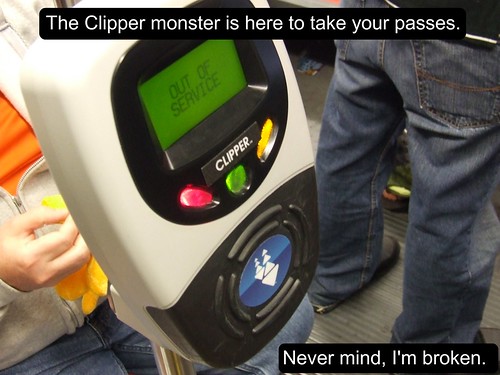
Clipper Monster Reader FAIL

There's been some new changes with the Clipper card that just started a couple of days ago on July 1st.  I'm skipping on all the fare and pass hikes, and going on the changes in rules governing Clipper.

Here's a summary of what's going on and how it may affect you:

Caltrain
The rail agency raised fares 25 cents per zone, but if you are a one-way fare passenger, you can be immune to the fare hike by simply using the Clipper card to pay for your rides.  If you use it for two rides, you'll save, but if you need a day pass to take three or more rides, you are better off by paying the paper ticket fare as the day pass program is unavailable through Clipper.

For those using 8-ride tickets on Clipper, the expiration has now been reduced to 30 days.

Lastly, passengers can now purchase monthly passes up until the 15th of the month; it used to be the 9th.  For example, for the July pass, you can buy up until July 15th.   Once it's July 16th, the August pass is available.

VTA
The agency has gone full blown Clipper by eliminating all paper monthly passes and going electronic only.  For those who have a local monthly pass and wants to ride an express bus, the passenger must have enough e-cash on their card to pay the difference.  Bus drivers cannot accept a cash payment substitute to compensate for the upgrade.

Day passes can now be earned using Clipper.  When a passenger uses their Clipper card to pay the e-cash fares, once it hits a threshold, the rest of the rides on the agency is free.  One bad problem: If you earn a day pass for local routes, but want to take an express, you don't pay the upgrade fee from your Clipper e-cash purse, you pay the FULL price of the express fare.  My tip: Continue to buy paper local day passes from the driver if you plan to take an express bus later on.

SF Bay Ferry
Formerly known as WETA, the agency recently permitted Clipper card use for the brand new South San Francisco Ferry route.  Passengers will need to tag-on and tag-off on this route because the agency is going to expand Clipper to other routes based out of Oakland and Alameda, and by tagging-off, the fare will be properly calculated.

Refunds for Caltrain passengers:
If you rode Caltrain between April 10th to the 16th and used Clipper card readers at San Francisco's 4th & King, or the San Mateo stations, you may be obligated to receive a refund.  The card readers overcharged passengers using the system.

Clipper should have issued refunds starting June 22nd, and the refunds are done by tagging your card.  Check your online records via the Clipper website for more information.  For more information about the refunds being issued, click here.