Showing posts with label public transportation. Show all posts

Tuesday, September 23, 2008

Translink on SF Muni - Looking for Testers (Victims)


Attention Muni victims! If you are a Translink cardholder, the time is now to sign-up for the soft launch testing of the Translink program.

Hmmm... sounds enticing, trying out a system that's been out for almost seven years to see if it finally works.

I noticed this on the Translink website, where the second announcement says that:

"Muni is inviting a limited number of customers to participate in trial use of TransLink."

So if you are interested in becoming a sucker... ahem... a victim... ahem, a tester to see if it all works well, it's a good time to have some fun.

I'm wondering, is the fares coming out of our own pockets, or will the SFMTA and Translink give victims... volunteers Translink e-cash to try this out?

To register for the dry run program, visit Translink.org and in the announcements section, wait for the second piece of news to show-up and click on the link. Or you can register directly here (I don't know why SFMTA is using Survey Monkey).

Unfortunately, I'm not going to sign-up for this test run, I'm a little fed-up with Muni to be spending time taking surveys on how's the program running. Just get the damn program running, there's no test runs really needed since nearly 95% are operational. Plus, I think they know who I am... I put Muni in a chokehold when I caught them red handed on camera.

UPDATE: Hot off the news wire, KGO-TV has this report with video.
It seems that the Muni employees are testing it out first, then the public volunteers after that. No word yet on an official rollout, but bad news is the testing will continue into the next year (damn damn damn damn damn).

Tuesday, September 9, 2008

Transit Effectiveness Project (TEP): SF Muni's Bad Ideas for 38 and 18 Lines

Many people may or may not know that I live in the Outer Richmond District. I noticed a little while back that San Francisco Muni had released these new proposals to modify many of the transit lines that we are so used to. But two of my local lines really started to hurt.

Since I cannot go to the hearing on Tuesday the 16th because I'm stuck at work, I e-mailed the SFMTA Board of Directors as requested by the TEP representatives, but I don't even know if they will even read my lengthy comments. So I'm going to post my ideas here:

For the 38-Geary line, the proposal by Muni will eliminate the Ocean Beach branch of the line. Currently the three major branches is: Ft. Miley (38 regular), Ocean Beach (38 regular), and 48th Avenue and Pt. Lobos (38 limited). I really think they are going in the wrong direction with this and should plan to restore service to the Ocean Beach terminal. I can understand that having huge articulated vehicles running on Balboa Street is not the best idea due to bus noise and the narrow lanes in certain sections, so it might work best if the line runs the 38-Limited route, but goes down Pt. Lobos past the Cliff House to the Great Highway and turns at Fulton to the Ocean Beach terminal. The inbound route will follow the opposite direction, but stop at the 38-Limited terminal for an easy transfer to the limited line.

(Inbound daytime service starting from Ocean Beach Terminal)

(Outbound daytime service to Ocean Beach terminal)

Muni's TEP people also proposed changing the 38-Geary Owl service to not terminate at the Ocean Beach terminal, but to stop at the Fort Miley terminal. I think Muni should take an opportunity to increase their coverage on the owl service line by serving all three terminals. People are used to taking the 38 Owl to Ocean Beach, so why not restore it and also serve the neglected areas like 48th & Point Lobos, and Fort Miley hospital? The area around here is very hilly, and for people who live north of the Ocean Beach terminal live on an extremely steep hill. Still, it follows my proposed route modifications, but will eliminate the loud noise on Balboa street since that line runs 24-hours a day in a neighborhood. Passengers who live on Balboa can easily take the 5-Fulton owl service and walk two blocks on a usually flat or slightly pitched sidewalk.

(CORRECTION: The 38-Owl service is proposed to terminate at 48th Avenue and Pt. Lobos, however this error still does not change my argument to serve all three terminals)


(Inbound 38-Geary Owl service route serving all three terminals)

(Outbound 38-Geary Owl Service route serving all three terminals)

Lastly, the 18-46th Avenue line's modifications are not really acceptable. While I did not make any maps, I'll point out the changes that might take place. To give some background on the 18-line, the bus line is one of the best lines in the entire city, easily accessible route to SFSU, and only the most senior operators with the best reputations get to drive this line (because everyone wants to drive it).
  1. In the northern section (above Golden Gate Park) of the route, it is proposed to remove the route going around the Cliff House by having the line actually drive through Balboa and turn North to serve 33rd Avenue and Geary. This route will slow down the line's current efficient route because Balboa is a "stop and go" type of road, and I think in the best interest of the neighborhood, eliminating the noisy gas powered buses will be a real help. And the people at Balboa can ride on the quiet 31-Balboa line to the Ocean Beach terminal to ride my proposed modified 38-Geary Ocean Beach branch line or the 18, or can even walk two block to ride the new proposed 5L-Fulton Limited line.
  2. In the area around Lake Merced, the TEP proposal will not go around John Muir Drive (the southern edge road of Lake Merced) and will run on the northern end of Lake Merced. It is true that it will make the ride faster, but it has a major disadvantage. If you have ever driven the south edge of Lake Merced, John Muir drive has this big apartment complex, and when I ride this bus, a lot of SFSU students, staff, and faculty board the bus for a direct ride to SFSU. The TEP proposal eliminates this and moves the 17-Parkmerced line to serve this area. However, this change will nearly triple the time it takes to get to SFSU because the eastbound bus will go into Daly City to pick-up Daly City BART passengers, and wind through the road maze known as Parkmerced. If the 18-line stays the way it is, it is only adding a five minutes to the route, and just that few minutes can bring in extra money to Muni since SFSU folks at John Muir drive depends on this route for direct service to campus.
  3. Also noted about the route change on Lake Merced, there is no easy to access bus stop for SFSU students at all. All SFSU affiliates get-off on the current route at Lake Merced and Font Blvd. (the dorms) and take a short walk to their classrooms. The new route will make people walk a longer route to make it to campus since it does not make a direct stop at campus, thereby may not make the line suitible for SFSU affiliates. This is especially discouraging for SFSU people who attend or work on the west end (lower end) of campus versus the east end ("up-campus") of campus. I use the 18 for a direct ride to SFSU, and if this route goes into effect, I might just drive to campus.
Thanks for reading. Below is the original letter I sent to the SFMTA Board of Directors:
--------------------------------------------------
Dear SFMTA Board of Directors,

I am e-mailing the SFMTA Board of Directors today to post my comments on some of the proposed changes to the lines serving the Outer Richmond district.

In regards to the proposed removal of the 38-Geary Ocean Beach branch line, I believe that this line is still very useful during its daytime operations as it also is part of the late night owl service used in today's Muni service.

--First of all, I believe the daytime route should be modified outbound to go straight down Geary and down Pt. Lobos on the road towards the Great Highway (passing the Cliff House) and going directly to the bus terminal. For the downtown trip, it would start at the Ocean Beach terminal, go up Pt. Lobos past the Cliff House, right turn at 48th Avenue to drop-off/transfer passengers for the 38-Limited for a faster ride (this will be a popular option for passengers!), and continue on Geary on the normal route. This alternate route is faster, gives easy access for tourists to visit the Cliff House, eliminates the "stop and go" driving on Balboa, use of noisy motorized buses on Balboa, and 38-Ocean Beach branch line passengers can still get to their destination on Balboa by simply transferring to the 31-Balboa line.

--The Owl line route should also help out more residents of the Outer Richmond too. Currently, the only 38-Geary route Owl service is the Ocean Beach branch. However the proposed modification would remove the route and terminate at the Ft. Miley hospital for owl service. Since the 38 line is one of the main lifelines of this city, I feel it best if the line should serve all three major terminals in one route so that it can accomodate everyone, espeically the very hilly parts of the Outer Richmond that makes it a challenge for older passengers (this is especially true in the 40th-48th avenues where the hills are steep between Cabrillo and Geary). My suggestion is to have the outbound owl buses serve in this order: Ft. Miley (by request), the bus stop at 48th Avenue and Pt. Lobos (northwest corner stop, diagonally opposite of the Seal Rock Inn), and terminate at Ocean Beach terminal (by driving on Pt. Lobos (going past the Cliff House). For the downtown route: Ocean Beach Terminal, 48th Ave. and Pt. Lobos terminal, and Ft. Miley by request of activation of the signal at Ft. Miley. If there is a concern about regular Owl passengers losing their service on Balboa, it should be noted that the 5-Fulton is an owl service line and Balboa is only two blocks away with little or no hills to climb and could calm the motorized bus noise problem dramatically.

I also disagree with the proposed changes to the 18-46th Avenue line. The current route of the line is very efficient, fast, and is considered one of the best bus lines in the entire city; even to the point where Muni operators highly desire to drive on this route.

--The modified route on the northern sector of the city will cause much longer driving times and does not serve any real convienence. Balboa is a very "stop and go" street and I believe that not using Balboa for this modified route will reduce the vehicle noise and help out the neighborhood at large since the 31-Balboa is a trolley bus line. If you are wondering if this will cause any problems for Balboa St. passengers, they can easily ride the 31 to the Ocean Beach terminal for the 18 or ride my proposed modified 38 Ocean Beach branch. Also, removing the 18-46th Avenue's service area covering the Cliff House and 48th Avenue/Geary to 33rd Avenue/Geary will hurt tourism for the Cliff House and the many residents who rely on an easy and direct route for many services (SFSU, SF Zoo, Stonestown, etc.) and connections to other major Muni lines.

--I am also aware of the removal of 18 service on the south end of Lake Merced (John Muir Drive), where it is proposed to be more efficient to run on the nothern rim of Lake Merced. I do agree that this route modification will improve service, however this does cause problems for students and employees of SFSU. The new proposed change will make it much harder to access SFSU as there is much more walking involved. Many SFSU students and staff exit on the current route at Lake Merced and Font, next door to the residence halls (dormitories) and most SFSU students to not exit at the end of the line (Stonestown) to walk half a mile to campus. There are also many SFSU students and employees who live at the apartments on John Muir Drive, and if the proposal goes through and the 17 line serves this route, there will be no fast direct access to SFSU for these people. The 17's modified route serving the John Muir Drive apartments would have to go through a dizzy maze serving other parts of Park Merced and Daly City BART, and that would really add much more time to their already simple commute. Now surely the modified route would cut the bus ride by five minutes, but that five minutes can also rake in more passengers and financial income if Muni does not modify this line.

In summary, I believe the proposed changes to the 38-Geary lines can be adjusted to still serve Ocean Beach terminal, there can be an easy change to adjust the 38-Geary owl service to serve more than one terminal, and the 18-46th Avenue line should not be changed for efficiency purposes and to keep its service on John Muir Drive for SFSU affiliates.

Thank you.

Tuesday, July 29, 2008

Two Weeks Late - Where's Translink (SF Bay Area)?


Let the insanity begin!

The Bay Area's Translink program is now two weeks overdue for its official rollout for San Francisco's Muni and Caltrain systems.

So what's the damn holdup?

In an article by Rachel Gordon of the SF Chronicle written in April of 2008, it states that the delay for Translink " has pushed back the estimated start date for the San Francisco Municipal Railway and Caltrain to July 15 and for BART to Sept. 25."

See article here.

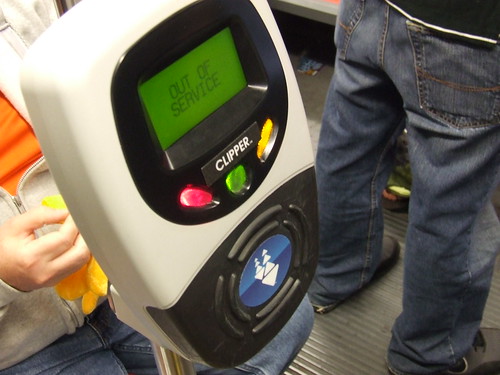
Come on... I know the damn things say "testing in progress," and I think the whole thing is ready to go. The readers are mostly working, although unfortunately this one I found on the 29-Sunset (a.k.a. the worst bus line in San Francisco) is not working.

Just reprogram all the readers, remove the yellow stickers, give a flier to the bus drivers on how to operate and accept the cards, and GET THE BALL ROLLING!

Muni also installed these on the far left faregates at all metro stations as well. Caltrain is allegely installing card readers at all their ticket machines, but I haven't been on that system in years.

I've been waiting for this program for over four years since I was a pilot tester, and the delays after delays are really pissing me off. HELLO METROPOLITAN TRANSPORTATION COMMISSION, TRANSLINK MANAGEMENT, SF MUNI MANAGEMENT, AND CALTRAIN MANAGEMENT, IT IS TIME TO GET THIS THING GOING!

OK management people, line up and bend over; it is time for your spanking for delaying the process! AND I HIT VERY HARD WITH A PADDLE WITH AIR HOLES.

Lastly, as for BART on "September 25th..." um... that's a total mystery if they will make it in just less than a month. So if they f-up, I'll be here blogging about it.

Tuesday, July 22, 2008

AT&T Park Muni Vendors MUST accept Muni Tokens too

Quick update before I get to my posting:

SF Muni is starting to make a little progress. I don't know if it is because of my blog or that I informed Phil Bronstein about the problem, but there's some changes:

One thing is they finally got their website FULLY (not partially) up to date. What I mean by "partially" is that one part of the page was correct with the new policy, while scrolling down at the bottom was incorrect.

Now the page clearly says:
"BART discount coupons are accepted" in the "Major Points" section.
"Muni to BART" discount coupons may be used" in the "Leaving the Ballpark" section.

Now, back to the topic!

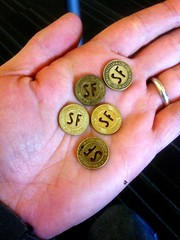
Here's the next task for Muni and its vendors at AT&T Park, how about accepting tokens and the token tickets too? They are the same fare media as paying in cash.

Their website says:
"Muni tokens or token coupons cannot be used at this time to purchase proof of payment at the Giants sales window" in the "Leaving the Ballpark" section.

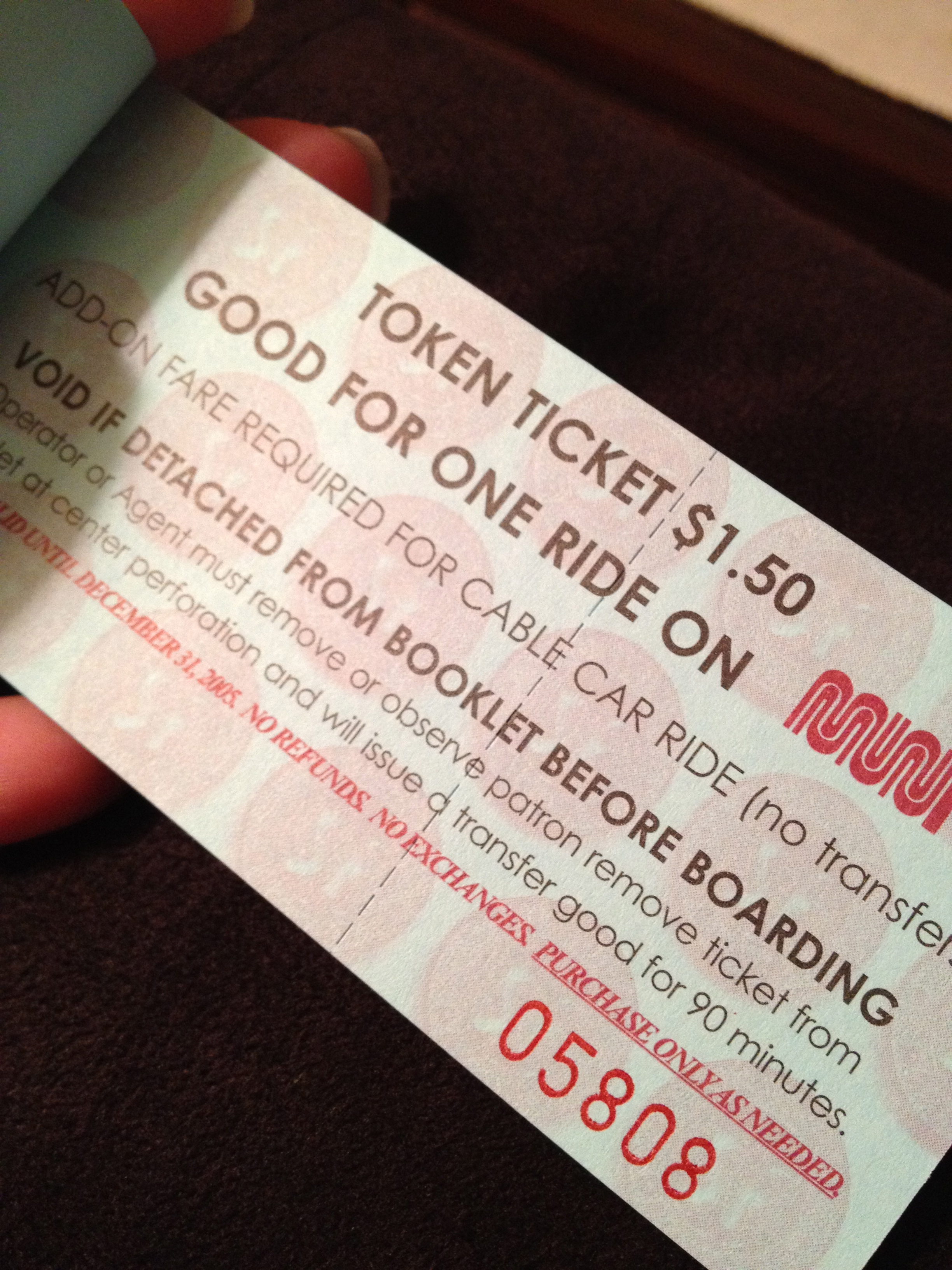
I use Muni token tickets because it is easier to carry than a handful of quarters and dollar bills. Plus, I can purchase these with my Commuter Checks, a program that issues me a check for public transit media (passes, tickets, etc.) and is automatically deducted pre-tax from my payroll.

So why not Muni?

If your policy says: "Please be prepared to show your Proof of Payment to Muni staff working the entrance lines to Muni Metro. If you do not have proof of payment, you will be sent back to the Giants sales window to purchase a ticket."

And a MUNI TOKEN OR TOKEN TICKET is a legal Muni fare, why can't AT&T park take it too so passengers can get their "Proof of Payment?" If the inspector is going to kick your ass for not letting you through and the vendor won't give you a transfer because all you have is a token at hand, that's just crazy.

Maybe I should just put the point across again, SF Muni promised its citizens that the token and token ticket is a LEGAL FARE for all Muni rides (except for Cable Cars and Candlestick Park express buses), so why not honor it for the return ride home from AT&T Park? Muni is simply dishonoring their agreement again to its citizens.

Do I once again need to walk to a 30 Stockton bus stop, give my token ticket to the driver, get a transfer, and walk back to the AT&T park metro platform for the ride home? Hell no.

Wednesday, July 9, 2008

Why don't they take the MUNI to BART discount?

I'm a little frustrated at San Francisco Muni for refusing to accept the "Muni to BART" ticket coupon when pre-purchasing Muni fare for the return trip home at AT&T Park.

The discount coupon is issued at all San Francisco BART stations and gives a 25 cent discount when riding Muni away from the station and a 25 cent discount when returning on a Muni vehicle going to a BART station within 24 hours of the coupon being issued.

I'm a fair weather fan at AT&T Park and I go to at least six to ten games during the summer, typically Friday night games and I try to get the best games, like against the Dodgers.

Since I don't trust taking Muni from one end of the city to the other at night (the 38 SUCKS at night), I park my car at BART Daly City and ride BART to Montgomery, recieve a transfer coupon for Muni Metro, pay $1.25 (includes the 25 cent discount), and get an open seat on the next metro train to AT&T Park.

When I try to return, I am instructed to purchase a transfer before boarding. It turns out that the vendors who sell the pre-paid transfers refuse to accept the transfer coupon for the quarter discount. When I questioned the employee, he didn't know why or why not, but encouarged me to ask Muni for some information and pass it along to him the next time I see him.

What the hell is Muni's problem with refusing to accept the coupon for the return trip to the BART station? They offer the 25 cent discount each way when you exit BART at Embarcadero, but experience tells me that if you try boarding Muni metro at Embarcadero on game day, you will be standing on a PACKED train. That's why I get off BART and transfer at Montgomery because I can get a seat.

WTF do I have to do to get my discount? Go the 30 Stockton bus stop, pay the discounted fare, get a transfer, and immeidately leave the bus so I can ride the metro with a 25 cent savings?

Hey Muni officials: It is time to change your policy and accept the discount coupon for the return trip home. Stop trying to RIP US OFF. I know that Muni is piss broke, but that doesn't mean that you dishonor your agreement with the citizens who use the system.

Thursday, July 3, 2008

It's Never On Time - San Francisco Muni

I can't believe this happened today. I was less than an hour away from leaving work and I noticed on NextBus (a GPS enabled program that monitors all bus lines to give real-time predictions for every stop) said that the next bus was to arrive in 60 minutes.

Sixty minutes? Really? The bus line runs on 20 minute intervals.

So I called San Francisco 311 for some information and the lady told me that THREE of the buses on the line were put out of service. The ride home was crowded.

Yeah... great job Muni.

Sunday, June 15, 2008

What's Wrong with Translink? (San Francisco, Bay Area)


For all you people who don't know, Translink is the program for the San Francisco Bay Area transit systems to provide one card for all transit systems. Think of it like your Visa card, it is accepted nearly everywhere and recognized by practically everyone. Translink does the same thing in the form of electronic cash, but improves it with the purchase of passes, automatic bus transfers, and other special features. Actually, if it worked perfectly, you can have multiple passes on your card. Plus, you never have to swipe the card, you simply wave the card near the sensor, or can be stuffed in a wallet or purse and you have to just get the card near it.

Just to note, the photo on the left is a little strange... The MTC (Metropolitan Transportation Commission) has this photo available for public use, and the lady tagging/scanning the card has the red light lit and it says that the ride is denied. How embarrassing to the lady, smiling while your ride got denied. Click on the photo to zoom in.

Smart technology, right? Of course...

But then we realize just how much of a hassle it is to get this program running. It is a welcoming sight that people who ride AC Transit and Golden Gate Transit & Ferry services can use this amazing card to get around to where they need to go. Plus a nice incentive is that AC transit users received a small discount per ride or a $10 discount for a 31 day pass.

Golden Gate Transit & Ferry services give patrons an automatic discount, treating any person like they purchased a discounted ticket book. Take a look at this grid from the Golden Gate Ferry website:

ONE-WAY FERRY CASH FARES

Effective July 1, 2007

Zone 2 – Sausalito

Adult
$7.10

Senior/Disabled/Medicare/Youth (6-18)
$3.55

Frequent Rider Ticket Book or TransLink

$3.80

Zone 3 – Larkspur

Adult
$7.10

Senior/Disabled/Medicare/Youth (6-18)
$3.55

Frequent Rider Ticket Book or TransLink
$4.45

OK, two agencies are working well. Haven't heard that many complaints in the news from these two agencies within the past year.

But how about the other agencies?

San Francisco Muni: Insiders are claiming that Muni should be ready to run with Translink (except Cable Cars) by July 15, 2008 after a few delays that got the attention of the Chronicle newspaper. Unfortunately, the people at Translink and the SFMTA (the authority controlling Muni) does not mention an official release date for the program. I've already e-mailed SFMTA and Translink last week and I still have not received a reply back from them. The SFMTA website mentions that Translink is still under "testing," and does not officially condone passengers to use the new program. They claim that it is not out for the public to use yet, but warns you that if you attempt to use it, to simply be prepared to have cash ready in case it does not work.

How about, if the reader works and accepts my electronic money, I should be offered a bus transfer if the reader is not working on the next vehicle I have to transfer to? There is no official message that a transfer will or will not be issued. It kinda leaves it out of the open, aye?

I'm also fortunate that I am a Commuter Check participant, and I now have the option to have my commuter checks be automatically uploaded into the Translink program. But without official notice from Muni about using the card, I don't even want to risk it. I'll stick to my token ticket book thank you very much.

BART (Bay Area Rapid Transit): They claim that they don't like the idea of Translink. Maybe it is because the company that installed those new ticket gates don't like the Motorola ERG technology? In fact... Cubic, the gate manufacturers, have their own card technology and is in strong use in the Washington DC area. Even more odd is that instead of letting Translink do a test run on the new equipment, they decided to go the opposite way by creating their own RFID card program using Cubic's technology.

In the future, we may have to carry two cards; although BART officials claim that they want to get on board the Translink wagon as well.

As for the other agencies, no word on what progress is happening.

Here is some interesting things with Translink:
  • I noticed on my recent bus ride that the RTC discount cards that are issued to people who have a disability receive their photo ID card with the Translink chip embedded in their card. Whoever thought of doing this is a very smart person because since disabled people need to have this card while using the transit systems of the Bay Area make perfect test subjects to try this on the systems.
  • My university that I work for and take grad school, San Francisco State University has noted in their "Master Plan" to improve the campus is to offer a "class pass" program that encourages students, staff, and faculty to ride public transit instead of driving to the University (parking is really tough, especially the free spaces in the Park Merced area). They are proposing that they want to not just offer free rides on Muni and free BART service within San Francisco, but to EXTEND BART service to also include the Daly City BART station. When BART passengers cross the San Francisco/San Mateo county line, they get heavily penalized, then it sucks for the students because they have to back trek to the San Francisco county side on the Muni bus to get to campus. The interesting part is that while the campus plans to make a deal with the two transit agencies and offer a really cheap price for the pass (like less than $70 for at least one semester), they want to also integrate this into the Translink card program (heck, it also makes them good lab rats to test out the system too!). I say, good luck SFSU and campus President Robert Corrigan, you've got a good challenge.
My credentials:

  • I was a pilot tester for the second round from about 2002 to 2004. I used the older (bottom) card and it is quite beat up. The program worked great, until some driver threatened me and wanted to throw the card out of the window. Lets just say that he and his bosses got a major lashing from me and the Translink program manager for mistreating me.
  • The new card they issued works, but I haven't used it in a very long time. If Muni can get their act going and officially get this thing moving, I'd be proud to use the card.
  • I gave a lot of feedback to Translink, to the point where the customer service people knew me by first name basis only.
My goals for Translink:
  1. Get Muni, BART and Caltrain up and going no later than the end of August. If they can meet the July 15th deadline, even better.
  2. These three agencies needs to start to recruit testers now. I know that Muni has their equipment installed and operational on nearly all their vehicles except Cable Cars.
  3. Get the other agencies up and running not by the year 2010, but at at least sometime in 2009.
  4. SFSU (San Francisco State University) should push for the Translink with "class pass" program now. Students cannot take advantage of the Commuter Check Program, but as a staff member, I have that privilege to save money because it is automatically deducted from my paycheck, and it is pre-taxed funds.
Comments are welcome!
Post at: http://www.akit.org/2008/06/whats-wrong-with-translink-san.html

Wednesday, August 15, 2007

More Delays from Translink Bay Area

There's news that the San Francisco Bay Area's "One Card" transit fare system known as Translink is delayed once again.

So... it's been about five or six years since they started the pilot project, and I thought things were going really well. Turns out, the goal of December 2007 for SF Muni and BART looks like it is delayed (again!).

Can't we just get on with this project? Muni is one huge system, so you would expect some issues, but I don't think any major problems.

BART is acting like little whiny children ever since they installed those new faregates. Why not just make it EASY for everyone and go with the one card system?

If they can create a one card system for places like New York and Hong Kong (which has multiple transit companies), I don't think there should really be any problems.

Monday, June 4, 2007

Translink Card Bay Area - How I would fix it


Ever since the Metropolitan Transportation Commission started their "Translink" program, I was there to help out their pilot program to test-out the program to assure that there will be no major problems to get it running in the future.

For about two or so years, I was primarily a pilot tester for San Francisco's Muni by using the product on their metro trains, but I was also issued a monthly sticker pass that I had to attach to my card to also use on other Muni transit vehicles.

One of the big advantages of the card is that I could load cash onto the card and use it on a limited number of transit agencies in the Bay Area, and I primarily stuck with BART, Golden Gate Ferry, and of course, Muni. I actually took transit more often just to try the card and visit some fun places like neighborhoods outside of SF and Great America.

Yet, out of all that "fun" of experimenting with the card, I hit several snags that made the experience interesting, but also rough on the edges. It was amusing that I contacted the Translink customer service center so many times that the people I talked to knew who I was.

The real problem with the Translink program stems from their poor implementation of the system, especially when it comes to installing the product on every single transit vehicle and station. When I was a tester for the program, the card worked very well on card readers that were permanently installed on train platforms/stations, and even the Golden Gate Ferry terminals. The permanently installed card readers were always on and 100% reliable, and that meant that I had a confident ride on-board public transit. The best experience is by taking the Golden Gate Ferry where all riders, regardless of being a daily user or infrequent user, would get the discount rate that was sometimes nearly 50% off the price of a ride across the bay. Muni Metro stations were not that bad, but because some stations only have one agent at one of the two booths, you sometimes had to tag the card and enter through the emergency gate. Caltrain was not so bad either, but the train conductors were not prepared to read the card, and had to fetch the card reader, which some had a little bit of a challenge to operate.

My solution: Install the program on permanent platforms first. Get it started on Caltrain first, because it will be the easiest to gain confidence with the public. Then, continue with installing it on BART, because the technology is already on the new faregates to read it. Lastly, get the product on the bus vehicles.

But let's talk about the bus vehicles. I've encountered a number of issues, including card readers that were marked "out of service" and not even turned-on. VTA buses were a real problem because it was supposedly installed on certain routes, but the readers were always broken. When they were installed on a majority of SF Muni metro trains, they worked when they were on; but when it was not powered-on, I practically had to teach the driver to turn-on the machine (just press the red button, and no it does not turn on the fire alarm... ok?). The problem with the card readers is that it has a slow startup time, and if you live at a bus terminal where they turn off their engines to not annoy the neighbors, you'd think that Translink sucks because the machine only operates when the engine runs. Plus, with the slow start-up time, would you just pay in cash or just say, I'll wait until the bus driver erupts in rage that he/she can't drive-off because you are still in front of the yellow line?

My solution: Why not put back-up batteries in each card reader, and when the bus is off, the batteries kick in, and when the bus is operating, it charges them. We have those electronic parking meters in San Francisco that runs on batteries (with no recharging capabilities), and they last quite a long time. Even better, upgrade the software for a quick start-up in less than 15 seconds. In just 30 seconds, the bus driver at the terminal is ready to leave after warming-up the engine.

Lastly, I've asked Translink on a number of occasions throughout the years about what's the progress, and they keep saying that it will be ready soon, and then later, and then years later. What's the delay? Can't they just cut the red tape and simply install it? If the price of the project keeps rising, wouldn't it be cheaper on the taxpayers if they just hurry and get it up and running?

I think the news said that the project originally cost about $38 million, but after all these years, it went through the roof to $150 million. If a contractor can rebuild a collapsed section of a highway ramp for a $5 million dollar bonus in less than a few weeks, would it be also worth it to just hire a contractor, train them, and give the company a nice bonus of lets say, $10 million to complete the project by a short deadline? If the project kept slacking-off and completion of the project would be in another two years, more than likely the cost of the project may hit $200 million; so if we are stuck at $150 million today, a $10 million bonus for a contractor to finish in lets say three to six months would be totally worth it.