"Akit is the man. He knows Clipper." (spenta)
"It’s a fantastic blog for any San Franciscan."
(Kevin)
"Your blog is always on point, and well researched!" (Nina Decker)
"Everyone's favorite volunteer public policy consultant..." (Eve Batey, SF Appeal)
"You are doing a great job keeping on top of Translink stuff. Keep up the good work!"
(Greg Dewar, N Judah Chronicles)
"...I don't even bother subscribing anywhere else for my local public transportation info. You have it all..."
(Empowered Follower)
"If anyone at City Hall wants to make public transit better for all San Franciscans, it would be wise to follow Akit religiously...
or, better yet, give him a job."
(Brock Keeling, SFist)
Showing posts with label cubic. Show all posts

Friday, November 2, 2012

Clipper Card Glitch Screws Passengers Again - When Will it Stop?

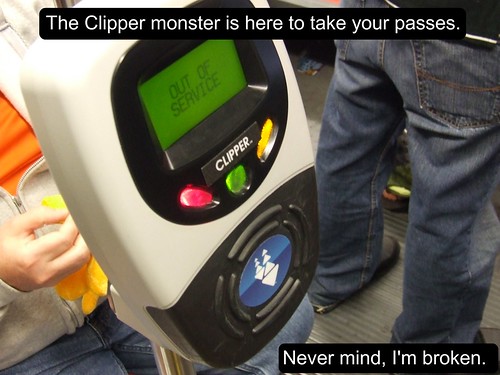
Broken readers is just one of many problems.
If you have a Clipper card, you may have been a victim of glitches or problems that are not your fault.  Throughout the years that I've been blogging about Clipper, I've written my fair share of issues and try to get MTC, and Cubic Transportation Systems (the contractor running the Clipper card) to get it fixed.

And while they do admit to their errors and fixes them as soon as they can, the problems continue to persist, like this most recent issue:
Starting on June 1st, Muni decided to end the paper version of the free ride transfers for those who exit Daly City BART and switches to the Clipper card handling the transactions.  This matter was concerning to commuters who used the SF State free shuttle as the transfer policy requires the passenger to ride the 28/28L line bus away from the station within the first hour of exiting the station; by taking the SF State shuttle, the transfer on the Clipper card is void and a return trip from SF State to BART will be charged at regular price.

Muni and SF State worked out a plan, effective August 1, 2012, instead of the one hour policy, it was extended to 23 hours for the first Muni ride.  The reason behind this is students that take the campus shuttle away from the campus, and can still ride the 28/28L line going back to BART with no fear of being charged a $2 fare (as long as it's within 23 hours of exiting BART).  Read story about the change in transfer policy.

But things didn't work out as planned.  As reported by the Golden Gate Xpress, the supposed reprogrammed transfer policy had a glitch and students who took the campus shuttle away from Daly City, was charged a $2 fare for their return to BART when taking a Muni bus.  Muni admitted the error and promised to have a fix by October 26th and Clipper will refund any passenger affected by the glitch.


The problem I have with this is, why do these glitches keep cropping up, and why isn't the contractor (Cubic Transportation Systems) not making sure it works perfectly the first time, every time?

It's not an isolated problem for Cubic, it's a chain of failures due to idiots programming the stuff without testing it.  Here's a list of their failures for the past few years:
  1. In August 2012, there was a discovery that happened in 2010 when their cards enrolled with autoload funded their cards, but didn't charge their credit card at the time of the reloading of funds. Passengers were finally charged in August 2012 on their credit cards for the reloaded funds.
  2. Back in May 2012, AC Transit passengers complained that when they rode an AC bus, transferred to BART, and took another AC bus, they were overcharged on their fare.  This glitch was the same problem Muni passengers faced before (see below).
  3. At the same time, passengers who rode Muni, took BART, and transferred to Muni was also overcharged.  I originally reported on the problem back in June 2011 and while Clipper promised to get it fixed, people were still getting screwed until May 2012.
  4. A software glitch delays the implementation of Clipper on Samtrans.  MTC fails to notify public until I broke the news.
  5. In October 2010, I reported on the Clipper card readers beeping like crazy and it wasn't fixed until February 2011.
  6. In early August 2010, those who linked their Clipper card with Wageworks was very angry when a glitch in the system resulted in pre-tax transit benefit users not getting their passes or funds loaded to their card in a timely manner. (Via my blog and SF Appeal)
  7. On one day in July 2010, a software update to Clipper card readers on Muni failed to work properly resulting in disabled Clipper card readers.
  8. April 2010, software update disables TransLink (pre-Clipper era) card readers.

I think I've made my point clear.  MTC needs to force Cubic to wise up and make sure that whenever there's a software or firmware update, that everything is throughly tested BEFORE the public uses it.  For every mistake or problem, people lose money from their Clipper card from errors or overcharges, transit agencies don't generate the correct revenue, and the time wasted for fixing the errors and issuing refunds to those affected.

Tuesday, August 14, 2012

Why I Don't Use Clipper Card's Autoload: 2010 Glitch Now Charging Customers

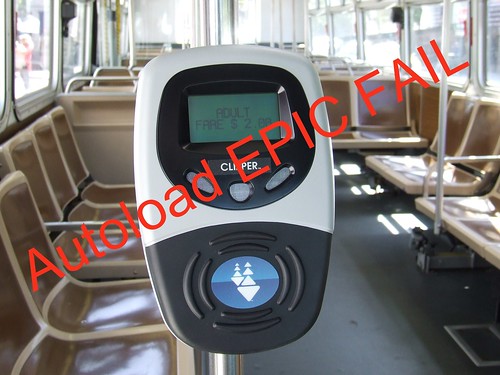
Clipper on Muni Epic Fail I've warned people before, Clipper card's Autoload program has problems.  But in light of the problems came the worst epic fail of all... being charged on your credit card for a reload of e-cash two years ago.

That's right.  KPIX reported yesterday that the folks at Clipper and MTC noticed a glitch in the system back from 2010.  Clipper card passengers who rode affected vehicles had their funds automatically reloaded for reaching a certain threshold, but the information from the consoles was not transmitted back to Clipper for credit card processing.

Basically, the passengers went off scott free with some free e-cash that was never charged to their linked credit card.

But now that the MTC found out, they are sending notices out to nearly 8,000 Clipper card users that they will get charged for the amount they owe.

Akit's Opinion
I can understand the MTC's point of view of getting back $230,000+ lost dollars, but it took two years?

Let's remember that Clipper card history reports can only be retrieved by customers as far back as 60 days.  The MTC should make an effort to show each customer being billed for the two year old charge to get some kind of documentation back from two years ago.

Now you wonder why I warn people to not use Autoload.  You'll get screwed no matter how long ago it was.  Stick to loading e-cash and passes by going to vendors and self-service machines.  You'll always know that when you load funds, it's both instantly available to use and you get a receipt of your transaction as proof.

Monday, May 16, 2011

$10,000 Each for a Clipper Portable Card Reader? More Expensive Stuff from the MTC


The MTC's Operations Committee has done it again... more of our taxpayer money being fried on expensive toys. They met last Friday, May 13th to discuss about six major expenses.

The shocking expense is a purchase for Caltrain. The MTC intends to spend $85,000 so Caltrain can accept Clipper payments with handheld card readers (they will purchase eight of them); the intention for the portable card readers is to use them for "collection of fares at special events" such as Stanford football games and after ballgames at AT&T Park.

The cost of each portable reader is a whopping $10,625 each. In my personal opinion, they should be able to find something a lot more inexpensive and able to handle the same job. Just one of those readers costs about one-third of my salary, but the MTC intends to spend that much crazy money on a device?

I'm wondering if the MTC knows there are other devices out there that can likely do the same job for a lot less money. LA Metro's fare inspection teams uses a special cell phone that is small and very portable to verify fares and transactions to check on passengers' TAP cards (see product description). Even rival RFID transit card company Scheidt & Bachmann offers a cell phone product that can verify fares and charge fare cards with just a push of a few buttons (watch here, fast forward to 3:57). We all know cell phones costs a lot less money, and I don't think Cubic would charge ten grand for each device that can likely do the same job versus the ones the MTC wants to buy.

The MTC could even invest just a little money for someone to create an Android or iPhone application and the necessary equipment (phone w/RFID reader attachment) to make it all work.

--------------------

Onward to other items:
  • The MTC reports the a 14% growth in the "average weekday transaction volume" in the month of April of usage of the Clipper card and is primarily due to the mandatory transition of the paper "M" pass to an e-pass on Clipper.
  • Other developments in the program includes the ability to add e-cash at all BART ticketing machines, new Clipper ticketing machines at all Golden Gate Ferry terminals, and a 50% reduction in phone calls to the Clipper customer service center after extensive outreach to Caltrain passengers.
  • MTC intends to spend $500,000 to offer third party commuter benefit companies (e.g. Commuter Check and WageWorks) a 1% commission for each customer who utilizes the direct load benefit to have their passes/e-cash automatically loaded to their Clipper card account. Other transit agencies offers this 1% incentive, but as of right now, the Clipper card program does not offer it.
  • Regarding the above bullet point, there is more information about why the MTC caved into the $2 monthly fee for those transit benefit users who utilizes third party programs. The MTC says that they have very little influence in the service fee because Cubic was the one who forced the fee to the third party benefit programs. The MTC had no choice but to agree to the $2 service fee for direct loading of passes/e-cash, but was able to make the transit benefit companies provide informed consent to all users about the fee by "opting in." This service fee will be in place for two years and will be renegotiated if the agreement is a failure. Only 4% of all Clipper users would be affected, and alternate methods are available to get away from the fees.
  • Since buses and trains gets their Clipper card updates while in the yard (via wireless network), the MTC is going to spend $90,000 to improve wireless coverage on the largest bus and train fleet in the entire consortium, Muni. The goal is to provide "more consistent coverage in the SFMTA bus yards, so SFMTA vehicles will be better able to upload and download Clipper data on a regular basis."
  • The MTC is going to invest an additional $73,000 to the contractor at the Embarcadero station's new Clipper customer service kiosk. The extra funding (on top of $289,200 already budgeted) will be utilized to increase staffing for the 2011-2012 fiscal year.
  • Booz Allen Hamlilton Inc. has been providing technical oversight for the Clipper program and has a multi year agreement with the MTC. The MTC wants to amend their contract to add an additional $1.35 million for their services for the 2011-2012 fiscal year.
  • Lastly, a budget item of $280,000 for the 2011-2012 fiscal year charges that AT&T bills MTC for telecommunication usage for the connection of all card readers, add value machines, and other devices connected to the Clipper network.
--------------------

Akit's Analysis:

With the mass confusion and frustration of the Clipper program for Caltrain, it seems the MTC's large investment in public relations is paying off due to a 50% reduction in calls regarding Clipper usage on Caltrain.

The 1% commission is something that I'm stuck in the middle about. It's a large expense (half a million dollars a year), but if the MTC doesn't provide that incentive, the third party transit benefit companies may wipe out direct loading of Clipper card passes/e-cash as an option; this is due to the fact that other transit agencies offers a 1% incentive when customers uses their transit benefits to get their transit passes/ridebooks mailed directly to their homes.

I'm upset about the $2 monthly fee being charged for those people who use third party benefit programs and requests for direct loading of passes and e-cash to their own Clipper card accounts. The MTC should have flexed its muscles a lot more; instead, they caved in and was only able to make a provision that every third party benefit program must provide informed consent that the passenger is willing to take on the $2 monthly fee. An easy way we the people can say "FU" to the $2 fee is to either get paper vouchers to claim at certain in-person locations, or request a debit card to be used at automated machines, Clipper's website, or by phone.

As for the $90K being spent on fixing the wireless coverage at Muni's yards, shouldn't this have been corrected years ago? If the wireless coverage was poor, shouldn't a provision in their contract would have made the adjustments and repairs FREE by the contractor?

$73K for additional customer service support at Embarcadero station is not a bad idea. It's never open during the weekends.

I have no comment about the contract increase for Booz Allen Hamilton because I don't even know what the hell they really do.

Lastly, the $280K being spent on AT&T services is just an annual expense, there's no going around it. For the thousands of card readers out there, they all need a telephone or network connection to provide updates to the Clipper server and receive updates on new e-cash/pass purchases, hotlisted cards, and new software patches.