"Akit is the man. He knows Clipper." (spenta)
"It’s a fantastic blog for any San Franciscan."
(Kevin)
"Your blog is always on point, and well researched!" (Nina Decker)
"Everyone's favorite volunteer public policy consultant..." (Eve Batey, SF Appeal)
"You are doing a great job keeping on top of Translink stuff. Keep up the good work!"
(Greg Dewar, N Judah Chronicles)
"...I don't even bother subscribing anywhere else for my local public transportation info. You have it all..."
(Empowered Follower)
"If anyone at City Hall wants to make public transit better for all San Franciscans, it would be wise to follow Akit religiously...
or, better yet, give him a job."
(Brock Keeling, SFist)
Showing posts with label transfer. Show all posts

Monday, October 26, 2015

Testing San Francisco MuniMobile Fare App

I haven't posted in over a year as I went into retirement from blogging, but Akit's out of retirement for a special edition blog post!

I was recently selected out of 1,600 applicants to participate in the SFMTA/Muni Mobile Fare App beta testing.  From what I've read around, about 800 people were selected to be Muni's guinea pigs for this project.

This reminds me of the days when I was a pilot tester for TransLink (old name for Clipper).

Let's give you folks who didn't sign up or selected a taste of how this all works.

First of all, you need to have a phone operating on Apple iOS or Android.  Once Muni releases the program to the whole public, you can download it at your application store for free.

When you first use the app, you can choose to register for an account or you can look around the app.  But if you want to buy fares, you must register for an account.


The Ticket Choices
You get to pick a variety of options, including:
1: Basic single fare
2: Single ride on a Cable Car
3: 1, 3 or 7-day Passports (valid on all of Muni, including Cable Cars)

The photo on the right is for adult fares, but you can also select Senior/Disabled/Medicare, Youth, and SF Paratransit options too.

The prices are all the same as paying cash or Clipper, and has no credit card surcharge tacked on.

Once you select the item(s) you want to purchase, you simply use the app to pay and it will direct you to a PayPal site to handle it.  You can choose to pay with your personal credit or debit card, or if you have a balance on your PayPal account, you can use that too.


Use Your Ticket
Once your payment is confirmed, your ticket is stored in the "My Tickets" menu.  Click the ticket you want and it will give you one last chance to back out.  If you want to use the ticket, click "use ticket" and the ticket activates immediately.

If you are using a single fare ticket, you should only activate it when you see the bus or train arriving.  90 minute clock immediately activates, and this will also be your Muni transfer; the driver will not give you a paper transfer.

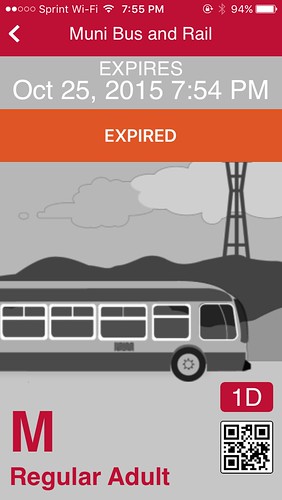
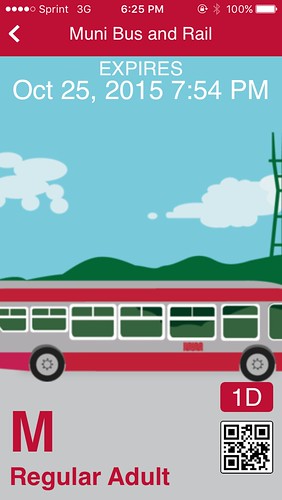
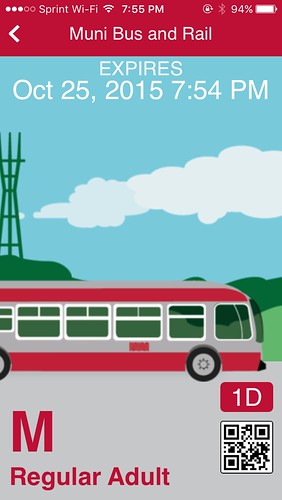
Once the ticket is activated, it will show an animated screen with blue skies, clouds (or is it Karl the Fog?), Sutro Tower, and the Muni vehicle driving by every so often.  The expiration will show on the top, and the type of ticket purchased on the bottom.

Just show the screen to the driver to verify it's a legitimate fare, take a seat and relax.

If you touch the screen, the background colors will change.  GlobeSherpa who made the application must have done this to prevent people from fraudulently using the app by playing a video clip or showing a screenshot.

If you touch the QR code on the lower right corner, it will show a large QR code that fare inspectors can use to verify your ticket.  I haven't encountered one yet, but who knows if they will carry a device to verify the QR code or not.

You can also close out the app and easily return to the Muni app to restore the ticket.


Expired Ticket
Once it expires, the ticket still looks like it's valid, but it's not when you compare the top time of 7:55PM to the bottom time of 7:54PM (left photo), but once you return back to the main menu by clicking on the left arrow on the top and then restore the ticket, it will definitely say: "EXPIRED" (right photo).  It's an odd quirk, hopefully something that can be fixed.

In Summary
Why you should use this app:
  1. When you don't have cash or your Clipper card on hand, it's an easy way to pay for your Muni fare.
  2. You want to pay for Muni with a credit card.
  3. If you don't want to disclose your credit card info, you can load some funds in your PayPal account and pay for Muni that way.
  4. You can buy Muni passports without visiting one of the few locations in the city for them.
  5. You can buy Cable Car tickets without hassling the conductor.
  6. It's eco friendly because you don't get a paper transfer or receipt in return.
  7. Faster than Clipper because once you pay for the ticket, you can activate it immediately.  If you order something on Clipper via their website, it can take up to five days to activate.
  8. If you activate your single fare ticket after 8:30PM, your expiration will be 5AM the next day (a.k.a. late night transfers).  Clipper cards and those paper tickets at the metro vending machines DON'T give you late night perks, just the lame 90 minutes.

Why you may want to avoid this app:
  1. For single rides, you are better off paying cash to the bus or metro operator and getting a paper transfer.  You'll always get a minimum of 90 minutes, but most hand torn paper transfers have much longer expiration, sometimes even four hours.
  2. If you transfer from BART, Golden Gate Ferry, Golden Gate Transit, or SF Bay Ferry to Muni you don't get the 50 cent inter-agency discount with the app, it's only good on the Clipper card.  Make sure to pay for your ferry, BART, or GGT fare with your Clipper card, and use the same card on Muni to get your discounted ride.
  3. If you transfer from Daly City BART to Muni, you get two free rides, one away from the station on the 14R, 28, 28R, 54, and 57, and one going back on the same bus lines within 24 hours, but it's only on Clipper.
  4. They don't sell monthly passes, it's only on Clipper.
  5. Prepaid tickets have an expiration date.  I bought mine on October 23rd, but if I don't use it, it will expire on January 21st.  Not a good idea to hoard those tickets.
  6. You have a smartphone with a lousy battery.  If the battery dies, you can't use the app!
  7. If you have a credit card that gives you a bonus when using it for travel (e.g. 2% on travel vs. the standard 1%), you won't likely get that bonus because it is charged through PayPal.
  8. If you use a pre-tax commuter benefit debit card, it looks like it's not supported on the app.  It's because the credit card processing is done through PayPal which may not be acceptable to the required federal standards for commuter debit cards.  Continue using your debit card on Clipper.
CORRECTION: Commuter benefit debit cards are accepted as per SFMTA's website: https://www.sfmta.com/getting-around/transit/munimobile/munimobile-frequently-asked-questions#BuyingTickets

However, do not link a your commuter debit card via your PayPal account.

Suggestions on Improvements:
Muni and GlobeSherpa can do a handful of things to make it better.
  1. Make the expiration easier to read.  A light blue sky background with white letters is hard on people, especially for the operator to read.  White letters is fine, but some black shadow for the letters makes it easier.
  2. I was expecting some more backgrounds in the animation.  Why just Sutro Tower?  Why not Coit Tower or the Golden Gate Bridge?
  3. When a ticket expires, it needs to automatically grey out and the orange bar is shown saying EXPIRED.  It should not be the normal background.
  4. Allow commuter benefit debit cards be accepted to purchase tickets.
  5. Fingerprint scan option to open the app, especially helpful to prevent your kids from accidentally activating your tickets.

Thursday, July 3, 2014

New Change to BART to Muni Transfer Policy using Clipper Cards

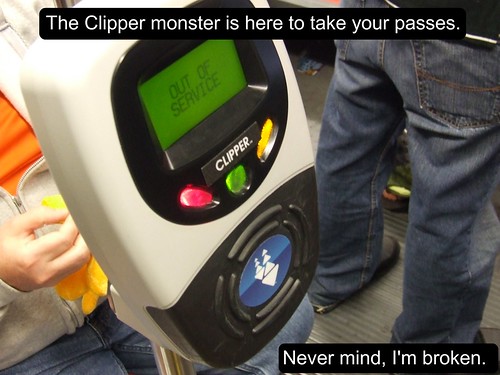
Clipper Monster Reader FAIL

If you use your Clipper card to transfer from a San Francisco BART station to a Muni vehicle or metro, there's a change in policy regarding the transfer rule.

The old rule:
When exiting BART from any station between Embarcadero and Balboa Park, you have one hour to transfer to Muni.  When tagging the same card you exited with BART and use it on Muni, you get a 25 cent discount on your Muni ride.  When you are ready to take your next ride on Muni (after the Muni 90 minute transfer expires and its less than 24 hours from the time you exited BART), your next Muni fare transaction is 25 cents off.  This is the exact policy just like when BART stations issued paper discount transfers which gave the same benefit.

The new rule:
When exiting BART from any station between Embarcadero and Balboa Park, you have one hour to transfer to Muni.  When tagging the same card you exited with BART and use it on Muni, you get a 50 cent discount.  There is no discount for a second ride.

Note: This policy is not valid if you have a Muni monthly pass.  It must pay in Clipper e-cash funds.  As always, if you have a Muni monthly pass on your card, Clipper always seeks the best deal, instead of yanking $1.50 out of your pool of funds.

Also, this policy is not in use at the Daly City BART station.  Passengers still get a free ride on any Muni line that serves Daly City BART.

How did I notice the change?
When I go to baseball games at AT&T Park, I have to take BART and Muni metro to and from the park.  I noticed when I tagged my card on the Clipper card reader to get back after the game, I had to pay full fare.  When I got home, I reviewed my Clipper card records online and found out that there was that change in transfer policy.

Akit's Opinions:
It's a simple change that makes it more simplified for Clipper card users.  Instead of wondering if the return ride 25 cent discount works, you just get the full 50 cents off in the first Muni ride away from BART.  I like it.

Reference to policy: https://www.clippercard.com/ClipperWeb/muni/fares.do

Friday, November 2, 2012

Clipper Card Glitch Screws Passengers Again - When Will it Stop?

Broken readers is just one of many problems.
If you have a Clipper card, you may have been a victim of glitches or problems that are not your fault.  Throughout the years that I've been blogging about Clipper, I've written my fair share of issues and try to get MTC, and Cubic Transportation Systems (the contractor running the Clipper card) to get it fixed.

And while they do admit to their errors and fixes them as soon as they can, the problems continue to persist, like this most recent issue:
Starting on June 1st, Muni decided to end the paper version of the free ride transfers for those who exit Daly City BART and switches to the Clipper card handling the transactions.  This matter was concerning to commuters who used the SF State free shuttle as the transfer policy requires the passenger to ride the 28/28L line bus away from the station within the first hour of exiting the station; by taking the SF State shuttle, the transfer on the Clipper card is void and a return trip from SF State to BART will be charged at regular price.

Muni and SF State worked out a plan, effective August 1, 2012, instead of the one hour policy, it was extended to 23 hours for the first Muni ride.  The reason behind this is students that take the campus shuttle away from the campus, and can still ride the 28/28L line going back to BART with no fear of being charged a $2 fare (as long as it's within 23 hours of exiting BART).  Read story about the change in transfer policy.

But things didn't work out as planned.  As reported by the Golden Gate Xpress, the supposed reprogrammed transfer policy had a glitch and students who took the campus shuttle away from Daly City, was charged a $2 fare for their return to BART when taking a Muni bus.  Muni admitted the error and promised to have a fix by October 26th and Clipper will refund any passenger affected by the glitch.


The problem I have with this is, why do these glitches keep cropping up, and why isn't the contractor (Cubic Transportation Systems) not making sure it works perfectly the first time, every time?

It's not an isolated problem for Cubic, it's a chain of failures due to idiots programming the stuff without testing it.  Here's a list of their failures for the past few years:
  1. In August 2012, there was a discovery that happened in 2010 when their cards enrolled with autoload funded their cards, but didn't charge their credit card at the time of the reloading of funds. Passengers were finally charged in August 2012 on their credit cards for the reloaded funds.
  2. Back in May 2012, AC Transit passengers complained that when they rode an AC bus, transferred to BART, and took another AC bus, they were overcharged on their fare.  This glitch was the same problem Muni passengers faced before (see below).
  3. At the same time, passengers who rode Muni, took BART, and transferred to Muni was also overcharged.  I originally reported on the problem back in June 2011 and while Clipper promised to get it fixed, people were still getting screwed until May 2012.
  4. A software glitch delays the implementation of Clipper on Samtrans.  MTC fails to notify public until I broke the news.
  5. In October 2010, I reported on the Clipper card readers beeping like crazy and it wasn't fixed until February 2011.
  6. In early August 2010, those who linked their Clipper card with Wageworks was very angry when a glitch in the system resulted in pre-tax transit benefit users not getting their passes or funds loaded to their card in a timely manner. (Via my blog and SF Appeal)
  7. On one day in July 2010, a software update to Clipper card readers on Muni failed to work properly resulting in disabled Clipper card readers.
  8. April 2010, software update disables TransLink (pre-Clipper era) card readers.

I think I've made my point clear.  MTC needs to force Cubic to wise up and make sure that whenever there's a software or firmware update, that everything is throughly tested BEFORE the public uses it.  For every mistake or problem, people lose money from their Clipper card from errors or overcharges, transit agencies don't generate the correct revenue, and the time wasted for fixing the errors and issuing refunds to those affected.

Friday, September 7, 2012

Discounts for Oakland/Alameda & Harbor Bay Ferries starting October 1st with a Clipper Card

In a recent board meeting of Water Emergency Transit Agency, the organization has approved for passengers to use their Clipper cards on board trips along the Oakland/Alameda and Harbor Bay Ferry routes. There are some perks and will be some definite losses for passengers:

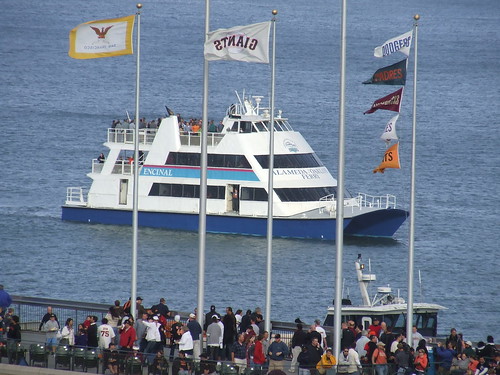
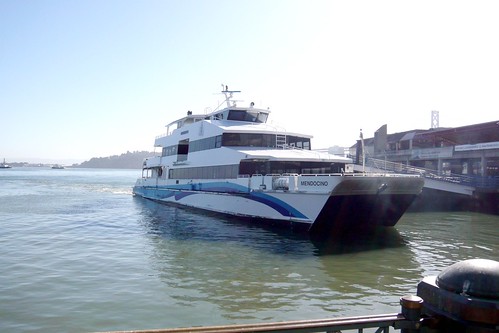
AT&T Park - Ferry Boat waiting for dock space
Perks
Starting October 1st:
  • The one-way adult fare for the Oakland/Alameda ferry using Clipper will be $4.75.
  • The one-way adult fare for the Harbor Bay ferry using Clipper will be $5.00.
The board decided to give all Clipper card users the discount price that is afforded to those who buy the bulk 20 ride ticket books. Oakland/Alameda passengers save $1.50 per ride ($4.75 Clipper e-cash vs. $6.25 regular cash fare) and Harbor Bay passengers also save $1.50 ($5.00 Clipper e-cash vs. $6.50 regular cash fare).

This is similar to Golden Gate Ferry’s policy for all Clipper card passengers to get the same discount as their former printed ticket books. Prior to Clipper, the TransLink card gave the same discounts, regardless if the passenger rides regularly or just a few times a year.

Loss
The board also decided to change the transfer policy for Muni. Effective October 1st, a passenger who paid the full fare in cash or used the ticket books was given the privilege to ride Muni for free away and to the SF terminal. The policy is now changing to 50 cent discount per direction and passengers must use the same Clipper card they paid to use the ferry to utilize the discount. This is exactly similar to Golden Gate Ferry’s existing transfer agreement with Muni.

Those with the ferry paper transfers will still be able to use them on Muni until November 1st, they have granted a 30 day grace period for people to use them up.


Akit’s Opinion
I like that Oakland/Alameda and Harbor ferries will be giving all Clipper card passengers the discount price, no matter if they are a regular commuter or just someone going to the farmer’s market on Saturdays. The discount price makes it attractive to casual passengers because a round-trip ride can save an adult $3 for a round trip ride. I applaud SF Bay Ferry for not trying to do something stupid by making passengers by Clipper card e-ticket discount books (I’m talking to you Caltrain).

Without the need to buy bulk ticket books, there’s no more worrying if a passenger is running short and needs to get more; this means passengers can simply just recharge their Clipper card at vendors like the Bay Crossings booth in the SF Ferry Building, the Clipper card machines at Golden Gate Ferry SF terminal, or any Walgreens in the Bay Area.

If you were to compare the cost to get from SF Ferry Building to Jack London Square ferry terminal, the ferry is the better choice. Passengers could take BART at Embarcadero, but the passenger must also take AC Transit too, and the total cost would be $5 ($3.15 BART and $1.85 discounted AC Transit fare for transferring from BART to AC). A trip on the ferry is $4.75.

I’m disappointed at the decision to cut the Muni transfers to just 50 cents per direction. Muni put the pressure on WETA to cut it down; while they say it’s in line with existing agreements with Golden Gate and BART, I think it indicates the SFMTA is trying to save money.

For regular commuters who uses ticket books, they get screwed because the ticket books gives free round-trip rides on Muni ($4 value), starting October 1st, they will have to pay $3 round-trip to ride Muni.

Casual passengers who switch from regular cash to Clipper won’t lose any money. The cash policy (pre October 1st) gives passengers a free Muni round-trip transfer at full value ($4). But when reduced to a 50 cent discount to and from the Ferry Terminal and compared to the $3 in round-trip savings for paying their ferry ride with Clipper, there’s no gain or loss for them.

Thursday, July 12, 2012

Is Muni's All-Door Boarding Policy Working and Big Mistakes the Agency Made

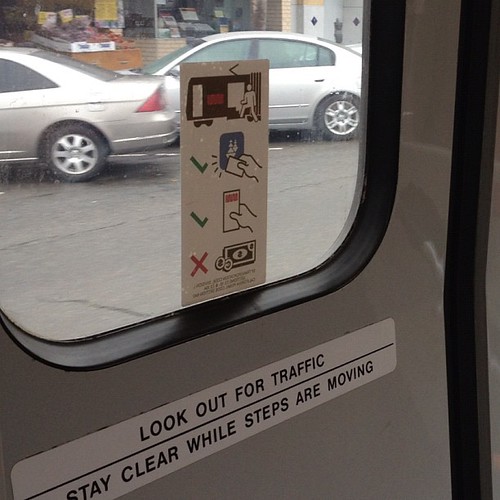
These #muni all door boarding stickers are so small. The length of your hand.

It's been twelve days, and now it's time to ask the big question...

Is Muni's new all-door boarding policy actually working?

In my opinion, the answer would be both yes and no.

Why no?
For Muni lines where rear-door boarding was happening all the time prior to the change in policy, I don't see much of a difference.  For example, I rode the 38L Geary Limited in both directions from 48th Avenue & Point Lobos to Geary & Park Presidio and things just seemed the same.  At the stops deep in the avenues where the bus would only pick up less than a few people, everyone still boarded the front door, regardless if they had a Clipper card or paper transfer in hand.  At the "major" stops like 25th & Geary and 20th & Geary, people boarded the rear doors as they did prior to July 1st.

Why yes?
For Muni lines that are not heavily used, the boarding process was much quicker.  Less people had to wait in line to board the front door, so the rear doors became the quick way to get on the bus and help reduce the dwell time.

One good example was on July 5th when I was at the Golden Gate Bridge on the San Francisco side.  I was waiting for the 28-19th Avenue bus and saw a group of ladies in a tour group with Clipper cards in hand waiting for the bus.  Instead of that mob boarding the front door, about three-fourths of them boarded the rear door and sat on the back half of the bus.  As you may know, a lot of tourists like boarding the front door and never moving to the back (thank you F-Market tourists), but boarding the rear doors encouraged them to take the seats in the back.

Some big mistakes Muni did:
  1. They made the announcement too late about rear door boarding, they only gave the public five days notice.  When Muni informs the public about service cuts and fare hikes, they do it MONTHS in advance.
  2. There's a lack of advertising.  With only five days notice, all they did was put information on their website, and some signage in the buses.  Some of us bloggers help spread the word, but having full page ads in newspapers and extra time to announce the program would have benefited Muni much more.
  3. The all-door boarding stickers are so small.  The one you see on the top of this blog entry is for Muni metro.  The sticker is about the length of your hand.  I would have expected something a bit bigger for people to see and read.  The universal images help a little, but maybe a few words in English may make it easier for people to inform them that boarding the rear is okay.

Thursday, May 31, 2012

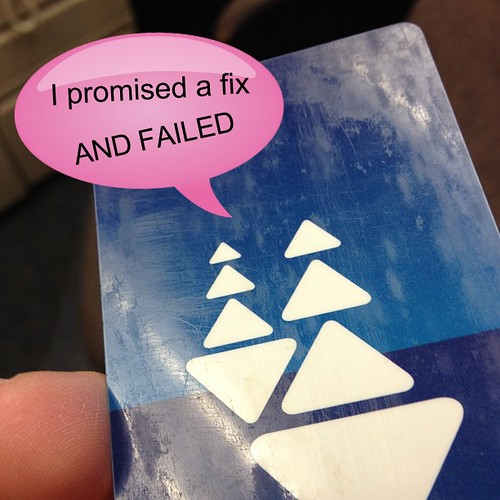
Clipper Card FAILS to Fix Problem They Promised to Fix a Year Ago - Muni & BART Transfers

Clipper Card Fail

UPDATE: Clipper responded to Mimi's message:
Hi Mimi. We are in the process of correcting this problem and these transfer rules will be changed within the next month. You - and anyone else - in this situation should contact Clipper Customer Service (custserv@clippercard.com or 877.878.8883) to request a refund.
While satisfactory for Mimi's problem, it still shameful that Clipper failed to fix the problem for nearly a year.

Original Blog Post:
Nearly a year ago, I mentioned about John Murphy's experience of using his Clipper card to ride Muni and BART within a 90 minute period.

Mr. Murphy did the following:
  1. Took Muni to a BART station in SF.
  2. Took BART to a different station in SF.
  3. Transferred to Muni.
The correct way this is supposed to work is that Mr. Murphy should have paid $3.75 because:
  1. He paid $2 to ride Muni.
  2. He paid $1.75 for the BART ride.
  3. His next ride on Muni [within 90 minutes of boarding first Muni bus] is free.
But... he was charged incorrectly, he paid $5.50:
  1. He paid $2 to ride Muni
  2. He paid $1.75 for the BART ride.
  3. He paid $1.75 because his Muni transfer was erased in favor of the "BART to Muni" discount e-transfer which gives a 25 cent discount on the next Muni ride.

Clipper's response to Mr. Murphy's inquiry nearly a year ago stated the following:
You're correct - you should not have been charged for the second ride.

This was an incorrect implementation of Muni's transfer policy and MTC has been working with our contractor to fix the issue.

We encourage customers to access their online transaction history records to determine if they were overcharged for this transfer trip. Customers who are affected by this issue should contact Clipper Customer Service to request a refund for the $1.75 that they were overcharged.
--------------------

Basically, Clipper and the MTC promised nearly a year ago to fix the problem.  Did it get fixed?  NO.

The Problem Still Exists
Just yesterday, a person by the name of Mimi Chan posted a statement on Clipper's Facebook page mentioning the same exact problem that John Murphy experienced a year ago.  She paid $5.50 instead of $3.75. 

On AC Transit too?
And just to take this home, just a few weeks ago, the SF Examiner reported a similar Clipper card failure regarding people using AC Transit, transferring to BART, and having their AC Transit transfer voided to pay the "BART to AC Transit Bus" transfer discount.


Akit's Opinions:

I have two big issues with Clipper FAILING in resolving this process:
  • They made a promise to fix the problem and didn't do it.  I don't like people who do not keep their word, especially those who serve the public.
  • Clipper and MTC better be ready for a class action lawsuit.  People can only research their Clipper card records online for up to 60 days.  People will start demanding to look at their records ever since 2009. 

Here's a FACT: Clipper (known as TransLink back in the day) started allowing all BART stations to have their card readers active as of August 3, 2009.  AC Transit and Muni has been a part of TransLink/Clipper ever since they started their pilot program back in early 2000.  I'm betting thousands of people have been victims of this particular transfer problem, and they all have a right to a proper refund.


There's no place to hide Clipper and MTC.  You screwed up and the public demands answers.

Wednesday, May 16, 2012

Update: Positive Change in Policy for SF State Students Taking BART and Muni to Campus

New Clipper Card and Carrying Case

I've been reporting for the past few weeks about Muni's plan to end the issuing of paper transfers for free Muni rides at Daly City BART in favor of going electronic only on the Clipper card starting June 1st.

For many regular residents, the change would not affect them as they would still be able to ride Muni away and back to that particular BART station.  For SF State students, staff and faculty, the end of paper transfers would result in a much more challenging problem.

As I've mentioned before, with the current policy regarding the use of the Clipper card, SF State affiliates have two options, they can take the free ride on the Muni 28 line or take the SF State shuttle.  Either way, the ride away from the station is free.  However, the return ride is much more challenging as those who took the free shuttle earlier has their free ride back on Muni voided because of a current rule: If a passenger does not tag their Clipper card on a Muni bus within one hour of exiting the Daly City station, the return ride transfer is VOID.

When it comes to SF State students and rising university tuition and fees, justifying to pay an extra $2 to ride back to BART can get expensive and not many are happy about the changes.

Confusing Information to the Public
What really stirred the pot of controversy was what the university's CampusMemo (a weekly employee newsletter) and the student operated Golden Gate Xpress newspaper reported to the public.  Both the CampusMemo and Xpress reported that the return ride on Muni to Daly City BART would be free, even if the person took the campus shuttle to the campus.  But they did not highlight their source of information about this new change in policy, and I solely relied on the SFMTA's alerts page about the upcoming change on June 1st.

When You Need Help, Just Ask!
Instead leaving the big elephant in the room with a huge sack of peanuts to see what will happen, I decided to contact the SFMTA for some assistance.  I e-mailed Paul Rose, Media Relations Manager of the SFMTA and asked him if the university was correct in the new policy change to allow SF State affiliates to ride back to BART for free within 24 hours of exiting the station, even if the person took the campus shuttle away from the station.

Paul Rose, SFMTA Media Relations Manager stated:
SF State brought this issue to the SFMTA’s attention and have come up with a solution that will be implemented no later than August 1. Although the initial transition will take place effective June 1 and customers will be required to take the first transfer to Muni within 1 hour from BART, this will not impact SF State students as the shuttle does not run during the summer. A business rule change will be in place by August 1 which will extend the transfer period requirement for the first trip on Muni to 23 hours which will continue to allow SF State students to take either the shuttle or Muni for their first trip and allow a second return trip within 24 hours.

We will update our website once the change is closer to taking place.
A Win for SF State Affiliates
Based on what Mr. Rose stated, this means SF State affiliates can take their first Muni bus within 23 hours of exiting Daly City, and can still take a second free ride on Muni within 24 hours.  This definitely benefits the campus community and provides additional flexibility for those who takes the campus shuttle.  It also clarifies the confusion of if they will have to pay for the ride back to BART or not.

An Exploit for Non-SF State Affiliates?
While it does benefit the students, the unintentional consequence (or benefit) is that non-SF State affiliates can also use this to their advantage.  If the passenger exits Daly City BART and a family member picks them up from the station, the passenger still has two free rides on Muni and must use the first free ride within 23 hours and is eligible for the second ride within 24 hours of exiting the station.

Why? Muni buses and trains does not register on their Clipper card operator consoles on what route and direction they operate.  In fact, if you log into your Clipper card account online and download your activity report, you will see that if you tag your Clipper card on a Muni vehicle reader, it will say: "SFM Bus" indicating you took the Muni, and "MTANONE" as the route.

If Muni maintains that policy of not indicating what route the bus runs on their Clipper consoles, for the bus lines that covers Daly City BART (14L, 28, 28L, and 54), this means passengers scores two free rides on practically any bus line on Muni.  Say for example: I exit Daly City BART with my Clipper card and my wife (in reality, I'm still single) picks me up at the station.  The next morning, I can ride any two Muni lines I want and not pay a single cent because the operator console uses a generic universal identification for the entire Muni fleet.

I guess you win some and lose some.

On a final note, this is the first time I've ever contacted a media relations manager for anything relating to my blog, and I appreciate Paul Rose taking time out of his day to conduct some research and provide me a helpful response to share with my readers.  Cheers to you.

Thursday, May 10, 2012

Easy Solution for SF State Students Regarding Change in BART-Muni Free Transfers to Clipper Cards

Clipper on Muni

Is there a solution for the upcoming change in free Muni rides for Daly City BART passengers that are also SF State students? If you recall from my previous posts (post #1 and post #2), Muni has decided to eliminate the transfers and go Clipper only starting June 1, 2012.

With the paper transfer, a student can take the SF State shuttle and still get a free ride back on Muni to Daly City BART. However, with Clipper, a student MUST ride Muni in order to ‘earn’ the free Muni return ride back to the BART station. With the campus providing the free shuttle, it eases the crowds on the Muni 28 line, but with the mandatory Clipper card transition, this will be a big problem as the flow of passengers will be uneven.

As I mentioned before, students have two options when they exit BART:
  1. Ride the Muni 28 away from Daly City to get free ride, and can choose the SF State shuttle or Muni 28 to get back to Daly City BART.
  2. Ride the SF State shuttle away from Daly City, and must take the SF State shuttle back to Daly City BART or pay $2 on Clipper card for return ride on Muni 28.

Due to the problem with the automatic voiding of the e-transfer, this will mean more people will ride the 28 line to SF State because they have two free options for the back to BART. By taking the shuttle away from BART, they are stuck with only one option for the free return ride.

Students interviewed by the Golden Gate Xpress said they hate the policy change from Muni.

I said to myself, how can this be easier for everyone? One idea I had is to install Clipper card readers on the SF State shuttles to validate the transfer for passengers to get a ride back to BART via Muni.  Now I realize that’s a very expensive option and shuttles would have to be taken out of service to install the equipment.

I thought of a very low cost, less confusing, and easy solution that will work:
Muni should allow SF State students, staff, and faculty to take the bus for free for the return ride back to Daly City BART (no Clipper card required).

How? Every student and employee of the campus carries their university ID. Students, faculty, and staff show their campus ID to the Muni operator at the 19th & Holloway bus stop for their free return ride.

The flashing of the campus ID is only good at 19th & Holloway and only for the route going to Daly City BART.

Passengers would have to follow the honor system to only exit at Daly City BART and not any of the interim stops between SF State and BART.

Cost wise, it wouldn’t make much of a difference than what’s happening right now with the paper transfers (take transfer, ride SF State shuttle away, and return to station on Muni). The Clipper card makes it challenging and students will be grumpy if they have to dish out an extra $2 because their e-transfer expired for not taking an away trip on Muni, or being forced to wait in long lines for the SF State shuttle.

What do you think of this idea?

Friday, May 4, 2012

Clarifying Misconceptions about Free Muni Rides when Exiting Daly City BART

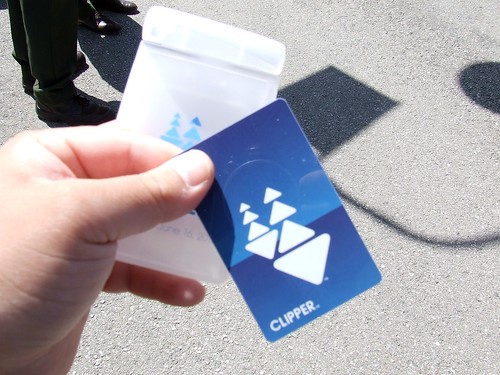
Three Generations of Transit Cards (TransLink Pilot, TransLink, and Clipper)

In a previous post, I mentioned about Muni’s decision to end paper versions of the yellow BART to Muni transfers from Daly City BART and that it will go electronic only via the Clipper card.

The message being given to the public is going in multiple directions, so I’m going to clarify this by getting the message from the source (SFMTA/Muni).

In the SF State CampusMemo released yesterday, it states:
“Beginning June 1, free transfers between BART and the Muni 28 line at Daly City Station will no longer be done via paper transfer. In order to get the free transfer from BART to the Muni 28 line, fares will have to be paid with a Clipper card. The Muni return fare will also be free if the return trip takes place within 24 hours, regardless of whether the BART-to-SF State trip was on the Muni 28 bus or the SF State shuttle.”
The last sentence (highlighted in bold) throws the whole situation in the wrong direction. My interpretation of the last sentence: If a person exits Daly City BART with their Clipper card and boards the SF State shuttle, they are obligated to a free ride back to BART via Muni 28 line.


Here’s the correct way to understand how this works: As per SFMTA:
“Beginning June 1, 2012, paper transfers will no longer be available for free transfers between BART and Muni at Daly City Station. If you transfer from BART at Daly City Station to the Muni 14L, 28 or 54 routes, your Muni fare will be free only when you pay your BART fare with a Clipper card and you board within one hour after exiting BART. After making your outbound journey on Muni, your Muni return fare will also be free when you return within 24 hours. You must make an outbound journey to receive the free return.”
Therefore, the last sentence from Muni (highlighted in bold) clearly states that a passenger must take an outbound ride on Muni (not the SF State shuttle) in order to qualify for the return ride back to BART.  How does that work?  The free rides (both outbound and inbound) is automatically voided after one hour passes from the time the passenger exits the BART station.  A person "earns" their free ride back to Daly City BART only if they validate their Clipper card by tagging their card on a Muni bus when leaving Daly City BART.

Since Muni is the official authority regarding this matter, SF State is not correct in their statement that taking the campus shuttle qualifies for a free ride on Muni back to the BART station.

There's very few solutions that can resolve this matter, such as installing Clipper card readers on SF State shuttle buses to validate the cards when students board the shuttle at Daly City, but as long as there are no more yellow paper transfers, this will be a long term problem and will surely rake Muni extra $2 fares here and there.


Let’s go over some common scenarios people may encounter, and if they would be eligible for free Muni rides:
Scenario #1: A passenger exits Daly City BART and uses the same Clipper card they exited to ride Muni 28 to SF State within one hour of exiting the station. The passenger returns from SF State to Daly City BART via the 28 line within 24 hours of boarding the first Muni bus using the same Clipper card. What is the correct answer?

Scenario #2: A passenger exits Daly City BART and rides the SF State shuttle to campus. The passenger returns to Daly City BART via the 28 line after his/her classes are over for the day and uses the same Clipper card he/she exited BART with. What is the correct answer?

Scenario #3: A passenger exits Daly City BART and gets picked-up by a family member to take them home. The passenger rides the 28 line back to Daly City BART the next morning using the same Clipper card he/she used to exit BART yesterday. What is the correct answer?

Answers:
Answer to Scenario #1: The passenger receives a free ride on Muni for exiting BART ($0 deducted from Clipper card), and receives a free ride back to BART ($0 deducted from Clipper card). The reason: He/she followed the procedures correctly: Exited BART and entered Muni with same Clipper card within one hour of from time of exit of BART gate to the bus, and boarded Muni for the return trip within 24 hours.

Answer to Scenario #2: While the passenger gets a free ride away from BART via the campus shuttle, he/she is not eligible for the free ride back to Daly City BART because Muni’s rules state a passenger must make an outbound trip on a Muni bus.

Answer to Scenario #3: Similar to the answer for Scenario #2, passenger does not qualify for free Muni ride back to Daly City BART because the passenger did not ride Muni away from the station.

Sunday, April 22, 2012

No More Paper Transfers at Daly City BART - Going Clipper Only June 1st

BART Gate & Clipper Card
Some not so great news for those of you who love the yellow paper transfers at the Daly City BART station's paid area...

Effective June 1, 2012, the machines will be taken out of service and those who ride BART and transfer to Muni must use a the same Clipper card they exit BART to get a free Muni ride away from the station (as per Muni updates page).

How it works:
When you exit BART at Daly City (regardless if you pay with e-cash or HVD), you will automatically receive an e-transfer encoded on your card.  When boarding a Muni bus (14L, 28, 28L, and 54) and tagging your card, you will receive a free ride and get your card automatically encoded for a free ride back to the BART station within 24 hours.

[Big secret] perk:
The Clipper system is a little bit dumb.  Let's say you exited BART and took the 28-19th Avenue bus away from the station.  You get off at Geary Blvd. & Park Presidio and you want to transfer to the 38L.  Because the Clipper system (for Muni) does not know what bus route you are riding or which direction, your second ride (on the 38L) is FREE.  This works on all Muni lines, it doesn't have to be the 38L.

This basically means, you get two free rides regardless of whatever line and direction you take, as long as you meet these minimum rules:
  1. You tag your card on a Muni bus within one hour of exiting Daly City BART.
  2. You take your second ride on a Muni bus within 24-hours when you complete the above task.
Unlike the two part paper transfer, you can only use the paper transfer to leave BART and return to BART.  Clipper: Free reign!

Disadvantages:
One disadvantage is if someone picks you up from the station or you take your car home from the BART lot.  If you take a paper transfer and get an alternate ride home, getting back to BART via Muni is free because you still have a piece of paper giving you the right to a free ride back.  But with going Clipper only, your free ride the next day is void because of the one hour rule when exiting the station.

The second (and WORST) disadvantage is if you ride the SF State shuttle.  This is going to be the biggest headache.  Back in May 2011, I mentioned about this big problem and said the easiest way to beat the problem is with the yellow paper transfer.

Here's the problem: Let's say you exited Daly City BART, earned your e-transfer on your card, and take the free SF State shuttle away from the station.  When you want to return to BART from SF State, you are left with two options:
  1. Take the SF State shuttle back to Daly City BART (free ride, no Clipper required).
  2. Take the 28 or 28L bus back to Daly City BART, and it will cost you $2 because after one hour after you received your e-transfer from leaving the BART station, it becomes VOID on the Muni ride back.
Option two becomes a big issue.  Lots of SF State students take the yellow transfer and can easily decide while waiting in the SF State shuttle line (back to BART) that if they see a 28 bus approaching, they'll take that instead and get their free ride.  But... with going Clipper only on those BART transfers, they'll learn that they lost $2 from their Clipper e-cash because they took the SF State shuttle to campus instead of Muni.

Is there an easy solution?  The answer is no.  You have to remind yourself:
  • "If I take the SF State shuttle to campus, I must take the shuttle back to BART."
  • OR: "If I take the Muni 28/28L to campus, I have the option to take either the SF State shuttle or 28/28L back to BART."
The SF State problem is the most challenging.  I am hopeful that the city, BART, Muni, and SF State officials can work out a deal that allows all SF State affiliates, including the staff and faculty the privilege to have free BART rides extended to Daly City station.  If you want to read more about this possibility, click here.

Friday, January 13, 2012

Muni Fast Pass Access to Daly City BART? Might be a Reality

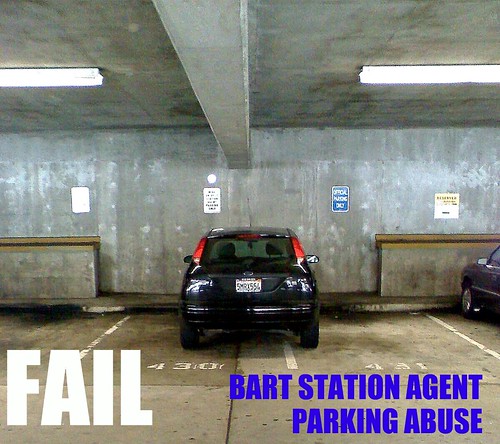
BART Agent FAIL - Setting bad example

From a Twitter source I rely on, Jerold Chinn has mentioned the city is working on a deal to possibly expand the Muni "A" Fast Pass access on BART to also include Daly City Station.

It's a big piece of news that's not getting a lot of media attention. Who wouldn't want extra access?

The "A" Muni Fast Pass
The Fast Pass provides passengers the opportunity to ride BART within San Francisco with no additional fare. It's been a big hit for those who lives near a SF BART station and needs to reach their workplace in downtown SF or attends City College of San Francisco because it gets them there quickly without the hassle of riding a bus.

But for SF State students, it's been a hot issue as the "A" pass does not cover Daly City Station; even though SF State is within San Francisco, Daly City is the closest station to the university campus. This forces students to choose to pay for BART in cash, or save money by taking a longer ride by utilizing Muni.


What's up with Daly City BART?
Daly City station is a very unique station as it lies right on the border between the two cities. Since BART declares Daly City Station not part of San Francisco, Muni does not have the privilege to allow their passengers to use their "A" fast pass, and all BART passengers who rides a train crossing the city border pays a surcharge, which costs a rider of a total of $2.95 to go from Daly City to Powell, and vice versa; while a ride starting and ending within SF is just a mere $1.75.

To compensate for the surcharge, Muni offers all exiting BART passengers a coupon (or Clipper e-transfer) to ride Muni's 28, 28L, and 54 lines for free away from the station, and a free ride back within 24 hours of the coupon issued.

SF State has also contributed to help people get to their campus with a free shuttle service where they run mini buses from the BART station to 19th Avenue & Holloway, and vice versa.

Combining the efforts of Muni's 28 and 28L, and the SF State shuttle has provided students a free way to get to the main campus, even though they pay a premium for the BART service to reach Daly City.

What would happen if BART allows the "A" pass to be accepted at Daly City?

Benefits to passengers:
  1. BART passengers who lives near Daly City and only rides BART to SF now has an unlimited ride option and would obviously save tons of money with a flat rate pass.
  2. Do the math: $2.95 one way from DC to Powell, times two (for round-trips), times 20 working days in January 2012 (not includes January 2nd and January 16th for holidays) = $118.00. By using a $70 pass, a passenger saves $48 a month, or $576 a year.
  3. Faster access for SF State students, meaning reduction in loads for Muni Metro's M-Ocean View and 29-Sunset lines (these are alternate ways to connect to SF State; M-Ocean View for downtown BART stations, and 29-Sunset for Balboa Park BART).
  4. Since no SF BART station has a parking lot, now there's a station that has one along the "A" pass boundaries. Perfect for those who attends games at AT&T Park and wants their car waiting for them after their BART ride, like me.
  5. Samtrans passengers who rides the feeder buses to Daly City also benefits with the flat price pass savings when riding BART.

Negative reaction/problems:

  1. Increase in passenger loads on Muni's 28 and 28L lines.
  2. Increase in passenger loads on the SF State Shuttle.
  3. With a lower cost to ride BART and increases attraction to ride to work in downtown SF, it may cause higher demand for parking at the station's parking garage and lots.
  4. BART ticketing machines don't sell Clipper products, only e-cash. This means passengers would have to buy it at a retailer or at a Muni metro station.
  5. The possible end of free paper transfers for the 28, 28L and 54 Muni lines. If Muni is in a major financial problem, they'd likely kill the Daly City free ride transfers because it costs up to $4 per passenger for the free rides. Muni has to somehow compensate for the switch.
  6. Muni could decide to maintain the coupons for the Muni lines, but only offer the 25 cent discount, just like all SF BART stations have.
  7. Samtrans passengers may use BART Plus for unlimited rides on Samtrans and Muni, but doesn't give unlimited BART rides within SF/Daly City.

Akit's Opinions
In my opinion, I think it's a great idea. It's a great way for SF State students to get to campus. This will also encourage more people to use Clipper to ride BART and Muni to get to/from campus.

Since I have a "M" pass, adding an extra $10 for the premium would help me during baseball season since a round-trip ride on BART from Daly City to Powell station already costs $5.90 round-trip. I would park my car at the station (free parking after 3PM weekdays and all-day on weekends), and take the train to/from the game.

Tuesday, September 27, 2011

Muni Pays 10 Minutes to Operators Just to Submit Their Unused Transfer Books (An E-Mail from an Anonymous Operator)

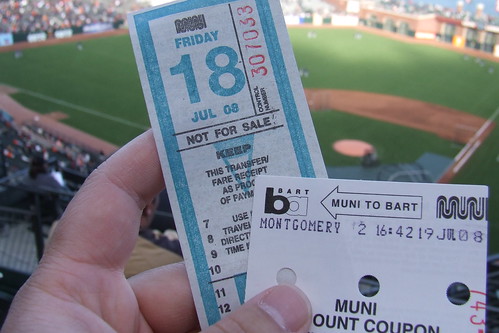
Muni Transfer and Muni to BART Coupon

I just got an e-mail from an anonymous Muni operator on an interesting fact about their pay (edited to protect privacy):
Akit,

Did you know that MUNI pays its drivers 10 minutes of time to turn in their transfer books? [Personal information omitted], one of the little things I learned:

When a driver finishes his run and returns his/her bus to the yard, MUNI pays each driver 10 minutes of worktime to turn the transfer book to the manager inside. The old policy was that the driver simply handed over unused books to the yardmaster as he entered the yard. And MTA wonders why it can't pay its bills!

The veteran operator who explained this to me laughed about it as he explained how stupid it was to pay drivers to prevent transfer theft as though there's an epidemic of drivers selling unused transfers.

Multiply ten minutes of work time at a minimum of approx $28 dollars per hour, by all the drivers in the system, every single day, and it must add up to a pretty penny.

Akit's Opinion
Wow, kinda freaky. They get paid just to turn-in their transfer books? So if they just take a minute to drop it off with the yard supervisor, they get paid 10 minutes worth of time? If you crunched in the numbers, it would be $4.67 for 10 minutes (at $28/hour), times say 300 operators, that's $1,400 a day or $511,000 in a year!

I could understand the idea to prevent selling the books to citizens so they can sell transfers for a buck, but I'm just amused this is another oddball policy in the Muni operators' contract.

The long term solution planned by the MTC that might kill the 10 minute pay rule is if transfers are only issued on Clipper cards; if that happens, let's see if the operators union will be protesting that it's unfair.

Tuesday, July 26, 2011

Muni Modifies & Clarifies the Definition of "Proof of Payment" & Expired Transfers

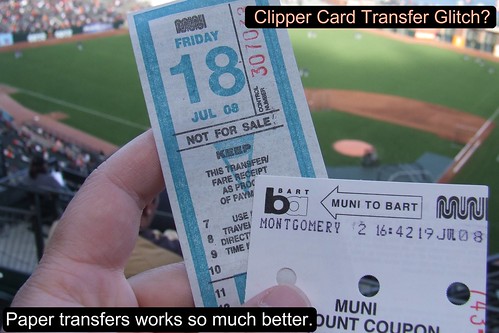
Muni Transfer and Muni to BART Coupon

Muni fare inspectors, many of us don't like them, but they do one thing well, make sure everyone pays their "fare share" for riding public transportation.

In a blog post I did just a year ago, I asked Muni to clarify the "Proof of Payment" system. The program's rules was too complex and didn't make a lot of sense to everyone. My particular topic with the POP system was the expired transfer policy and how that is blurred between what Muni called "POP lines" and "non-POP lines."

One of the reasons why I wrote the blog post is accusations from the Chinese American communities of fare inspectors citing people for expired transfers, but I knew the expired transfer policy was much different on buses than trains.

Let's take a look at the rules:
  • Muni defined "POP lines" as all metro lines.
  • Muni defined "non-POP lines" as all bus lines and the F-Market.

Let's say I ride a Muni bus (a "non-POP" line), board the bus with an unexpired paper transfer and it expired during the journey... here's what Muni's POP rule said:
"There is no need to correct the problem on non-POP lines, but you will not be able to subsequently board a POP line or enter the paid area of a subway station without obtaining Proof of Payment."
I challenged Muni to clean-up their rules to make it simpler and universal across all Muni modes of service as the non-POP and POP lines was so blurred in conjunction with the expired transfer policy.

As a result, I did a little looking around the current Proof of Payment policy for Muni under their "expired transfer" FAQ section. Here's what says now:

What if your Proof of Payment expires during your trip?

If you have a paper transfer:
  • Don't get stuck entering with a transfer that will later expire while you are waiting on a platform or riding in a vehicle. If you are not sure your transfer will last, then pay for a fresh trip on the surface or at a Ticket Vending Machine in the subway.
  • If your Proof of Payment is about to expire, be sure to obtain a new Proof of Payment before the old one expires.
  • If your Proof of Payment has expired and you are riding a Proof of Payment vehicle,
  • If you are on the surface, go pay your fare immediately if it is safe to do so, and get a transfer as Proof of Payment, or else exit the vehicle at the next stop.
  • If you are inside the paid area of a Muni station, or on a vehicle in the subway, exit the station and obtain Proof of Payment .
  • Don't try this if Proof of Payment enforcement officers are aboard the vehicle or present in the paid area of the station; it is too late to correct the problem.

If you have a transfer on a Clipper card or Muni ticket:
  • You will need to have cash or a ride available on your card or ticket for a new payment.
  • If the transfer loaded on your card or ticket is going to expire during your trip, do not board the second car of a two-car train unless you are absolutely certain your card or ticket has sufficient cash or ride value to pay an additional fare.
  • You will need to track when your transfer will expire.
  • Upon the 90-minute transfer expiring, you will need to re-tap and hold your card or ticket to a Clipper reader to get an additional 90 minutes of travel time.
  • If the reader rejects your card or ticket, you will need to go to the operator and pay a fare in cash and receive a paper transfer.
--------------------

In summary, here's what Muni changed after my challenge to clean-up the rules:
  1. There is no such thing as a "non-POP lines" that made separate and confusing rules, currently all Muni lines are now "POP lines." This means the rules for proof of payment is the same regardless of whatever mode of service you take on Muni.
  2. If riding the bus with a transfer that is unexpired when boarding, but expires while aboard the bus, it's now considered a violation; unlike the old rule saying it's okay, but can't ride the next bus without paying for a new transfer.
  3. They now warn passengers paying with e-cash on a Clipper card to keep time of when the e-transfer will expire vs. a paper transfer that easily tells when it expires (when paying cash).
--------------------

Muni should at least do some other things to clean-up the rules a little more:
The website's POP rules was updated to end the blurred policies regarding non-POP lines, but many of the sentences still reflects the old rule about when the phrase "POP lines" meant metro lines only.

Here's an example I found on the POP website today. This was found as a general question, and not specific to buses or metro only:
How do you board a Muni vehicle on the street or at an outside Muni station, excluding West Portal Station?

If you already have Proof of Payment:

  • Make sure you have your Proof of Payment before boarding, and that it will be valid for the duration of your entire trip within the Muni Metro System.
In this particular example, Muni's POP website didn't do a great job of doing a full clean-up after redefining what a "POP line" is. They still mention in portions of their website that the POP rules still applies to the METRO ONLY.

They should rephrase the bullet point like this:
  • Make sure you have your Proof of Payment before boarding, and that it will be valid for the duration of your entire trip within the Muni system.
There's other parts of the Muni website that needs to be cleaned-up to make sure the rules are the same throughout the entire system and not separated by metro lines and non-metro lines. If there's a Muni official who can read and rephrase words in the the POP websites here and here, the public would appreciate it.

Monday, June 27, 2011

Clipper Could be Overcharging You for Using Transfers (UPDATE: Clipper Admits Error, Refunds to be Issued)

Muni Transfer and Muni to BART Coupon

Fellow blogger, John Murphy, posted a blog entry asking people to guess correctly how much he paid with his Clipper card when he took Muni and BART. The prize for the first correct answer was some micro-brewed beer.

Here's the situation:
  1. Rode a Muni bus to the 24th Street BART station.
  2. Transferred to BART to exit in downtown SF.
  3. Transferred to Muni.

What would the answer be? The most obvious answer would be: $3.75. This is computed as:
  1. $2 for the Muni ride
  2. $1.75 for the BART ride within SF
  3. The second Muni ride is free because the transfer is valid from the time issued from the first ride.

Actually, John experienced something that hasn't been fixed by Clipper. He paid $5.50. Let's break this down:
  1. $2 for first Muni ride
  2. $1.75 for BART ride
  3. $1.75 for second Muni ride (saved 25 cents off automatically due to BART to Muni e-transfer)
Why did he get charged an extra $1.75?
John did use the same Clipper card and transferred to his second Muni bus within 90 minutes of tagging his card on the first Muni bus, but was overcharged, which doesn't make a lot of sense.

What happened is he did receive an e-transfer from his first ride on Muni, but when he took BART, his e-Muni transfer was wiped off and the "BART to Muni" transfer was encoded; this meant that instead of a free ride utilizing the e-Muni transfer, he was charged $1.75 by using the other e-transfer.

This can also happen on other agencies, such as taking BART and AC Transit. An AC Transit passenger could use their Clipper card to pay e-cash for their ride to BART, take BART, and transfer to another AC Transit vehicle to get to their destination. AC Transit's transfer policy is that transferring to another AC Transit bus is just 25 cents, but if the passenger took BART, the 25 cent offer gets wiped off and the passenger instead pays $1.75 to AC Transit.

How can this be fixed?
The easiest solution is for passengers to carry a second Clipper card or pay with cash for some of the rides, but I think this is just a waste of plastic and the need to think creatively to get around the system.

Let's ask the folks at MTC, Clipper, and Cubic. I'm waiting for an answer. Leave a comment.

UPDATE:
John asked Clipper on Facebook for answer on why he was overcharged. Here's how they responded:
You're correct - you should not have been charged for the second ride.

This was an incorrect implementation of Muni's transfer policy and MTC has been working with our contractor to fix the issue.

We encourage customers to access their online transaction history records to determine if they were overcharged for this transfer trip. Customers who are affected by this issue should contact Clipper Customer Service to request a refund for the $1.75 that they were overcharged.
I can't believe they publicly admitted to a mistake. That's rare.

Thursday, February 10, 2011

Maximize Clipper Card Inter-Agency Transfers & Discounts


Some people are curious of why they are getting a 25 cent discount on their Muni rides when using their Clipper card. Some say it's a glitch, while others thinks it's an exploit.

To tell you the truth, it's neither. It's all about automatic discounts with the Clipper card.

For the longest time, transit agencies have inter-agency agreements and this means for qualifying customers meeting certain criteria, they can either get a free transit ride on another agency, a local fare credit, or a discount. With the Clipper card in place, inter-agency transfers are even easier as you don't need to get a paper transfer from a machine and you always get the best discount available.

--------------------

The current agencies operating under Clipper (Muni, BART, AC Transit, Caltrain, Golden Gate Transit & Ferry, Samtrans, and coming soon, VTA) all have inter-agency agreements with one or multiple agencies. This blog entry will explain how the agreements work.

Remember the general rules: You must use the same Clipper card to get the benefits, and if you have a pass on your Clipper card for the transferring agency, it overrides the discount.

Reminder: VTA won't be accepting Clipper until February 16th.

BART & Muni Discounts (All SF stations)
  • When exiting BART within San Francisco, board any Muni vehicle or enter the metro within one hour, and receive a 25 cent discount on your ride. A Muni pass overrides this discount.
  • Once you activate your $1.75 discount going away from BART, you are entitled to a 25 cent discount within 24 hours on your return trip to BART.
  • Interestingly, since Clipper readers on Muni doesn't know what line or direction it is operating, even if you ride a different bus within 24 hours and it doesn't go to BART or you exit before you reach the BART station, you still get the 25 cent discount. If you have ever read your Clipper history report online, it doesn't mention which Muni line you rode (it says "MTA NONE") while taking BART or Caltrain will say what station you entered and exited.
BART & Muni Free Ride (Daly City Station)
  • For passengers exiting at Daly City station, they are entitled to a free Muni ride on the 54, 28, or 28L away from the station. The Clipper card will be encoded upon exiting BART and transferring to the Muni bus will not deduct the e-cash purse, but will give the OK to enter as the ride is free as long as you board the bus within one hour.
  • The return trip to Daly City BART is free on the 28 and 54, as long as you use it within 24 hours.
  • But... once again, the system is a little bit dumb. Muni Clipper readers don't know what line it is, so if you take another bus on your way to somewhere, your next ride is also free. It doesn't matter if you ride 28 or 54 back to BART, Clipper takes advantage of the best deal available for the passenger.
Golden Gate Ferry & Muni
  • Upon exiting the SF Golden Gate Ferry terminal, you get 50 cents off to take Muni within one hour.
  • When returning on Muni to Golden Gate Ferry, you get 50 cents off your Muni fare back to Golden Gate Ferry within 24 hours of your initial exit from Golden Gate Ferry.
  • Updates: Just take Muni and transfer to Golden Gate Ferry and receive a 50 cent discount on the ferry ride. When riding Golden Gate Ferry, transfer to Muni and get a 50 cent discount on the Muni ride. There is no more 24-hour policy.
Golden Gate Transit & Muni
  • When transferring from a Muni vehicle to Golden Gate Transit, the passenger receives a 50 cent discount on their Golden Gate Transit fare.
  • When transferring from Golden Gate Transit to Muni, the passenger receives a 50 cent discount on their Muni fare.
Caltrain Monthly Pass on Samtrans & VTA
  • Caltrain monthly pass users must have at least two zones on their Clipper card to use the inter-agency benefit.
  • When riding Samtrans, tagging the card gives a local fare credit (on almost all routes, it's a free ride).
  • When riding VTA, it is free rides on all local and light rail routes. When riding an express bus, it is a $2 discount (for adults, an express ride will deduct only $2 from your e-cash fund).
Samtrans & VTA
  • For those with VTA monthly passes wanting a local fare credit for Samtrans, you need to board VTA first to activate the discount, and when transferring to Samtrans in Palo Alto, tag the card on the Samtrans bus to receive the discount.
  • The procedures are reversed for those with Samtrans monthly passes to get a local fare credit for VTA.
  • To get the local fare credit for the transferring agency, you need to do it within two hours of boarding your "home" agency.
  • The transferring must be done within the confines of Palo Alto (e.g. the transit center).
AC Transit (including Dumbarton Express) & BART to VTA
  • AC Transit and Dumbarton Express passengers transferring to VTA receives a local fare credit within two hours of boarding an AC Transit/Dumbarton vehicle.
  • BART passengers transferring to VTA at Fremont station receives a $2 discount upon boarding VTA within one hour. Your e-cash purse will deduct $2 instead of the full $4 fare.
  • There is no discount for returning on VTA to AC Transit, Dumbarton, and BART. Discount only valid when exiting the other agencies and boarding VTA.
BART to AC Transit
  • Upon exiting BART and boarding an AC Transit bus within one hour, you receive a 25 cent discount off your e-cash fare for AC Transit local buses.
  • When returning on a local AC Transit bus to BART within 24 hours of exiting BART, you get a 25 cents off your AC Transit ride.

These inter-agency discounts are different or was omitted from Clipper:

Caltrain & Muni
  • While not exactly an inter-agency transfer agreement, monthly Caltrain pass users can also purchase the Muni monthly pass add-on for a discounted price of $55.
  • This does not include BART rides in SF and Cable Cars.
Samtrans & Muni
  • The Samtrans website about Clipper does not mention about the $55 Muni pass that can be purchased when purchasing a monthly Samtrans pass.
  • For now, you can still buy the paper Samtrans pass and pay the extra $55 fee for the Muni sticker.
Golden Gate Transit & AC Transit
  • The Golden Gate Transit website does not mention if a Clipper e-transfer is applicable. They explicitly only mention paper transfers. Can a GGT and/or AC Transit representative clarify this?
BART Plus
  • This won't be active on Clipper for a long time until they get the other smaller agencies like WestCat to join the Clipper consortium.

I believe I covered all inter-agency transfers with agencies that are participating in the Clipper card program. If I missed one, leave me a comment.

If you attempt to use an inter-agency benefit and for some reason it didn't work, I suggest contacting Clipper customer service to get it resolved as soon as possible.

Thursday, September 23, 2010

BART to Muni Transfers are Clipper Only Starting October 4th


New news from the SFMTA/Muni folks, if you love your paper "BART to Muni" transfers you get when you exit the BART system and immediately transfer to Muni metro or the surface vehicles, you are not going to get them anymore starting October 4th.

On October 4th, instead of a paper transfer, all passengers will be required to use a Clipper card to receive their automatic 25 cent discount when transferring to Muni (within one hour) and their return trip to BART on Muni (within 24 hours).

Some basic rules about the transfer with Clipper: It must be the same plastic Clipper card you exited with BART to receive the discount to transfer to Muni and discount for the ride back. Any Muni pass on your card overrides the transfer.

The main reason for this is since the new fare gates are installed, the station agents can't give passengers the discount and the new ticketing machines have no way to accept the coupons. It's just another step to eliminate paper waste with the Clipper program, just like how Golden Gate Ferry stopped giving paper Muni transfers and converted to a Clipper only basis.

Muni's new policy is only effective on BART stations between Embaracadero and Balboa Park. Daly City passengers will still receive the paper yellow transfers for free rides on the 28 and 54 lines.

If you get a chance, get yourself one final paper souvenir/keepsake on October 3rd by riding BART. I know I will since I'm going to the last regular season Giants game that day.

Thursday, July 29, 2010

August 1st is End of "BART to Muni" Paper Transfers?


We should be familiar with the paper "BART to Muni" discount transfers: If you ride BART and exit at any of the San Francisco stations, you can get a white paper transfer to receive a 25 cent discount riding Muni away from the BART station, and a 25 cent discount for a return trip back to the station. At Daly City BART, passengers can get a free yellow colored transfer for a free ride on Muni's 28, 28L and 54 lines and a free ride back within 24-hours.

In February, the MTC and TransLink/Clipper board posted a list of deadlines that transit agencies must meet to transition paper media to be electronic. On number seven, it mentions that by August 1, 2010, all paper "BART to Muni" transfers must be converted to Clipper only.

Now that we are just a few days away from August 1st, is BART and Muni ready to give-up the paper transfers and force people to use Clipper cards? From looking at the BART and Muni websites, there is no confirmation. The SFMTA website simply says the word "soon."

While BART and Muni whine like little children, Golden Gate Ferry has followed through on their goal to end paper transfers valid on Muni in favor of Clipper cards on April 1, 2010.

Wednesday, March 24, 2010

Free Muni Rides for Golden Gate Ferry Passengers Ends Next Week


Sorry to tell you the the bad news Golden Gate Ferry passengers, your free rides on Muni is ending in a week.

For over a decade, Golden Gate Ferry passengers would get a two part transfer for a free ride on Muni to go away from the terminal (expired in 90 minutes) and one to return to the terminal (expired in 24 hours). It was an exceptional deal to get a free lift on Muni after paying about $4 (TransLink) or $8 in cash for a one-way ferry trip.

During the TransLink era, passengers who paid with their TL cards could decide to get the paper transfer or just use their TL card for their free ride away and back to the ferry terminal (e-transfer).

Starting April 1st, there will be two major things happening:
  1. The Muni transfer will not offer free rides. Instead, passengers will get a 50 cent discount away from the terminal, and 50 cents off for the return trip. (Seniors, youth, and disabled will get a 25 cent discount)
  2. No paper transfers will be issued from the terminal. A TransLink card is required to make the initial transaction with Golden Gate Ferry to be eligible for the discount transfer. A valid TransLink e-Muni pass will override the discount transfer.
Golden Gate Ferry passengers know they get a huge discount when using their TransLink card instead of paying cash, so do you have a card? Get a card at a retailer for a $5 fee (credited back if you register for autoload) or keep your eyes peeled for card giveaways at key locations within San Francisco. Next distribution will be at SF State this Thursday from 10:30AM to 2PM (I'm not sure exactly where, it's likely on 19th/Holloway or in the Student Center).

Wednesday, March 3, 2010

The Muni Transfer Debate... A Big Mess Every Time


Muni transfers have always been a center of debate when there's a budget crisis for the agency.

Transfers have been an important part of our city's transit system for many decades (even before I was born).

The last time Muni really took action on transfers is during the Frank Jordan era when transfers were completely eliminated (the POP system never existed back then) and riding from one part of town to the other and transferring would cost double or triple the regular fare. But... the city repealed the policy after the citizens got really ticked-off.

Just yesterday, the SFMTA was considering to charge a 50 cent fee for transfers. People were in panic on the comment boards on SFGate, but just hours later, an updated piece of news came out that the SFMTA decided to not charge for transfers.

But let's remember that the transfers debate could return at anytime. Muni could decide to put the issue back on the table by proposing a fee for transfers or completely eliminating them, but there are major consequences for charging or wiping-out those slips of paper.

Here's what would happen if Muni charged or eliminated transfers:
  • The "proof of payment" system is dead. Passengers now have the choice to pay the fare and not get a transfer; since that piece of paper is supposed to be a fare receipt, the fare inspectors cannot enforce the rules.
  • Illegal back door boarding (fare evasion) will get even worse since fare inspectors can't really do their primary job.
  • Passengers would sell their non-expired transfers to others (an illegal act) or give them away to someone else.
  • On the brighter end... those fare inspectors can actually enforce a major problem, rear door boarding should be stopped or they should check fares to allow back door boarding so the vehicle can leave faster.
But one thing definitely will happen in September 2011, say goodbye to paper transfers and hello to TransLink/Clipper.

Tuesday, February 23, 2010

No More Muni Paper Transfers Starting September 2011 - Fare Inspectors Worried


With the progression of the TransLink/Clipper program to take over all paper media including passes, tickets, and transfers within the next couple of years, there will be some serious changes to the atmosphere of public transit. Muni is going to be one big target.

The MTC mentions on page 25 of resolution #3866 (PDF document) that bus and metro transfers is tentatively scheduled to be eliminated by September 30, 2011 (as long as the SFMTA Board approves this transition date). After this date, the only form of free transfers would be only on the TransLink/Clipper card. This is similar to Washington D.C.'s rail and bus service where as of January 4, 2009, paper transfers are no longer issued, and an RFID fare card was required to do all transferring.

For Muni, eliminating paper transfers means a huge cost savings on printing the thousands of transfers for every single day of the year, and will stop the litter at terminal stops where in some places, are just all over the ground and the trash can is just a few steps away.

Surely, no more paper transfers will help save money for the suffering agency, but Muni will have to fix some serious problems and issues with their current "Proof of Payment" system:
  • People who pay cash won't be issued a transfer or payment receipt. What do they show when demanded to provide proof? An empty wallet? I asked a similar question last April about what to do if Muni charged all passengers if they wanted a transfer.
  • Without the paper transfers as proof to show the fare inspectors, this means the inspectors are much less useful to enforce the fare evasion laws/codes that governs the transit agency. A passenger can easily claim to the inspector that he/she paid in cash, when in reality, boarded the back door and didn't pay a cent.
  • Fare inspectors would be only able to do one thing since they can't check for "proof" anymore, just write tickets for gate jumping and back door boarding.
For the fare inspector force, get ready for some fat trimming. The amount of tickets they write doesn't make-up for their salaries (simple math shows each inspector only writes an average of $9,800 worth of tickets per year vs. a $50K+ salary), and by killing paper transfers, at least expect a pay cut (minimum).

Fare inspectors, I suggest: You have one year and seven months to start looking for another job. I'm sure Muni won't need your services anymore while their budget is hemorrhaging like crazy.