"Akit is the man. He knows Clipper." (spenta)
"It’s a fantastic blog for any San Franciscan."
(Kevin)
"Your blog is always on point, and well researched!" (Nina Decker)
"Everyone's favorite volunteer public policy consultant..." (Eve Batey, SF Appeal)
"You are doing a great job keeping on top of Translink stuff. Keep up the good work!"
(Greg Dewar, N Judah Chronicles)
"...I don't even bother subscribing anywhere else for my local public transportation info. You have it all..."
(Empowered Follower)
"If anyone at City Hall wants to make public transit better for all San Franciscans, it would be wise to follow Akit religiously...
or, better yet, give him a job."
(Brock Keeling, SFist)
Showing posts with label 8-ride. Show all posts

Saturday, January 14, 2012

The "Caltrain Screwjob" - End of 8-Rides Means 15% to 25% Fare Hike

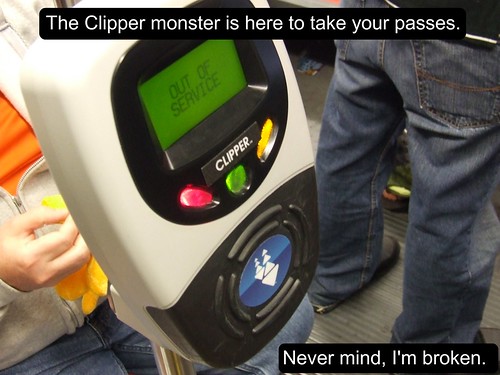
Clipper Monster Reader FAIL

If you haven't read the news lately, Caltrain is proposing to do some changes to their fare structure.

Penalty for Paper Tickets
Essentially, it's going to a penalty on the people who buy paper tickets at their train stations. They are proposing passengers to pay an extra 25 cents per zone for one-way tickets, and 50 cents per zone for day passes. Another way of saying it, it's a 10% fare hike for paper ticket users.

However, Caltrain will not impose the additional fee on those who uses Clipper cards to pay for their rides (e-cash).

By operating on a different fare structure for cash vs. Clipper e-cash, it does cause one unique problem:
  • For those who rides more than two times in one day, Clipper e-cash does not give you a day pass; therefore if you ride three times with Clipper, you get charged three one-way rides.
  • At least with a paper day pass, you have to pay an extra 50 cent penalty per zone covered, but you get UNLIMITED rides within the zones covered.

End of 8-Rides
This is going to stir more controversy than the paper ticket hike.

I have argued the 8-ride system for Caltrain on Clipper is pretty much a stupid move, and I have suggested that all passengers who rides Caltrain using Clipper should get an across the board 15% discount on their train fares by paying for one-way rides with Clipper's universal e-cash purse.

Well, it didn't turn out the way I expected it.

Caltrain's proposal is to end 8-ride, therefore Clipper users can pay with e-cash for their single trip rides. But as mentioned from above, Caltrain's 25 cent per zone fee for paper ticket makes it sound like you will still receive a discount, but if you were to spend time and crunch the numbers, you are about to get very screwed over.

Caltrain's way of saying it on their website makes it sound cool the 8-rides will die a painful death, but you'll be paying more. Example:
  • A two zone 8-ride: $32.25
  • New Clipper only 2-zone one-way e-cash per ride: $4.75
  • Multiply new 2-zone Clipper one-way e-cash fare by eight: $38.
  • Divide 32.25 into 38, you get .849. A simple way of saying it, 8-ride passengers being converted to Clipper e-cash one way fares only will be paying for a 15% fare hike.
  • However, if an ex 8-rider uses Clipper, they won't pay the 25 cent per zone paper fee, but if the passenger switches completely to paper tickets only, it will be a 25% fare hike (15% hike for ending 8-ride, and 10% hike for the paper charge).

Akit's Opinion
Regarding the paper ticket fee (10% fare hike):
This begs the question, why hasn't Caltrain and Clipper devised a way to let people essentially 'earn' a day pass when they ride two one-way trips (a.k.a. "pass accumulator")? VTA is planning to do this in the near future where if a passenger rides their buses/trains a certain number of times, the rest of the rides for the remainder of the day is free.

Caltrain also has very few Clipper add value machines, they've only installed them in a few major stations. They refused to modify their paper ticket machines to handle the job, so now people will have to carefully monitor their Clipper e-cash balance, or consider autoload (which I don't recommend).

Regarding the end of 8-rides:
It's a screwjob for the 8-ride users as they lose their 15% off and pay the 'normal' cash fare like other Joes and Janes do today and when the proposal becomes reality. It's an even bigger screwjob for those who decides to skip Clipper completely and pay the paper ticket fare, therefore getting a 25% fare hike.

This ain't cool at all. They kicking their most loyal passengers in the butt, while their casual passengers get a break.

Caltrain's proposal is bad; whomever wrote it will sure get a lot of 8-riders angry. Here's how I would have handled it:
  1. Follow how Golden Gate Transit did it. Instead of raising fares, kill the 8-rides and give all Clipper card passengers an across the board 15% discount on one-way e-cash fares; this will compensate for the end of 8-rides. This attracts more ridership as people who infrequently ride it will notice a 15% discount for them too.
  2. Do not add 10% penalty for paper tickets.
  3. Start doing a transition every six months until you meet the goal you established; either reduce the 15% to 10%, or all fare categories gets a hike of 25 or 50 cents per zone.

By doing the three steps, it makes it sound much better by easing the pain of a hike, but they way they proposed it, it's like getting kicked in the nuts, then kicked in the face seconds later.

The "Caltrain Screwjob"
If you are wondering why I called it the "Caltrain Screwjob," it's similar to professional wrestling's infamous "Montreal Screwjob." You can read about it here.

If you feel upset that you'll be paying a 15% to 25% fare hike, I encourage you to complain to Caltrain. Their e-mail is: changes@caltrain.com or for alternate methods, click here. Make sure to call these changes the "Caltrain Screwjob" so they know Akit encouraged you to contact them and you stand beside him.

Thursday, July 28, 2011

Tell Caltrain: No More 8-Ride Tickets on Clipper!


Just recently, SF Weekly published an article mentioning about how bad it's gotten with Clipper card passengers on Caltrain. There's also a new order from Amtrak management (contracted to run Caltrain) to basically be as unforgiving to a Clipper card user whose card is invalid or just having trouble.

Well, there has to be a solution, and I thought of one as I left it in the comments. Soon enough, I learned my fellow blogger, John Murphy, beat me to the punch. While we have the same exact goals, our views on how to implement it is slightly different.

Here's my take on ending 8-ride tickets:
8-ride tickets has been a staple on Caltrain for a long time. It used to be 10-rides until the validation machines at Caltrain stations kept malfunctioning. The tickets had a few basic rules, including an expiration date for use, and any passenger needing to travel further than what's listed on the 8-ride can pay for a zone upgrade ticket.

Not long ago, Caltrain switched from paper 8-rides to Clipper only and it came with some mixed fanfare. The rules of the program had to change because of the way Clipper operated. What was kept was the expiration rules, but the zone upgrade was not available anymore, thereby passengers wanting to go further had to buy an additional 8-ride to their Clipper card or just buy a one-way ticket at the non-discounted (regular) price.

I wrote on my blog about how to properly use it, taking more of Caltrain's side to say that as long as what's out there, follow the rules; that turned-out ugly when Caltrain's web geeks decided to link my blog to their website and I had a flurry of mean spirited commentary on my blog. I felt like I was a puppet spokesperson for Caltrain.

That was not a great move for me. Sure, that added some more ad revenue and fans flocking to my blog. I realized there's a more critical problem with Caltrain and Clipper, 8-rides is just pointless.

My solution:
End 8-rides on Clipper and give everyone an across the board 15% discount by using the universal e-cash fund.

If you ever cracked the numbers on how much an 8-ride can save passengers, the amount is 15% (give or take around 0.1%).

This process would be very simple. Everyone can use e-cash which is like having cash in your wallet to pay for any transit rides you want. Passengers tag-on at their starting point, and tag-off resulting in being charged at 15% off the one-way cash fare.

This makes it simple and clean. No worries about not having enough 8-rides, no worries about last minute zone switching because your significant other wants to meet you at the mall, or you forgot to grab groceries before heading home.

One Transit Agency Did it a Long Time Ago
Golden Gate Transit and Ferry was one of the first transit agencies to adopt TransLink (old name prior to the switch to the newer "Clipper" branding).

Back in the days, Golden Gate had two options for passengers to pay their fare, pay in cash for a one-way ride, or pre-purchase frequent commuter ticket books. The commuter books are very similar to Caltrain's 8-ride tickets because using them came with a discount and had an expiration date. Since Golden Gate's commuter ticket books was zone specific, they had to print multiple types of zone books on a frequent basis to cover all six zones; and that meant a lot of money being wasted.

When TransLink came around, the agency thought smart: Instead of having TransLink sell electronic versions of the zone books and follow the same rules as they had before about usage (including expiration date), they decided to go with the e-cash only route.

Golden Gate Transit and Ferry went with this great offer: Use the TransLink card, and regardless if you ride it daily or just once a year, every card user will pay less and there's no need to purchase e-ride books. This meant all Golden Gate Transit riders gets 20% off (10% on Marin Transit), and Ferry passengers receives a discount ranging from 40 to 50% off.

What Golden Gate did was a bold move, but it made it much simpler for passengers by just asking all passengers to have ample e-cash on their account, and just tag-on and off to be charged the appropriate one-way fare with the commuter discount savings. This helped passengers who decides to exit the bus early or take a longer trip; this also helps with reducing the complaint loads on customer service; unlike how Caltrain's implementation caused a very high number of complaint calls.

How Does the Caltrain Idea Compare to John Murphy's?
His idea is to have a separate e-cash fund known as "Caltrain Cash" which is the only way to receive the across the board discounts for Caltrain. Using regular e-cash would result in paying the regular one-way fare.

The C-Cash fund would be similar to what BART offers, for those wanting high value discount tickets (prepay a high amount to BART and get a 6.25% bonus), it would be designated in a separate fund on your Clipper card and can't be shared between other agencies. Having a separate fund pool means that transit agencies can earn interest on the extra cash (known as the "float") in a savings account. BART is known to make money off the "float" from the residual tickets thrown in the trash (a.k.a. "tiny tickets") and now they can also get "float" from the Clipper card users who have remaining HVD balances on their card.

While agencies can benefit from the "float," that just makes it more complicated for passengers. These days, people wants it to be easy to ride transit without buying separate e-tickets and e-passes and other garbage to make the program complex. Clipper's universal e-cash fund is the easiest way to ride public transit because it's accepted on all transit agencies and Golden Gate Transit didn't want to make their Clipper system complex and just gave across the board discounts to all card users.

Basically, in comparison:
  • I want Caltrain to only accept e-cash and give a 15% discount to Caltrain passengers.
  • John wants Caltrain to have a separate cash fund that will give 15% discount to Caltrain passengers.
Eliminate Caltrain Monthly Passes?
While I'm on the topic of Caltrain, I'm not sure how to eliminate the monthly passes. E-cash paying only with the 15% discount may not give the appropriate discount necessary because people could ride Caltrain just twice a day on weekdays only, or ride multiple times per day every single day.

A possible option is to go with the pass accumulator. This means a passenger just needs to fund their Clipper card with e-cash and when it reaches a certain threshold within a specific time period, a pass is "earned" and future rides during that time period is free. This would end the multiple choices to purchase monthly passes, whether it be online, at a retailer, or an automated machine.

This option would work well for agencies like Muni, but for Caltrain operating a zone system, this would be really complicated on how to calculate a passenger's travels to 'earn' the pass.

Until Caltrain Kills the 8-Ride Tickets...
Do not register for Clipper's autoload program or the automatic loading through commuter benefit agencies.

If autoload screws up and it wasn't your fault (say your credit card charge was denied), your card is blocked from future Clipper usage until it's cleared-up with customer service. That may take days for the card to be unblocked.

If the automatic loading from commuter benefits doesn't happen on-time, you are left out in the cold with no Caltrain pass or 8-rides to cover your journey. That could mean attempting to ride for free and risking a court visit for fare evasion, or paying cash for a regular one-way ticket.

The easy solution is to use in-person vendors, transit agency ticketing offices, self-service machines, or Clipper customer service locations at Embarcadero station and the Ferry Building. By using one of these options, you get your pass, e-cash, or 8-rides INSTANTLY on the card and available for immediate usage. This beats ordering online because it can take up to 5-days for it to be loaded onto the card.

Here's two video examples I produced of how to use a self-service machine:


For commuter benefits, ask your employer or use the benefit agency's website to modify your ordering from automatic loading to one of these choices:
  • Ask for a paper voucher. They are accepted at Walgreens, Clipper customer service, and transit agency ticketing offices.
  • Ask for a debit card. They are accepted at all self-service machines (such as all Muni metro stations), Clipper customer service, and some transit agency ticketing offices.
By going away from autoload and commuter benefit automatic loading, you never have to worry about your card being blocked ever again.

Friday, February 4, 2011

Caltrain Passengers - Learn to Use Clipper Correctly


I'm noticing on the Twitter feeds I keep tabs, and there's a bunch of you who keep whining about how Clipper on Caltrain just sucks.

Listen folks, it's your own fault if you don't pay attention to the rules, and especially the rule about always tagging-on and off to be charged properly (oh boy, here comes the hate mail...). The system may be new and its a learning curve for all, but if you pay attention to the policies noted on Caltrain and Clipper's websites, or grabbed a brochure made by Clipper, you'll understand how it all works.

A lot of people whined about tagging their card on Muni and always getting the "three beeps of death," but that's because they didn't hold the card steady to the reader. A few months later, no complaints because people know the proper technique.

It's all about time, give it a couple of months and you'll get the hang of it.

--------------------

The most frequent complaint is failure to tag-off, and it results in being charged the maximum fare. There's a reason for being charged max fare upon tagging-on: the system does not know when you are going to exit, thereby tagging-off is required to tell the system that you are entitled to a proper refund so you are properly charged for your travel.

Nearly a decade ago, TransLink (prior to rebranding as Clipper) was on Caltrain, and passengers had to press the appropriate zone button on the reader prior to tagging their card; once card is tagged, the proper fare was charged for that coverage and no tagging-off was required. But this easily sets up Caltrain for financial loss because people could just press a zone that's the cheapest and gamble on not getting caught by a conductor or inspector. In my past experiences on Caltrain with an electronic fare card, no conductor ever conducted an inspection, while some others just looked at it and said okay without scanning it. The max fare system works well because even if fare inspection doesn't happen on a frequent basis, there's much less risk to Caltrain from being ripped-off by passengers. We all know how bad Caltrain's financial condition is right now, and they want to reduce the risk of fare evasion as much as they can.

Think about this: Imagine if BART did not have fare gates; their fare structure is similar to Caltrain, and the tag-on and off procedure is necessary in order for the system to properly calculate the correct fare. The only way this can work is the card must be charged the maximum fare, but when tagging-off, the fare is properly refunded so you technically paid the correct amount for your journey.

The same goes for Golden Gate Transit. They operate on a zone system and the Clipper readers are connected with GPS units to know when it enters another zone. When a passenger tags their card on boarding, the maximum fare is charged, and when exiting, the refund is issued so the passenger pays their proper fare. It would be a waste Golden Gate Transit's time to have their drivers push buttons all day long for passengers saying they want to exit at this stop or zone when it's easily simplified with a tag-off procedure.

This is in no way compared to agencies with a flat fare system, like Muni. Tagging once means you can ride where ever you want and no tagging-off is required.

--------------------

So here's the "rules" I'm talking about so we are on the same page. This does not explain how to purchase e-cash, monthly passes, or 8-rides.

Step-by-step instructions for e-cash (single ride) and 8-ride ticket customers:
  1. Card must have at least $1.25 in value. If you have less than that, your ride is denied, even if you have an 8-ride on the card. Why? The card has a max negative balance of $10, and Caltrain from end to end costs more than $10.
  2. Tag the card at your starting station. Green light or green & yellow light means OK. Your card will deduct the maximum fare, and the card may go into the negative balance.
  3. When an inspector asks to review the card, hand the card and the inspector's reader will say "YES."
  4. At your end station, tag the card to get your money back from when you tagged-on. If 8-ride, full refund and one ride deducted. If I am doing e-cash only, refund is partial so you are properly charged for the fare zones you covered (if my card deducted $10 on entry, and a two zone ride is $2, I would be refunded $8 at my end station).
Step-by-step for monthly pass users:
  1. On the first day of travel for the new month, you must tag your card at your starting zone.
  2. During that first day of travel, card must have at least $1.25 in value. If you have less than that, you are denied a ride.
  3. Tag the card at your starting station. Green light or green & yellow light means OK. Your card will deduct the maximum fare, and the card may go into the negative balance.
  4. At your end station, tag the card to get a full refund, and the card will be encoded as a pass for the zones you are covering.
  5. On subsequent rides during the valid month, you DO NOT need to tag the card at the beginning and end. Fare inspector readers will note the zones you are covering. If riding beyond your designated zone, purchase a paper zone upgrade at a vending machine.
WARNING: If you tag-on at a reader and get the red light and three rapid beeps, DO NOT board Caltrain; if you do, you will risk being kicked-off and/or a citation for fare evasion (your card is NOT VALID FOR TRAVEL!!!). Pay for a paper ticket and call Clipper for help.

For a comparison about Caltrain paper tickets & passes versus Clipper, click here.
For the best guide around on how to use Clipper, click here.

Best wishes and enjoy your weekend.

Tuesday, February 1, 2011

Clipper Card Changes for the Month of February: Caltrain and VTA


February is going to be a big month for Clipper with the end of paper media for many Caltrain users, and the induction of VTA to the family.

Caltrain
For those of you taking Caltrain, yesterday was the last day to purchase paper 8-ride tickets (valid for 60 days). Today, 8-ride tickets are only sold on the Clipper card. Please remember, there are no Clipper self service machines at the stations to help you purchase 8-rides; you need to visit an in-person vendor, or if commuting to downtown SF, a Muni metro station ticketing machine. You can also register for autoload or purchase your 8-rides online (with up to a five day waiting period).

Also, this is the last month for passengers to purchase a paper monthly Caltrain pass. Starting with the March 2011 pass, it must be purchased on a Clipper card.

To learn how the Caltrain transition to Clipper works, click here. If you do not have a Clipper card, the time to start getting one is NOW. You can get one at any in-person vendor that can add Clipper value, a Muni metro ticketing machine, or get one via snail mail by ordering online.

Santa Clara Valley Transportation Authority
VTA will be going live with Clipper starting February 16th. If you jumped the gun and purchased a February Caltrain pass with a minimum two zone coverage on your Clipper card, you can't use that inter-agency benefit until VTA's first day of Clipper acceptance. To learn how VTA works with Clipper, including how the inter-agency benefit works for Caltrain pass users, click here.

--------------------

Lastly, before you all start bragging that Clipper sucks, or you think you've been ripped off, I suggest reading this guide I made that will provide you the information you need to have a good relationship with Clipper.

Friday, January 7, 2011

It's Ugly: Caltrain 8-Ride and Monthly Pass Transition to Clipper


If you ride Caltrain and depend on the 8-ride tickets or monthly passes, you could be in a shock during the months of February and March as the paper version will not be sold. But have no fear, Clipper is here! Okay, maybe a little fear or a lot.

8-Ride Tickets
Big Changes in Policy with 8-Ride Tickets
  • Clipper card machines to purchase new cards and adding value are not at all stations. To make matters worse, passengers must buy their 8-rides at retail locations, automated machines at places like SF Muni metro stations, or online (with standard 3-day waiting period). Read more about how to add value. Until Caltrain can find a way to allow Clipper purchasing at their stations, you should make preparations now.
  • The card must be tagged-on at your starting station and tagged-off at your ending station. This means, if you have a zone one to zone two 8-ride, you tag on in zone one, and tag-off at zone two.
  • There must be at least a minimum $2.50 on the Clipper card at all times when using Caltrain. Used to be $1.25, but fare increase for 2011 has changed it.
  • You can have up to 24 rides stored on the card. When it drops down to at least 16 rides, you can purchase another 8-ride.
  • You can purchase multiple 8-ride tickets for multiple areas. For example, I can load a zone 1 to 2, and zone 1 to 3 on a single card; but be aware of the 24-ride limit.
  • Unfortunately, you cannot do zone upgrades, unlike the paper system. If you ride beyond your designated zone, you will be charged the e-cash fare; the system will not deduct one ride and the upgrade fee. Also, since there is a tag-out procedure, you can't buy a paper zone upgrade ticket to cover your butt.
  • You can tag-off at the same reader you tagged-on and get a full refund within 15 minutes (perfect when there's a train delay or incident). If tagged-off beyond 15 minutes, passengers get charged a one zone e-cash fare (or one ride if their 8-ride ticket covers just that one zone only).
  • It is unclear if someone has a three or more zone 8-ride and tag-off midway. Will it deduct e-cash or just deduct a ride?

Monthly Passes
  • Starting with the March pass, all monthly passes will be on a Clipper card only basis. If you have two or more zone purchased, you can ride VTA and Samtrans free (local fare credit) by tagging card to bus/light rail platform reader. VTA will be active in February, just in time for Caltrain's transition.
Big Changes in Policy for Monthly Passes
  • Unlike being able to purchase paper passes at station machines, there is no way to purchase a Clipper e-pass at your station machines. Look for retailers or enroll in autoload.
  • The card must have at least $2.50 minimum e-cash value at ALL TIMES when tagging-on Caltrain.
  • You can mix a monthly pass with an 8-zone ticket on a single card.
  • On your first ride for the new month, you must tag-on and tag-off for your pass to be active.
  • Once you do your first ride, you don't have to tag-on and off for the entire remainder of the month. The conductor will scan your card and will tell him/her what zones you are covered.
  • Optional: You can tag-on and off, but only do it within your designated start & end zones.
  • Zone upgrades are available, but you must buy a paper zone upgrade and show it to the conductor when he/she scans your card.

Akit's Point of View
I totally support a transition away from paper passes and 8-ride tickets, but the changes in policy makes it a total mess. Why didn't Clipper try their best to exactly mimic policies set forth just like the paper versions? Here's my list of arguments to this being a terrible transition:
  1. Ticketing machines can't handle Clipper monthly pass or 8-ride transactions. Very few vendors in San Mateo and Santa Clara county contracted to handle Clipper loading.
  2. Zone upgrades banned on 8-rides for Clipper.
  3. Still have to purchase a paper zone upgrade for a monthly pass.
  4. System unable to charge an automatic zone upgrade fee when a monthly pass or 8-ride is present and the passenger tags on and off.
  5. Unclear policy regarding what would happen if a 8-ride passenger exits at a zone less than what's designated.
  6. For e-cash only passengers, there is no day pass option; only paper will exist. Ride three times, get charged three one-way fares.
  7. If a monthly pass passenger has to tag-on their pass at the first day of travel for the new month, but decides to cut their ride short (e.g. take BART at Millbrae), one may be charged full one-way fare instead of pass.
  8. Why not just enforce a policy of tagging-on and off every single time? By allowing automatic charging of zone upgrade fees and handling appropriate charges for taking less of a ride than the designated zones purchased, it makes it easy.
Maybe Caltrain should have followed in the footsteps of Golden Gate Transit & Ferry. Instead of those complicated paper ticket books while operating a zone system, they simply gave all Clipper e-cash paying customers a discount. Passengers would not have to purchase zone specific tickets to get their discounted rides, they just used their card to get the equivalent and it helped infrequent passengers get an incentive to ride the system even more.

If you don't know what the heck Clipper is, I wrote a great guide giving you all the info you will ever need.