Welcome to Akit.Org, home to the Complaint Department and started on February 7, 2002. Featured on: SFist, Curbed SF, SF Citizen, N Judah Chronicles, SF Examiner, SFGate, Rescue Muni, SF Appeal, Pacific Citizen, NBC Bay Area, SF Weekly's The Snitch, Streetsblog SF, and Muni Diaries.
"Akit is the man. He knows Clipper." (spenta) "It’s a fantastic blog for any San Franciscan." (Kevin) "Your blog is always on point, and well researched!"(Nina Decker) "Everyone's favorite volunteer public policy consultant..."(Eve Batey, SF Appeal) "You are doing a great job keeping on top of Translink stuff. Keep up the good work!" (Greg Dewar, N Judah Chronicles) "...I don't even bother subscribing anywhere else for my local public transportation info. You have it all..." (Empowered Follower) "If anyone at City Hall wants to make public transit better for all San Franciscans, it would be wise to follow Akit religiously... or, better yet, give him a job." (Brock Keeling, SFist)
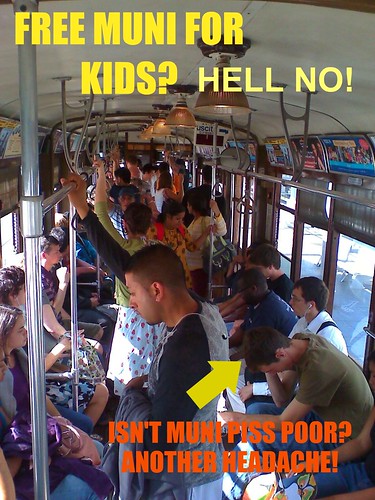
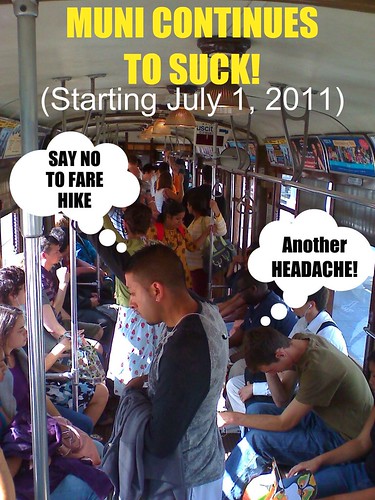
UPDATE: SFMTA Board approved giving free passes to youth, instead of investing money towards keeping Muni running, especially since the meltdown. Big frown! Read Tweet from Muni.
Original posting: Yesterday was one of Muni's worst days ever with two major incidents: a passenger being dragged over 500 feet when struck by a F-Market streetcar, and the meltdown of Muni metro.
Muni Metro serves tens of thousands of people every single workday, and a transformer at the Van Ness station practically ended all tunnel service within the city, therefore forcing city buses to take the brunt of transporting riders from West Portal to Embarcadero. Muni blames the transformer on the weekend's heavy rains for ruining the commute after 6PM, but fortunately service is restored to the light rail system for the morning commute.
Also on the agenda is the board will be voting on $1.6 million in grant funding from the MTC to provide free Muni youth passes for those who qualify. The rest of the grant money ($5.1 million) will be going towards a rehabilitation of the light rail vehicles. (View PDF of proposal here)
Other than my views of using taxpayer money to fund free rides for kids (I deeply oppose any free rides for kids), in light of the major Muni metro meltdown last night, I want the SFMTA Board to reject the $1.6 million in funding and change the proposal to spend that money to fixing the critical infrastructure of Muni in order to maintain operational status.
While I know $1.6 million won't solve all our problems, at least fixing certain critical components such as making sure the electrical transformers for Muni metro won't explode is more important because the metro service serves a bigger population, and not just kids who might be eligible for a free pass. I depend on Muni metro on days when I go to the ballpark, and many of you depend on it to bring you fast service to your workplace in downtown.
What would you spend $1.6 million? Making sure Muni works for all, or give free passes for kids?
I'd make sure Muni works for all. And for you kids, be lucky Muni gives the BIGGEST DISCOUNT for youth passengers versus other agencies in the Bay Area.
Muni: $2 adult, $0.75 youth (62.5% discount) with free transfer.
Samtrans: $2 adult, $1.25 youth (37.5% discount) with no transfer.
VTA: $2 adult, $1.75 youth (12.5% discount) with no transfer.
AC Transit: $2.10 adult, $1.05 youth (50% discount) with additional $0.25 for one ride transfer.
For many months, the battle of youth Muni passengers getting free passes for rides has been a hot topic. While many youth and low income advocates are pushing hard for it, and the SFMTA and SFUSD has put their support towards it, I've noticed a lot of other people feel they don't like the idea.
The epic battle raged on yesterday at the Metropolitan Transportation Commission's meeting where they decided on the fate of giving $5 million in funding, which will cover over half of the $9 million needed for the 22 month project.
The vote was close and it failed with only seven commissioners saying yes, and eight commissioners saying no. Majority ruled and the attendees was angry because all the work they've done just went down the toilet in a very close vote.
Akit's Opinion:
I can sympathize the fact that the people who have been hard at advocating for the free passes are both upset and depressed. When you fight hard for a cause and it can be taken away with a simple vote, things can go from bright to dark in a flash. But just because the MTC voted against giving $5 million for the project doesn't mean you should get full blown emotional with anger and crying (as shown by the Chronicle), will not being able to get free passes affect your grades? I've seen people with much more difficult financial situations and those in foster care beat the odds.
I have to look at the whole picture. What can five million dollars be used for and how can it benefit everyone? It doesn't make practical sense to give the youth of SF free rides. I believe money should be invested in something that can benefit EVERYONE and would be a long term benefit versus a 22 month pass pilot project. For five million, it could partially pay for a new bus which can last at least 10-15 years and serve hundreds of thousands of passengers in its lifetime, rehabbing transit vehicles so they can operate longer with fewer breakdowns, fund transit routes to areas neglected with lack of transit, and plenty more.
There can also be the argument of discrimination; why should the MTC, a regional authority regarding transportation would give Muni a huge chunk of money for free passes, when other agencies such as AC Transit and VTA would only get some funding for a reduction in fares or passes? It could be argued that others that live in Marin County (which is under the MTC's jurisdiction) and San Mateo County can also demand for it too. So truly the project will be more than just several million, because other counties and their advocates will demand they should get free passes too; therefore a chain reaction will start. Even if the pilot program is successful, continued investment into it will be extremely expensive, and what will happen if the MTC decides to kill funding to it? I feel the youth of the Bay Area will revolt.
If there's a middle ground to all of this, I'd consider an option to only give the youth of San Francisco two rides per school day with the usual 90 minute electronic transfers on their Clipper card. This keeps both the costs lower and would supplement the years of neglect from the SFUSD for not funding school buses to get students to and from school. Having free rides on weekends, holidays, and non-school hours is a big no-no.
As I mentioned in my blog in March, the youth of San Francisco should be grateful of Muni's contribution to keep fares low. When comparing transit agencies within the region, Muni gives both the steepest discount (in comparison to the adult fare) and free transfers valid for 90 minutes to get to where they need to go. Other agencies gives a discount, but doesn't come with transfer privileges:
Muni: $2 adult, $0.75 youth (62.5% discount) with free transfer.
Samtrans: $2 adult, $1.25 youth (37.5% discount) with no transfer.
VTA: $2 adult, $1.75 youth (12.5% discount) with no transfer.
AC Transit: $2.10 adult, $1.05 youth (50% discount) with additional $0.25 for one ride transfer.
Lastly, cheers to the MTC for doing the right thing. Kids, stop crying and getting angry, it makes you look like fools in the Chronicle.
Just recently, SF Weekly published an article mentioning about how bad it's gotten with Clipper card passengers on Caltrain. There's also a new order from Amtrak management (contracted to run Caltrain) to basically be as unforgiving to a Clipper card user whose card is invalid or just having trouble.
Well, there has to be a solution, and I thought of one as I left it in the comments. Soon enough, I learned my fellow blogger, John Murphy, beat me to the punch. While we have the same exact goals, our views on how to implement it is slightly different.
Here's my take on ending 8-ride tickets: 8-ride tickets has been a staple on Caltrain for a long time. It used to be 10-rides until the validation machines at Caltrain stations kept malfunctioning. The tickets had a few basic rules, including an expiration date for use, and any passenger needing to travel further than what's listed on the 8-ride can pay for a zone upgrade ticket.
Not long ago, Caltrain switched from paper 8-rides to Clipper only and it came with some mixed fanfare. The rules of the program had to change because of the way Clipper operated. What was kept was the expiration rules, but the zone upgrade was not available anymore, thereby passengers wanting to go further had to buy an additional 8-ride to their Clipper card or just buy a one-way ticket at the non-discounted (regular) price.
That was not a great move for me. Sure, that added some more ad revenue and fans flocking to my blog. I realized there's a more critical problem with Caltrain and Clipper, 8-rides is just pointless.
My solution: End 8-rides on Clipper and give everyone an across the board 15% discount by using the universal e-cash fund.
If you ever cracked the numbers on how much an 8-ride can save passengers, the amount is 15% (give or take around 0.1%).
This process would be very simple. Everyone can use e-cash which is like having cash in your wallet to pay for any transit rides you want. Passengers tag-on at their starting point, and tag-off resulting in being charged at 15% off the one-way cash fare.
This makes it simple and clean. No worries about not having enough 8-rides, no worries about last minute zone switching because your significant other wants to meet you at the mall, or you forgot to grab groceries before heading home.
One Transit Agency Did it a Long Time Ago Golden Gate Transit and Ferry was one of the first transit agencies to adopt TransLink (old name prior to the switch to the newer "Clipper" branding).
Back in the days, Golden Gate had two options for passengers to pay their fare, pay in cash for a one-way ride, or pre-purchase frequent commuter ticket books. The commuter books are very similar to Caltrain's 8-ride tickets because using them came with a discount and had an expiration date. Since Golden Gate's commuter ticket books was zone specific, they had to print multiple types of zone books on a frequent basis to cover all six zones; and that meant a lot of money being wasted.
When TransLink came around, the agency thought smart: Instead of having TransLink sell electronic versions of the zone books and follow the same rules as they had before about usage (including expiration date), they decided to go with the e-cash only route.
Golden Gate Transit and Ferry went with this great offer: Use the TransLink card, and regardless if you ride it daily or just once a year, every card user will pay less and there's no need to purchase e-ride books. This meant all Golden Gate Transit riders gets 20% off (10% on Marin Transit), and Ferry passengers receives a discount ranging from 40 to 50% off.
What Golden Gate did was a bold move, but it made it much simpler for passengers by just asking all passengers to have ample e-cash on their account, and just tag-on and off to be charged the appropriate one-way fare with the commuter discount savings. This helped passengers who decides to exit the bus early or take a longer trip; this also helps with reducing the complaint loads on customer service; unlike how Caltrain's implementation caused a very high number of complaint calls.
How Does the Caltrain Idea Compare to John Murphy's? His idea is to have a separate e-cash fund known as "Caltrain Cash" which is the only way to receive the across the board discounts for Caltrain. Using regular e-cash would result in paying the regular one-way fare.
The C-Cash fund would be similar to what BART offers, for those wanting high value discount tickets (prepay a high amount to BART and get a 6.25% bonus), it would be designated in a separate fund on your Clipper card and can't be shared between other agencies. Having a separate fund pool means that transit agencies can earn interest on the extra cash (known as the "float") in a savings account. BART is known to make money off the "float" from the residual tickets thrown in the trash (a.k.a. "tiny tickets") and now they can also get "float" from the Clipper card users who have remaining HVD balances on their card.
While agencies can benefit from the "float," that just makes it more complicated for passengers. These days, people wants it to be easy to ride transit without buying separate e-tickets and e-passes and other garbage to make the program complex. Clipper's universal e-cash fund is the easiest way to ride public transit because it's accepted on all transit agencies and Golden Gate Transit didn't want to make their Clipper system complex and just gave across the board discounts to all card users.
Basically, in comparison:
I want Caltrain to only accept e-cash and give a 15% discount to Caltrain passengers.
John wants Caltrain to have a separate cash fund that will give 15% discount to Caltrain passengers.
Eliminate Caltrain Monthly Passes? While I'm on the topic of Caltrain, I'm not sure how to eliminate the monthly passes. E-cash paying only with the 15% discount may not give the appropriate discount necessary because people could ride Caltrain just twice a day on weekdays only, or ride multiple times per day every single day.
A possible option is to go with the pass accumulator. This means a passenger just needs to fund their Clipper card with e-cash and when it reaches a certain threshold within a specific time period, a pass is "earned" and future rides during that time period is free. This would end the multiple choices to purchase monthly passes, whether it be online, at a retailer, or an automated machine.
This option would work well for agencies like Muni, but for Caltrain operating a zone system, this would be really complicated on how to calculate a passenger's travels to 'earn' the pass.
Until Caltrain Kills the 8-Ride Tickets... Do not register for Clipper's autoload program or the automatic loading through commuter benefit agencies.
If autoload screws up and it wasn't your fault (say your credit card charge was denied), your card is blocked from future Clipper usage until it's cleared-up with customer service. That may take days for the card to be unblocked.
If the automatic loading from commuter benefits doesn't happen on-time, you are left out in the cold with no Caltrain pass or 8-rides to cover your journey. That could mean attempting to ride for free and risking a court visit for fare evasion, or paying cash for a regular one-way ticket.
The easy solution is to use in-person vendors, transit agency ticketing offices, self-service machines, or Clipper customer service locations at Embarcadero station and the Ferry Building. By using one of these options, you get your pass, e-cash, or 8-rides INSTANTLY on the card and available for immediate usage. This beats ordering online because it can take up to 5-days for it to be loaded onto the card.
Here's two video examples I produced of how to use a self-service machine:
For commuter benefits, ask your employer or use the benefit agency's website to modify your ordering from automatic loading to one of these choices:
Ask for a paper voucher. They are accepted at Walgreens, Clipper customer service, and transit agency ticketing offices.
Ask for a debit card. They are accepted at all self-service machines (such as all Muni metro stations), Clipper customer service, and some transit agency ticketing offices.
By going away from autoload and commuter benefit automatic loading, you never have to worry about your card being blocked ever again.
There are some funny parts to this change in policy. Once this process starts, there will be no prorated passes you can buy for a discount. Also, the Clipper card in-person vendors are spread a little thin around San Mateo County; all Walgreens locations near the Caltrain tracks can handle the purchasing of passes, but if you depend on Samtrans in Half Moon Bay and the coastline areas, you are screwed.
I'm curious to know if anyone even uses Clipper on Samtrans, other than those Caltrain passengers with a two+ zone monthly pass. I wait for my 18-46th Avenue bus at a joint Muni/Samtrans stop and all the passengers who boards pays in cash.
I know a lot of you are griping about the complicated and sometimes pain in the ass process with using Clipper cards on Caltrain, and especially with monthly passes.
Caltrain Monthly Passes A curious question was posted on Clipper's Facebook page by Henry about the tag-on and tag-off policy on the first day of travel for those using monthly passes by purchasing in-person vendors and self-service machines.
Clipper came back with a really amazing answer:
If you purchased your Caltrain monthly pass at an in-person vendor or a self-service machine, you DO NOT need to tag-on and off on the first day of travel for the new month.
Why? Same principle Clipper has been teaching us, in-person vendors and self-service machines loads it on the card immediately. This also resolves complications for those passengers whose first day of travel may go beyond their designated zones; they can now purchase a paper zone upgrade ticket while utilizing the zones loaded on their Clipper card.
However... if you utilize autoload, or purchased it online or phone, tagging on and off the first day of travel is still required in order to load the pass onto the card.
But, no matter which way you pay for a Clipper card, there must still be a minimum of $1.25 e-cash on the Clipper card at all times.
So Why is Caltrain & Clipper Still Encouraging Tagging-On and Off? Both agencies still encourage the tactic because Caltrain on Clipper is already way too complicated. By telling everyone to do the tag-on and off steps, it makes it easier to market Clipper to everyone who uses monthly passes (regardless of how it was paid).
I write a lot, so here's the simple way to explain it:
Self service or vendor purchase of a Caltrain pass? No need to tag card on Caltrain.
June 1st is coming up in just a couple of days, for some people out there, they will be affected by the few big changes that was planned a long time ago.
New Card Issuance Fee A new Clipper card will cost $5 each for all adults starting June 1st. The blue cards have been given for free for nearly a year, and the free cards will come to an end after May 31st. During the 'free' card period, a person must purchase a minimum value to get the free card, such as $5 in e-cash or a transit pass. Since the new $5 fee is not a deposit or a credit to one's Clipper card account, it is unknown if a passenger must still load a minimum card value on top of the $5 fee.
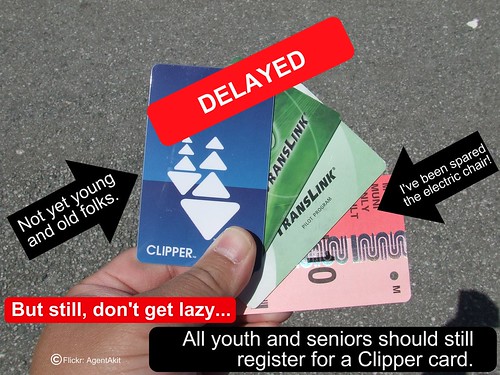
Clipper cards for all youth & seniors will still remain free.
UPDATE: One of my fellow bloggers is questioning when the card fee may expire. My news sources from many months ago says: "...through June..." which could be interpreted as June 1st or June 30th (last day of fiscal year). If a Clipper representative is available, please inform me in the comments section on the OFFICIAL last date. Thanks.
Mandatory Muni Senior Pass to Clipper Only Starting with the June 2011 Muni pass period, senior passes are only available on senior Clipper cards. Seniors who did not obtain a Clipper card can receive one immediately by going to one of these sign-up locations. Remember to bring proof of age to demonstrate to the staff member that you are eligible to receive the grey colored card.
These places will always issue Senior cards (versus their traveling crew that does a few locations a day and moves-on to different locations the next day):
Clipper customer service at Embaracadero Station & Bay Crossings at SF Ferry Building.
SFMTA customer service center at Market & South Van Ness (SW corner).
Presidio sales booth at Geary & Presidio (across from Office Depot).
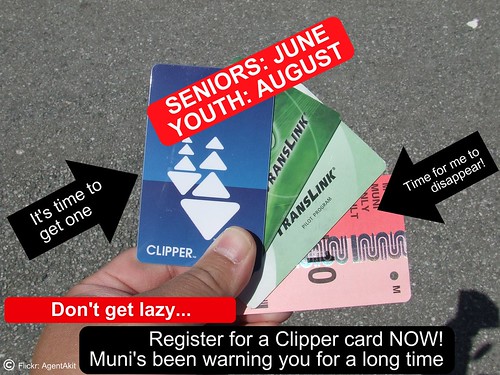
Youth Muni Pass Goes Clipper Only Starting August 1st (not June 1st) Muni has given San Francisco's youth a little break on switching to Clipper. The last paper "Y" pass will be sold for the month of July and will go Clipper only on August 1st.
This is a little more complicated than what it seems...
While the last paper pass will be July's, Muni will slash the number of locations where the youth pass will be sold for the July pass. Only 11 Muni pass outlets will sell the July paper pass, thereby encouraging all youth to start applying for their customized youth Clipper card as soon as possible. See list of the 11 retailers by clicking here. June paper passes will be sold at all Muni pass retail outlets as usual.
To sign-up for a youth Clipper card, complete the application form before arriving to a sign-up location (click here for application form; PDF file) and bring proof of age to the sign-up location. The form cannot be mailed to Clipper customer service or Muni, and must be submitted in-person.
A parent or guardian can submit the form without the youth's presence by visiting Muni's customer service center at 11 South Van Ness (Bank of America building). Make sure to bring a COPY of the birth certificate.
Youth cards can be issued on the spot at the following locations:
SFMTA customer service at 11 South Van Ness.
Clipper customer service at Embarcadero Station.
Clipper customer service at the Bay Crossings Booth in the Ferry Building.
Note: SFMTA did not clarify if the youth must be present at the Clipper customer service locations in order to obtain a card.
For other sign-up locations this week, click here. Be aware, the representative will only accept the application, and Clipper will mail the youth card within 10 days.
SPECIAL NOTE FOR YOUTH CARDS: If the youth passenger will also be getting an AC Transit monthly youth pass, you must register for a new youth Clipper card at AC Transit's ticketing office.
AC Transit has a unique policy where the youth Clipper card will also include their photo and the card's chip is programmed to allow purchasing of the AC Transit youth monthly pass. Youth cards issued by other transit agencies or the Clipper customer service centers will not allow purchasing of the AC Transit youth pass, but will still honor the youth e-cash price for single rides.
FAQs If you are wondering, why can the SFMTA customer service office and the two Clipper customer service locations are able to issue youth cards on the spot?
The reason is they have the computers to enter the youth's information into the database (to prevent people from getting more than one card under their name so they can share the extra card(s) with adults) and they have special card reader devices to program the youth card with the youth's birth date.
Inputting the youth's birth date is important as the youth card will automatically turn into an adult card when the person reaches the age of 18; however, BART has a policy at 12 years old when the discount price is not applicable and must be charged the regular adult fare; thereby if a youth passenger is between the ages of 12 and 17, BART will be full adult fare, but other transit agencies will charge the youth rate.
When you submit an application at other locations such as a special sign-up table at a festival, the card cannot be issued because they don't carry the hardware needed to issue new cards.
--------------------
So why can Senior cards be issued on the spot at all sign-up locations, including at festivals and temporary sign-up tables?
The main reason why they can issue Senior cards is because they don't need to be individually customized, unlike the youth cards. The general rule is seniors must be at least 65 years of age or older to get the senior citizen discount price to ride transit, thereby if the applicant shows they are 65 or older, they can get a card on the spot. Clipper will soon later process the application to verify if the passenger is not in possession of more than one card under their name.
Adult passes will be raised by $2. "A" fast pass will go up to $72 a month, and "M" Muni only pass will go up to $62 a month.
Youth, senior, disabled, and lifeline passes will be raised by $1. Y/S/D passes goes to $21, and lifeline goes to $31.
Cable car prices goes up $1. Single ride will go up to $6 and on-board purchased day-pass goes to $14, and late night/early morning disabled & senior fare goes up to $3.
All visitor passport books goes up $1.
Special service fares goes up $1 and $2. Adults will pay $12 (from $10), Y/S/D pays $10 (from $9), and those with a valid Muni pass pays $8 (from $7).
What won't change:
Basic cash fares for Muni will still stay the same. $2 for adults and 75 cents for the rest.
For the complete list of changes starting July 1, 2011, click here (PDF file).
Lastly, a PSA for all youth and senior Muni passengers: Paper passes will not exist starting June 1, 2011. Get a specialized Clipper card NOW. Slacking off = FAIL.
While I love to report about the notes posted on MTC's Operations Committee (the de facto Clipper card board), I should warn you now, there won't be much new material.
The Operations Committee will be meeting this Friday, April 8, 2011 at 10:15AM. (See agenda) Clipper will be discussed in calendar items (item 2, part "D") regarding contract actions. Normally these 'contract actions' is an opportunity for the MTC to modify or establish contracts with the goal of using or increase funding based on the needs of the Clipper card program. The committee uses this opportunity to address MTC staff and Clipper representatives about the program, and the agenda items posted online (see here) also gives helpful info to the public.
Highlights
As of April 1st, all existing paper 8-ride tickets for Caltrain has expired and now operates on Clipper only. This is for any passenger who purchased their paper 8-ride on the very last day prior to being sold on Clipper cards only.
Clipper staff are been doing heavy outreach to all Caltrain passenger stations, and have been on all rush hour evening trains on March 29th to answer questions about the switch.
Muni has recently switched from the paper "M" Muni only pass to Clipper only.
BART's activation of their ticketing machines for Clipper e-cash purchases is currently at 30 stations (as of April 1st). BART will be activating functionality on the last 14 stations this month.
Golden Gate Ferry completed installation of Clipper purchasing machines at their ferry terminals in February, and will begin patron operations in April.
Contract Actions
The committee approved $750K for upgrading VTA's existing ticketing machines to be able to also add Clipper value, however the planned cost for Cubic to handle the work has come way under budget. Due to the reduced budget cost, the entire build will now cost $500K, and they will vote on shifting the extra $250K to the "VTA Funding Agreement."
The committee is to receive a proposal to amend a contract for the Bay Crossings booth at the Ferry Building. If you remember in my prior blog posts, the Bay Crossings vendor is one of only two in-person customer service centers for Clipper cards. The plan is to increase the existing contact to $167,000 in order to extend Clipper services at that location to June 30, 2012. The original contact was approved for $64,500, but in order to sustain continued services, the proposal is to increase it by $102,500 (thereby equaling $167,000).
Akit's Opinion and Analysis After spending a four day weekend riding Muni to see old friends and get lunch, it seems things are going okay with the big switch for all Muni "M" pass users to Clipper only. There's only been a few occasions where rookie users didn't know how to properly tag their card, and that's going to be expected this week as the 3-day grace period has officially ended. This switch also means their favorite pass vendor, whether it be a corner liquor store, discount housewares shop, or their donut shop won't be able to handle Clipper transactions. It's a change for many, but realize that if you take transit and pass by a nearby authorized Clipper vendor, just take ten minutes of your busy life and hop-off the vehicle and go purchase it.
Clipper on Caltrain will always be the nagging problem for the program. It's not an easy to use system as Clipper is required to mimic existing pass and ticketing policies from Caltrain (with a few modifications, such as tag-on and off). With so much complexity, there is a need for the program to simplify, such as following the model used by Golden Gate Transit & Ferry where they eliminated all ticket books (they never sold passes) and just gave all passengers an across the board ride discount equal to the discount given from the ticket books.
While I'm on the topic of transit payments, when will Clipper consider the pass accumulator program and a regional pass? A pass accumulator is a system where a passenger pays for their rides with a specific agency with e-cash, and when it reaches a certain threshold, the rest of the rides for that specified period is free. A regional pass is similar to BART Plus where a rider has the ability to ride unlimited rides on multiple agencies for one flat price. While these are two separate ideas, the ultimate dream for all Bay Area transit riders would be a program where if you spend so much in a specified period on ANY participating agency, the rest of the rides on all agencies are free. The MTC has talked about this before, but have been quiet about it. Plans are in the works to simplify the fare structure for all transit agencies using Clipper.
If you ever wondered about where all this money comes from to fund Clipper and its services, one primary source comes from the "Regional Measure 2" funds us voters approved back in 2004. The funding comes from the additional dollar all drivers must pay to cross all Bay Area bridges (except Golden Gate Bridge) and is used to fund transportation projects with the goal to reduce congestion and to improve existing toll facilities (read more). Other funding comes from the state and federal levels.
Well folks, a classic piece of San Francisco Muni's history is disappearing today, the colorful adult paper passes.
It's sad, really sad that a classic relic of our transit history will be gone for us adults. But let's remember the best parts of it, the fun colors, the hologram, people accidentally leaving it in their pants pocket and throwing it in the washing machine, and an easy way to keep track of how much Muni keeps burning a hole in our wallet every few years.
I still remember when I was 18 and the pass was just $35 and it came with BART and Caltrain access too. These days, we pay double that and we don't get free Caltrain rides within SF, or for us cheapskates, the cheap-0 $60 "M" pass.
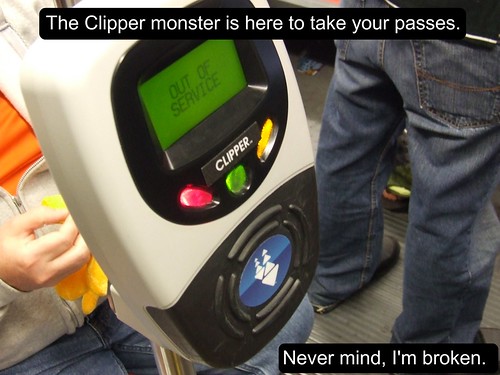
And while the paper pass is going to be leaving us, out comes another hero in blue and white, the Clipper card. A lot of you read my blog about Clipper, and while I give praise for being the future, I will still miss the retro paper passes. I sometimes still have doubts about Clipper on Muni with the occasional broken card readers, far fewer vendors in San Francisco able to sell Muni passes for Clipper, and making it more challenging for the fare inspectors to enforce the city traffic code on proof of payment.
I'm hopeful that one day, Muni and the MTC will find an easier way to smooth out the Clipper card and make it a lot more user friendly. I'm hopeful we can switch from pre-purchasing passes to operating as a "pass accumulator" program where if you reach an e-cash threshold on Muni, the rest of the rides for the month is free.
While I'm on the topic of Muni passes, if you haven't heard word from the SFMTA, starting July 1, 2011, your favorite adult passes will cost $2 more making the "A" pass $72 and the "M" pass $62. While $2 extra a month is not much, it just shows how much it is a slap in the face to us taxpayers. If the economy gets better, does that mean the pass prices can finally go down?
For the tens of thousands of Muni's "M" (Muni Only) pass users using March's paper pass, are you ready for the mandatory switch to a Clipper card starting April 1, 2011?
I hope so!
This is now the time to prepare for the switch. As my former supervisor taught me, early = on time, and on-time = LATE.
Let's go over what you need to do:
Don't have a card? You can get a card at these locations:
Any San Francisco Walgreens location, or select Walgreens locations in the Bay Area.
Clipper customer service at Embarcadero station (mezzanine level, east gates) and the Bay Crossings booth (a contracted customer service location) in the Ferry Building.
Visit ClipperCard.com and order one (but do it earlier than later).
To purchase a pass to be loaded on a Clipper card:
Go to an in-person vendor (including Walgreens) and tell them what pass you need.
Use a self-service machine like at Muni metro stations or the Temporary Transbay Terminal. BART ticketing machines with Clipper purchasing capabilities does not allow pass purchasing.
Purchase online at ClipperCard.com, but you must purchase it at least FIVE DAYS before the new month starts.
Forms of payment:
In-person vendor: Cash and sometimes a credit or debit card.
Walgreens: Cash and commuter benefit paper vouchers.
ClipperCard.com: Credit, debit, and commuter benefit debit cards.
How to use card:
Buses and metro vehicles: Place card over black sensor zone. Metro gates: Place card on Red/White circular on right hand side of gate.
Hold card until confirmation tone or metro gates open. Never swipe card.
Remove card.
Recommendations:
I suggest adding some Clipper e-cash value to your card for some flexibility. If you decide you need to ride BART or Caltrain, you have the ability to ride transit with the same card and not worry about exact change.
Always tag your card to reader every time you board a vehicle or enter a metro station. Hearing the confirmation tone is the only way the Muni employee can verify you have a valid pass in possession.
The card is reusable, so always reload to your plastic card. The card can last many years if it is taken care of. You will destroy the card's internal electronics if you bend it or punch a hole.
The card can be scanned through a wallet, purse, pass holder, and other personal items. No need to tag the card 'bare.'
Use a label maker or permanent marker and put your name on the back of the card.
Register the card on Clipper's website for additional benefits, including balance protection if the card is lost, damaged, or stolen, history report of usage, and loading of funds online.
If you constantly forget to buy passes or has to scrounge around the city for a pass vendor at the last minute, sign-up for Clipper's autoload program and passes will be automatically loaded on the card and charged to your credit card on a monthly basis.
I thought I'd crack the numbers and find out if buying a Muni "M" pass is actually worth the value.
Based on my usage for February, I haven't used my Clipper card enough times to make up the value of the "M" pass at $60. I'm not keeping up with my New Year's resolution of taking Muni more often than driving to work.
I should have just added the $60 spent on a pass and converted it to no expiration e-cash for flexibility.
--------------------
But while it sounds like an easy choice, there's a lot of pros and cons between buying a Muni pass vs. paying rides with Clipper e-cash:
Muni passes are only valid for the specified month for unlimited rides, Clipper e-cash doesn't expire but is limited to a number of rides until the card can be replenished.
Muni passes are only valid on Muni (BART for "A" pass), Clipper e-cash is flexible and can be used for any participating transit agency.
Muni passes are also good for unlimited Cable Car rides, Clipper e-cash is not accepted and if it was, it would be pretty costly as it's $5 for a ride.
One of the most difficult choices is about encountering those Muni fare inspectors. If you have a Muni pass, you still have to tag your card, but you get that comfort knowing that you don't have to worry about 90 minute transfers that expire, and the inspector's card reader can tell them there is a valid pass, even if the passenger fails to tag when a vehicle card reader is broken.
With e-cash, sure, I'd save money if I spend less than $60 a month on bus rides, but I'd have to be careful to keep an eye on how much time is left on my Muni e-transfer on my Clipper card. Paper transfers are easy to tell when it expires and when you should buy a new one, but Clipper only tells you the expiration when you tag your card to a reader. Since you just can't magically pay for a fresh e-transfer until the current one expires, some may not keep track unless if they are using a stopwatch and able to re-tag their card once the e-transfer expires.
Muni says the transfer must be valid for the journey, but how do they handle that for Clipper cards if an inspector scans a card 91+ minutes after the first scan that issued the e-transfer?
For many people who just pay with e-cash and primarily uses it to go from home to their job (and vice versa), it would not be an issue since it definitely takes less than 90 minutes to get to your final location and the ride back home would be hours after the e-transfer expired.
The e-transfer issue is more towards those who rides leisurely on the weekends. Other agencies doesn't have this problem as they either don't have inspectors, doesn't issue e-transfers, or requires card to be tagged-off. Is there a way Muni can modify their policy to instill confidence in their passengers to ride with e-cash and not get hit with a citation?
My suggestion is for Muni to give a "last ride" when if the e-transfer is less than 30 minutes from expiration, the passenger is given a 30 minute window to complete the trip. This would help close the gap, but not completely as some journeys on Muni can take more than 30 minutes, for example, riding end to end on the 38-Geary.
9:00AM: I board first vehicle and pay $2 in e-cash, and issued an e-transfer to expire at 10:30AM.
10:29AM: I use e-transfer and no e-cash deducted, and Clipper gives me a temporary transfer guaranteeing me a 30 minute protective window set to expire at 10:59AM.
10:45AM: Fare inspectors check my card, and even though my initial transfer expired 15 minutes ago, I can still ride due to the 30 minute policy.
What do you think of this idea? Have a suggestion? Just post it in the comments.
One big change coming for Caltrain monthly pass users is the mandatory transition to Clipper starting with the March pass. You can now pre-purchase your pass now at in-person retailers or automated machines, or purchase it online as soon as you can to not become a victim of the five day policy. If you don't have a card, you can get one for free at in-person retailers or request one online.
Some pointers before you think the card is some kind of miracle that will be perfect every time you use it...
There are not many locations along the Caltrain corridor with in-person Clipper retailers. There are no add value machines at stations. If you frequently go to the 4th and King station, there's a Walgreens next door that can help you add value. Consider the autoload program as an alternative.
The card must have at least $1.25 in e-cash value. It might not make sense to you, but trust me, if you have less than this amount, you are in trouble.
On the first day of use for the new month, you must tag your card at the starting station and tag the card at your ending station. This will program your card as a valid pass.
Once the card has been activated on its first trip, you don't need to tag-on and tag-off at your start and end stations. Show the inspector the card and his/her reader will tell him/her what zones you are allowed to travel.
For riding further than your designated zones, purchase a paper upgrade ticket and show it to the inspector upon request.
When purchasing a Muni pass add-on, you can do so when you do you purchase your pass.
Transfer agreements are honored with VTA and Samtrans when you have a pass with two zones or more on your Clipper card. Just tag your card on the bus or light rail platform reader.
Monthly parking permits can be purchased at Caltrain paper ticketing machines. You'll need your Clipper card serial number for the system to verify you purchased a valid pass.
That's the basics. If you want a comparison on the transition from paper to electronic passes, click here. For more tips about properly using Clipper on Caltrain, click here.
(Sorry for the delay in posting, it's been quite a busy week and I've been coming home exhausted.)
I'm noticing on the Twitter feeds I keep tabs, and there's a bunch of you who keep whining about how Clipper on Caltrain just sucks.
Listen folks, it's your own fault if you don't pay attention to the rules, and especially the rule about always tagging-on and off to be charged properly (oh boy, here comes the hate mail...). The system may be new and its a learning curve for all, but if you pay attention to the policies noted on Caltrain and Clipper's websites, or grabbed a brochure made by Clipper, you'll understand how it all works.
A lot of people whined about tagging their card on Muni and always getting the "three beeps of death," but that's because they didn't hold the card steady to the reader. A few months later, no complaints because people know the proper technique.
It's all about time, give it a couple of months and you'll get the hang of it.
--------------------
The most frequent complaint is failure to tag-off, and it results in being charged the maximum fare. There's a reason for being charged max fare upon tagging-on: the system does not know when you are going to exit, thereby tagging-off is required to tell the system that you are entitled to a proper refund so you are properly charged for your travel.
Nearly a decade ago, TransLink (prior to rebranding as Clipper) was on Caltrain, and passengers had to press the appropriate zone button on the reader prior to tagging their card; once card is tagged, the proper fare was charged for that coverage and no tagging-off was required. But this easily sets up Caltrain for financial loss because people could just press a zone that's the cheapest and gamble on not getting caught by a conductor or inspector. In my past experiences on Caltrain with an electronic fare card, no conductor ever conducted an inspection, while some others just looked at it and said okay without scanning it. The max fare system works well because even if fare inspection doesn't happen on a frequent basis, there's much less risk to Caltrain from being ripped-off by passengers. We all know how bad Caltrain's financial condition is right now, and they want to reduce the risk of fare evasion as much as they can.
Think about this: Imagine if BART did not have fare gates; their fare structure is similar to Caltrain, and the tag-on and off procedure is necessary in order for the system to properly calculate the correct fare. The only way this can work is the card must be charged the maximum fare, but when tagging-off, the fare is properly refunded so you technically paid the correct amount for your journey.
The same goes for Golden Gate Transit. They operate on a zone system and the Clipper readers are connected with GPS units to know when it enters another zone. When a passenger tags their card on boarding, the maximum fare is charged, and when exiting, the refund is issued so the passenger pays their proper fare. It would be a waste Golden Gate Transit's time to have their drivers push buttons all day long for passengers saying they want to exit at this stop or zone when it's easily simplified with a tag-off procedure.
This is in no way compared to agencies with a flat fare system, like Muni. Tagging once means you can ride where ever you want and no tagging-off is required.
--------------------
So here's the "rules" I'm talking about so we are on the same page. This does not explain how to purchase e-cash, monthly passes, or 8-rides.
Step-by-step instructions for e-cash (single ride) and 8-ride ticket customers:
Card must have at least $1.25 in value. If you have less than that, your ride is denied, even if you have an 8-ride on the card. Why? The card has a max negative balance of $10, and Caltrain from end to end costs more than $10.
Tag the card at your starting station. Green light or green & yellow light means OK. Your card will deduct the maximum fare, and the card may go into the negative balance.
When an inspector asks to review the card, hand the card and the inspector's reader will say "YES."
At your end station, tag the card to get your money back from when you tagged-on. If 8-ride, full refund and one ride deducted. If I am doing e-cash only, refund is partial so you are properly charged for the fare zones you covered (if my card deducted $10 on entry, and a two zone ride is $2, I would be refunded $8 at my end station).
Step-by-step for monthly pass users:
On the first day of travel for the new month, you must tag your card at your starting zone.
During that first day of travel, card must have at least $1.25 in value. If you have less than that, you are denied a ride.
Tag the card at your starting station. Green light or green & yellow light means OK. Your card will deduct the maximum fare, and the card may go into the negative balance.
At your end station, tag the card to get a full refund, and the card will be encoded as a pass for the zones you are covering.
On subsequent rides during the valid month, you DO NOT need to tag the card at the beginning and end. Fare inspector readers will note the zones you are covering. If riding beyond your designated zone, purchase a paper zone upgrade at a vending machine.
WARNING: If you tag-on at a reader and get the red light and three rapid beeps, DO NOT board Caltrain; if you do, you will risk being kicked-off and/or a citation for fare evasion (your card is NOT VALID FOR TRAVEL!!!). Pay for a paper ticket and call Clipper for help.
For a comparison about Caltrain paper tickets & passes versus Clipper, click here. For the best guide around on how to use Clipper, click here.
February is going to be a big month for Clipper with the end of paper media for many Caltrain users, and the induction of VTA to the family.
Caltrain For those of you taking Caltrain, yesterday was the last day to purchase paper 8-ride tickets (valid for 60 days). Today, 8-ride tickets are only sold on the Clipper card. Please remember, there are no Clipper self service machines at the stations to help you purchase 8-rides; you need to visit an in-person vendor, or if commuting to downtown SF, a Muni metro station ticketing machine. You can also register for autoload or purchase your 8-rides online (with up to a five day waiting period).
Also, this is the last month for passengers to purchase a paper monthly Caltrain pass. Starting with the March 2011 pass, it must be purchased on a Clipper card.
To learn how the Caltrain transition to Clipper works, click here. If you do not have a Clipper card, the time to start getting one is NOW. You can get one at any in-person vendor that can add Clipper value, a Muni metro ticketing machine, or get one via snail mail by ordering online.
Santa Clara Valley Transportation Authority VTA will be going live with Clipper starting February 16th. If you jumped the gun and purchased a February Caltrain pass with a minimum two zone coverage on your Clipper card, you can't use that inter-agency benefit until VTA's first day of Clipper acceptance. To learn how VTA works with Clipper, including how the inter-agency benefit works for Caltrain pass users, click here.
--------------------
Lastly, before you all start bragging that Clipper sucks, or you think you've been ripped off, I suggest reading this guide I made that will provide you the information you need to have a good relationship with Clipper.
My suspicions are correct, the MTC is following through with delaying the mandatory Clipper card transition for all seniors and youths who uses their paper passes on Muni.
If the MTC follows on their path to delaying the pass transition, the new goal will be June 2011; they want to accomplish the full transition of nearly all Muni passes (except the senior "P" pilot pass and "L" lifeline pass) before the start of the new 2011 fiscal year (July 1, 2011).
--------------------
However... I still encourage all youth and seniors of San Francisco to register for a Clipper card. This means, get your butt down to a registration site or a transit ticketing office and complete the registration forms and provide proof of age. For more information on how do get a youth or senior Clipper card, click here. As one of my commentators said, you can get an INSTANT youth or senior Clipper card if you visit a Golden Gate Transit/Ferry ticketing office, and this means no waiting two to three weeks for it in the mail.
If you ride Caltrain and depend on the 8-ride tickets or monthly passes, you could be in a shock during the months of February and March as the paper version will not be sold. But have no fear, Clipper is here! Okay, maybe a little fear or a lot.
Clipper card machines to purchase new cards and adding value are not at all stations. To make matters worse, passengers must buy their 8-rides at retail locations, automated machines at places like SF Muni metro stations, or online (with standard 3-day waiting period). Read more about how to add value. Until Caltrain can find a way to allow Clipper purchasing at their stations, you should make preparations now.
The card must be tagged-on at your starting station and tagged-off at your ending station. This means, if you have a zone one to zone two 8-ride, you tag on in zone one, and tag-off at zone two.
There must be at least a minimum $2.50 on the Clipper card at all times when using Caltrain. Used to be $1.25, but fare increase for 2011 has changed it.
You can have up to 24 rides stored on the card. When it drops down to at least 16 rides, you can purchase another 8-ride.
You can purchase multiple 8-ride tickets for multiple areas. For example, I can load a zone 1 to 2, and zone 1 to 3 on a single card; but be aware of the 24-ride limit.
Unfortunately, you cannot do zone upgrades, unlike the paper system. If you ride beyond your designated zone, you will be charged the e-cash fare; the system will not deduct one ride and the upgrade fee. Also, since there is a tag-out procedure, you can't buy a paper zone upgrade ticket to cover your butt.
You can tag-off at the same reader you tagged-on and get a full refund within 15 minutes (perfect when there's a train delay or incident). If tagged-off beyond 15 minutes, passengers get charged a one zone e-cash fare (or one ride if their 8-ride ticket covers just that one zone only).
It is unclear if someone has a three or more zone 8-ride and tag-off midway. Will it deduct e-cash or just deduct a ride?
Monthly Passes
Starting with the March pass, all monthly passes will be on a Clipper card only basis. If you have two or more zone purchased, you can ride VTA and Samtrans free (local fare credit) by tagging card to bus/light rail platform reader. VTA will be active in February, just in time for Caltrain's transition.
Big Changes in Policy for Monthly Passes
Unlike being able to purchase paper passes at station machines, there is no way to purchase a Clipper e-pass at your station machines. Look for retailers or enroll in autoload.
The card must have at least $2.50 minimum e-cash value at ALL TIMES when tagging-on Caltrain.
You can mix a monthly pass with an 8-zone ticket on a single card.
On your first ride for the new month, you must tag-on and tag-off for your pass to be active.
Once you do your first ride, you don't have to tag-on and off for the entire remainder of the month. The conductor will scan your card and will tell him/her what zones you are covered.
Optional: You can tag-on and off, but only do it within your designated start & end zones.
Zone upgrades are available, but you must buy a paper zone upgrade and show it to the conductor when he/she scans your card.
Akit's Point of View I totally support a transition away from paper passes and 8-ride tickets, but the changes in policy makes it a total mess. Why didn't Clipper try their best to exactly mimic policies set forth just like the paper versions? Here's my list of arguments to this being a terrible transition:
Ticketing machines can't handle Clipper monthly pass or 8-ride transactions. Very few vendors in San Mateo and Santa Clara county contracted to handle Clipper loading.
Zone upgrades banned on 8-rides for Clipper.
Still have to purchase a paper zone upgrade for a monthly pass.
System unable to charge an automatic zone upgrade fee when a monthly pass or 8-ride is present and the passenger tags on and off.
Unclear policy regarding what would happen if a 8-ride passenger exits at a zone less than what's designated.
For e-cash only passengers, there is no day pass option; only paper will exist. Ride three times, get charged three one-way fares.
If a monthly pass passenger has to tag-on their pass at the first day of travel for the new month, but decides to cut their ride short (e.g. take BART at Millbrae), one may be charged full one-way fare instead of pass.
Why not just enforce a policy of tagging-on and off every single time? By allowing automatic charging of zone upgrade fees and handling appropriate charges for taking less of a ride than the designated zones purchased, it makes it easy.
Maybe Caltrain should have followed in the footsteps of Golden Gate Transit & Ferry. Instead of those complicated paper ticket books while operating a zone system, they simply gave all Clipper e-cash paying customers a discount. Passengers would not have to purchase zone specific tickets to get their discounted rides, they just used their card to get the equivalent and it helped infrequent passengers get an incentive to ride the system even more.