"Akit is the man. He knows Clipper." (spenta)
"It’s a fantastic blog for any San Franciscan."
(Kevin)
"Your blog is always on point, and well researched!" (Nina Decker)
"Everyone's favorite volunteer public policy consultant..." (Eve Batey, SF Appeal)
"You are doing a great job keeping on top of Translink stuff. Keep up the good work!"
(Greg Dewar, N Judah Chronicles)
"...I don't even bother subscribing anywhere else for my local public transportation info. You have it all..."
(Empowered Follower)
"If anyone at City Hall wants to make public transit better for all San Franciscans, it would be wise to follow Akit religiously...
or, better yet, give him a job."
(Brock Keeling, SFist)

Tuesday, March 9, 2010

Japanese Americans Interned during WWII to be Honored at SF State's Commencement 2010


This blog entry is dear to my heart and my cultural heritage. Japanese Americans who were forcefully sent to the internment camps during World War II and had their higher education disrupted, are eligible for an honorary degree from the University of California, California State University, or the Community College systems. If the person has passed away, a family representative is able to accept the honorary diploma on their behalf.

My alma mater and employer, SF State will be one of the select CSU campus honoring those students who had their lives disrupted by one of the most disturbing civil rights violations in modern United States history. Other CSU campuses holding ceremonies: Dominguez Hills, Fresno, San Diego, San Jose, and Cal Poly SLO.

Each campus honors those who currently live within their region or the closest to their current home; for SF State, they will honor those currently living in the Bay Area, even if the person attended a different CSU campus.

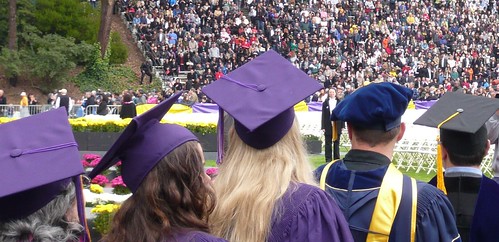
SFSU Commencement 2008 - Liberal Studies and Special Majors

For more information, please visit: SF State's Commencement page dedicated to the Nisei project - http://www.sfsu.edu/commencement/nisei.htm

If the student attended any CSU campus, please contact (562) 951-4723 or e-mail: nisei@calstate.edu

If the student attended a California Community College, or University of California campus, please review this info sheet (PDF) and contact the representative of the Japanese Cultural and Community Center of Northern California.

My wish came true, SF State President Robert Corrigan and other CSU campuses will give the honorary degrees at their commencement ceremonies. SF State will host their 109th Commencement on May 22, 2010.

TransLink Cards are 3 Times Slower than EZ Rider on BART


TransLink cardholders, ever wondered why the BART gates are slow in responding to TL cards while others who use the EZ Rider card are getting speedy access?

I originally thought BART hated TransLink and just wanted to piss passengers off by slowing them down, but after doing some sleuthing around the web, I found this PDF document from the January 28, 2010 meeting of the BART board of directors. (Refer to pages 34-37)

TransLink admits
: "TransLink processing time meets the contractual fare gate throughput requirement of 30 customers per minute. However, the TransLink processing time is 3 times longer than the EZ Rider card, due to differences in the software architecture between the two card types..."

TransLink's suggested solution is to increase the power of the proximity sensor and it requires modifying the card readers. You may notice the new white card readers (photo sample from Twitter user) at places like Daly City and Embarcadero. The conversion and power increase is so the card readers are "more forgiving when a customer makes a less than ideal tag." They plan to complete this conversion within several months.

TransLink is also modifying the software in the BART gates so the processing time is reduced. This means a quicker tag of the card to gain entry to the system. Modifications started in February, another update in July, and final updates by September.

Things are looking brighter for TransLink. I hope these improvements will help.

Monday, March 8, 2010

TransLink (Clipper) Gate Installation for Muni and Cable Car Access


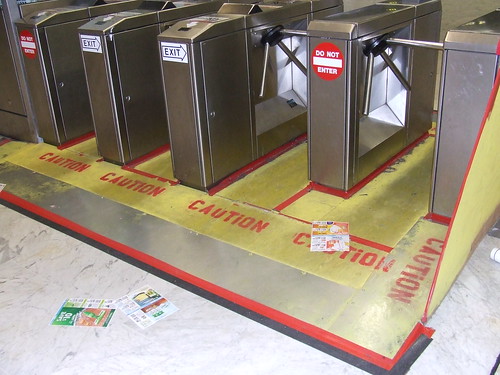
Thanks to a tip from Streetsblog San Francisco, new fare gates are being installed at the Civic Center Muni station. I took a couple of photos the changes being made on a Sunday (when they are not working) to show the future placement of the gates and their vending machines.

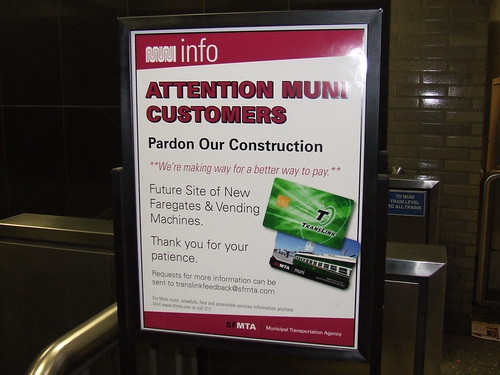
The new gates and RFID vending machines are being made by Cubic Transportation Systems. Cubic is the company who also made the Muni fare box for their vehicles, and the latest generation of BART fare gates and ticketing machines. Here's a sample of what the new Muni fare gates will look like (PDF document) and the vending machines (PDF document).

TransLink Construction at Civic Center Muni

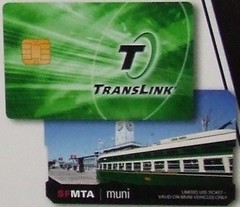
What is known about the new fare gates and vending machines is it will be solely dependent on TransLink. The gates will surely accept TransLink media, but it is not clear if they will still accept the magnetic striped media of the paper passes. The vending machines should be able to do add value just like the current fleet of add value machines installed around all the Muni metro stations, and they will also be issuing "limited use" RFID cards made from paper from the vending machines so passengers can use the ticket to enter the metro and transfer to any Muni vehicle by tagging the ticket.

TransLink on Muni: The Future Gates

From my knowledge, there's no exact timeline of completion for this project, but I have e-mailed the SFMTA for more information and will update this blog posting as necessary.

--------------------

Cable Cars are also getting prepared with TransLink technology as well. Since historic monument status means the city can't install the TL equipment on the Cable Cars, the conductors who collect the cash fares have been issued the handheld readers.

Just yesterday, I noticed a conductor having a PDA like device in a holster on his right side. I should have asked the guy to try it out on my card that has a monthly pass. Since Cable Cars are part of the "premium" services that an adult "A" fast pass will give unlimited access to (sorry "M" users), the card readers must be in operation no later than August 1, 2010 since the paper "A" passes will be eliminated in favor for TL/Clipper cards.

Cable Car #1

Saturday, March 6, 2010

Comments to Author of: "Burn Your TransLink Card"

I noticed on TweetDeck a blog entry titled "Burn your TransLink card" written by David Pollak, and it has been re-tweeted several times this evening. Since he did not allow any comments to be posted on his blog entry (but he has allowed on other entries on his blog), I'm going to post my comments on my blog as I am known to write very thorough opinions and commentary about the TransLink program.

--------------------

First accusation: He states, without any links supporting it, "there are certain bus lines that will only accept the TransLink card during rush hour... you won't be able to ride the bus except with one..."

Akit's reaction: Since I monitor the meeting agenda and documents presented to the TransLink management group, there is no such policy where the TransLink card is mandatory to ride a bus or train line during rush hour, and would never be enforced today or ever in the future. People still have the right to pay for their transit rides in cash. Tourists and visitors will ride public buses and trains during rush hour, and they have the right to pay for their rides in cash.

You should revise that statement. The only agency requiring TransLink is AC Transit for Transbay bus service. Passengers who want to use a 31-day pass to go across the bay must use a TransLink card with a pass loaded onto it, but passengers who still wish to pay the $4 fare can do so in cash by utilizing the farebox. Muni also plans to transition their adult monthly fast pass to TL, but passengers still have the right to pay their fares in cash if they refuse a monthly pass.


Second accusation: David alleges that it is not appropriate to ask for a birth certificate to get issued youth TransLink cards. He states his children are kindergarten age (five years old). He continues to rant about privacy rights and the absurdity of the program requiring such information.

Akit's reaction
: I understand your frustration that your children, who are very young, need to have proof of identification before being issued a card. I'll also admit that the policies on issuing youth and senior cards are very lacking and not the most up-to-date on the TL website. With the transition from TL to Clipper, the website will definitely get a major update in the coming months.

As I understand the policy, in order for TransLink to issue a specially encoded youth card, the applicant must show proof that they are of the appropriate age, regardless if they are five or seventeen. Unlike adult cards that can be issued immediately at a vendor, a youth card must go through an additional process where TL will mail the card to the applicant.

The transit agency responsible for preparing the application for the card must also take a photo of the youth applicant. The reason why they must do this is because the card will be a personalized one with their photograph attached to it (as per AC Transit). In a situation where the person may be required to show proof of age, the TL card with the photo will be sufficient proof. This also can stop illegal activities with the card, such as passing on the discount to an adult, as a fare inspector or bus driver can look at the card and notice that it is not issued to that appropriate person.

Also, people with disabilities are issued an RTC discount card which informs the transit agency operator or ticketing agent that they are eligible for a discount fare without being questioned about their disability every single time. Their photograph is taken onto a card, and enables a passengers to either pay the discounted cash fare, get issued a disabled pass, or can use the encoded TransLink feature on the card to ride (PDF document). Disabled people who wants to get the discounted fare and TransLink rights have to go through this process and show documentation to get the card, so what's the difference of having people under 17 show proof of age when getting a specialized TL card and getting their photo taken?

Let me modify your complaints in this fashion: If your children are 16 years old and look like adults, would you still get upset that you would need to produce a birth certificate to get a youth encoded TL card?

Transit agencies who issue discount passes and allow discounted cash fares have the right to deny passengers to pay the discounted rate if they don't show proof of age. Sure, agencies rarely ever enforce this policy, but it's absolutely true. Muni fare inspectors have the right to check for proof of age if they believe a passenger is wrongfully using a senior fast pass; so the same goes for youth. TransLink is getting into the middle of the mess by issuing a transit card with their photograph to give them the proper rights to ride with a discounted fare or pass and the transit agency would not need to demand identification anymore.

The Peralta colleges also utilize the photographs to the card as well. Their EasyPass program allows full-time students to ride all AC Transit lines for a small per-semester fee, and the agreement between the Peralta colleges, AC Transit, and TransLink is to take the student's photograph and attach it to the TL card. The photo policy is similar to the youth card policy where only the card issuer who is receiving the discount, is the only person with the right to use the card (no sharing).

Next time, call TransLink to find out where you can register for a youth card. Some places do tabling at a major train station (schedule varies), while others requires passengers to visit their main headquarters.

I don't know what to say about privacy rights as I am not such a blogger to cover that field. The best I can suggest is to tell your kids to keep paying cash fares; it's the only way to be truly anonymous and not be "tracked."

Disclaimer: I don't work for TransLink or any other public transit agency.
Friday, March 5, 2010

Questions and Thoughts While Riding Muni

When riding Muni or just waiting for it, have you ever thought of these questions or said these statements?
  1. Why do passengers pull the "stop requested" cord while the metro train is in the subway?
  2. Also, why do passengers 'kick' the door handles on the metro train while it is in the subway and just arrived at a station?
  3. Do the emergency exit red handles on the windows actually work?
  4. When will Muni revise the mispronounced street names?
  5. Why do some people think the back doors automatically open when they don't read the sign that says "STEP DOWN TO OPEN DOORS?"
  6. Whose idea was it to make a shrill noise when someone touches the closing doors of a metro train?
  7. Can I actually fit into that metro seat that's next to the window and in front of the middle doors?
  8. If the fare box is not working and fare inspectors board the vehicle, what's next?
  9. Why did you pick your nose and eventually put your fingers on the pole?
  10. Is there a reason why someone has to clip their fingernails now, on the bus, when it can be done at home?
  11. I wonder what the lady next to me is talking about on the phone.
  12. Ding ding, "please exit through the rear doors." I GET IT! STOP TELLING ME THAT!
  13. I'm going to sneak a peek at that newspaper the guy is reading. Sale on shoes? I'm there!
  14. I don't need to be told every few minutes in three languages that the front seats are reserved for seniors and the disabled. Hell, I can lip sync every single Chinese word spoken.
  15. I wonder if I can get away with taking two transfers from the rubber band on the fare box when paying my fare.
  16. Hold the card steady dumbass while using that TransLink card.
  17. It's dark, I'm wearing a black jacket and dark pants. Should I wave my hand at the approaching bus I need?
  18. Shit, fare inspectors!
  19. If I lay a fart on the metro train and the air conditioner sucks that air in, will it spread to the rest of the train?
  20. If the station agent's booth says pay cash at other booth, why are the fare gates still allowing me to dump money into the box?
  21. Muni bio diesel... the bus passing by doesn't smell like french fries.
  22. Another delay? Where's my tax money going?
  23. 311 is telling me to call 511 to get bus arrival times and use the "stop ID #," so where the hell is the sticker telling me that?

Wednesday, March 3, 2010

The Muni Transfer Debate... A Big Mess Every Time


Muni transfers have always been a center of debate when there's a budget crisis for the agency.

Transfers have been an important part of our city's transit system for many decades (even before I was born).

The last time Muni really took action on transfers is during the Frank Jordan era when transfers were completely eliminated (the POP system never existed back then) and riding from one part of town to the other and transferring would cost double or triple the regular fare. But... the city repealed the policy after the citizens got really ticked-off.

Just yesterday, the SFMTA was considering to charge a 50 cent fee for transfers. People were in panic on the comment boards on SFGate, but just hours later, an updated piece of news came out that the SFMTA decided to not charge for transfers.

But let's remember that the transfers debate could return at anytime. Muni could decide to put the issue back on the table by proposing a fee for transfers or completely eliminating them, but there are major consequences for charging or wiping-out those slips of paper.

Here's what would happen if Muni charged or eliminated transfers:
  • The "proof of payment" system is dead. Passengers now have the choice to pay the fare and not get a transfer; since that piece of paper is supposed to be a fare receipt, the fare inspectors cannot enforce the rules.
  • Illegal back door boarding (fare evasion) will get even worse since fare inspectors can't really do their primary job.
  • Passengers would sell their non-expired transfers to others (an illegal act) or give them away to someone else.
  • On the brighter end... those fare inspectors can actually enforce a major problem, rear door boarding should be stopped or they should check fares to allow back door boarding so the vehicle can leave faster.
But one thing definitely will happen in September 2011, say goodbye to paper transfers and hello to TransLink/Clipper.

Monday, March 1, 2010

An In-Depth Look Into Muni's 18-46th Avenue


The 18-46th Avenue is the line I take to get from my home in the Outer Richmond district to my job at SF State. I also took this line as a graduate and undergrad at State, and frequently took this line when going to City College (via the 29-Sunset). It was known as one of the best bus lines in the city, and was extremely desirable for the most senior Muni operators for the easy to drive route, happy passengers, and great views. For the passengers, this bus line was always on-time, reliable, and able to connect with many major lines heading towards downtown.

But after the major re-route on December 5, 2009, the line's reputation has gone down the gutter. I never see the same bus driver every single time, the on-time reliability has dropped drastically, and the morale of the passengers is really low.


Problem 1: It's not a community service route.
As you see on this weekday grid provided by Muni, the 18-46th Avenue is receiving the worst service reduction out of the rest of the lines. Service is being reduced from 20 minute frequencies to 30 minutes (mid-day weekday, weekday evenings, and all-day on Saturdays and Sundays).

Why is it the worst? Look at the mid-day weekday time changes: the 18 is going to be cut back 10 minutes while many other lines are only getting a cutback of an average of 3 minutes (5 minutes for the 33 and 37). Also, no other lines (other than the 18) are being reduced to 30 minute frequencies.

As you look at the grid, you will notice the lines currently operating mid-day with 30 minute frequencies are the lines considered "community service" and typically runs the 30-foot hybrid buses and specifically drive within a certain neighborhood or smaller zone versus buses that drive miles covering multiple neighborhoods/areas.

By doing a reduction in the 18's service to 30-minute frequencies, it's like turning the line into a "community service" line instead of it's true nature, a crosstown route like its brother, the 29-Sunset. How can Muni punish the 18? This line is the only lifeline serving the far west end of the city, and is the sole bus route route to access the Janet Pomeroy Center, Legion of Honor, and the apartments along John Muir Drive (southern end of Lake Merced).

It serves more than any community service route can ever do. This line stops at major stops like:
  • Stonestown, SF State, Lowell High, Janet Pomeroy center [for the disabled], SF Zoo, Ocean Beach, Beach Chalet, Safeway "at the Beach," Balboa business district, and Legion of Honor.
The crosstown bus line also has transfer connections to all these lines:
  • 1, 1AX, 5, 16X, 17, 23, 28, 28L, 29, 31, 31AX, 38, 38L, 38AX, 71, 71L, L, M, and N.
  • SF State Shuttle
Problem 2: Post December 5, 2009 reroute not helpful.
The 18 used to run along Geary and Point Lobos, and passed by the Cliff House. But after December 5th, Muni decided to run the 18 along Balboa and Cabrillo and remove the 38-Geary Ocean Beach. I've argued that it is a bad decision to eliminate the 38-Geary Ocean Beach branch and Muni should have eliminated the Fort Miley branch since the 38L (weekdays and Saturdays) and 38 (weekday evenings and Sundays) drops passengers just ONE BLOCK away from the hospital. If Muni just eliminated the Fort Miley route, there would be no reroutes for the 18 or the elimination of the 38-Geary Ocean Beach branch.

The 18 currently runs at 20 minute frequencies which is less than what the 38-Geary Ocean Beach branch ever operated, and when changing the 18's frequency to 30 minutes, the passengers will suffer greatly. Many have to ride the 18 so they can connect with the 5-Fulton, 38L-Geary Limited (faster ride to downtown vs. the 31-Balboa), and access to Chinatown via the 1-California.

--------------------

Can someone tell me why Muni is targeting the 18-46th Avenue? I thought the re-routes were bad enough, but 30-minute frequencies just makes it worse.

When a Muni representative presented to the SFMTA Board the service cuts, the lady specifically targeted the 18-46th Avenue. I thought to myself, why target the 18? Why get on the microphone and do a P.R. stunt for shock value by saying the line will be getting cut to 30-minute frequencies (10 minute increase) while not comparing all the other routes that will only get a 3 to 5 minute increase to no more than 20 minute frequencies?

The 18-46th Avenue will receive a 33% cut in service. How can they claim a "10%" reduction?

Just today, I was reading NextBus and it showed the 18-46th Avenue was to arrive in 14 minutes and 44 minutes. There's supposed to be another one in 29 minutes (15 minute frequencies during rush hour). Reliable? Not anymore.

If this agency has a grudge against me, don't take it against the public who ride this line.

Do you like someone who can find huge mistake, expose it on the internet, get it re-tweeted to thousands of people in a matter of minutes, and change public policy? I've done it multiple times: Not posting new route schedules and failing to update trip planning programs just a week before changes, barely informing the public about a pass hike, ineffective fare inspectors, and Muni promised to accept "Muni to BART" transfers for the ride back from AT&T Park and I exposed them on video of them failing on their promise.

You will not let the 18-46th Avenue die. I won't let you do that without a fight.